Beta Orionis – Part XXV

Build Log:

How to begin on this…

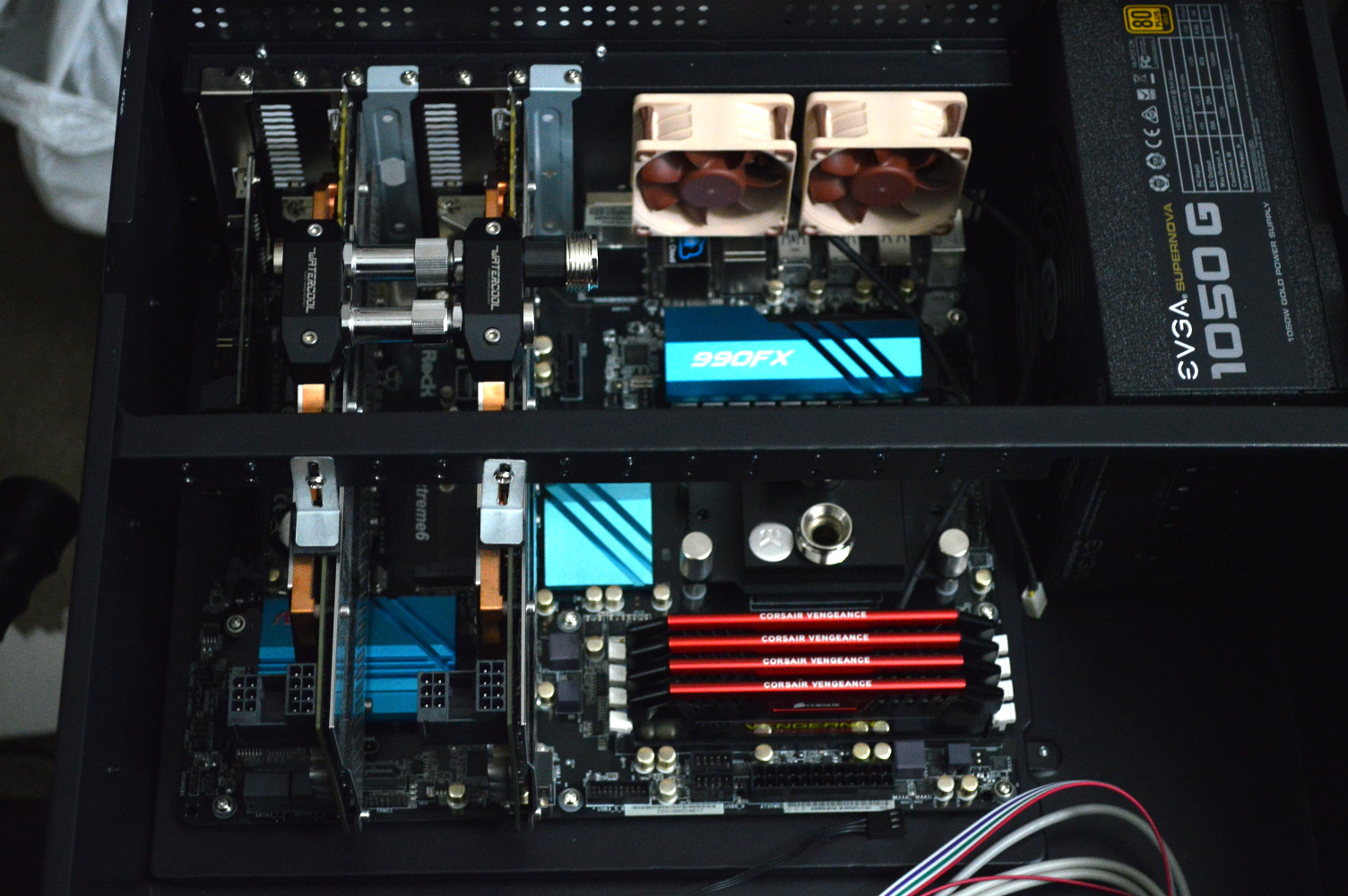
Beta Orionis (β Ori.) was reduced to little more than parts due to the work on Desert Sapphire. The reason was to move β Ori. into a 4U rack chassis — specifically the Logisys 4802.

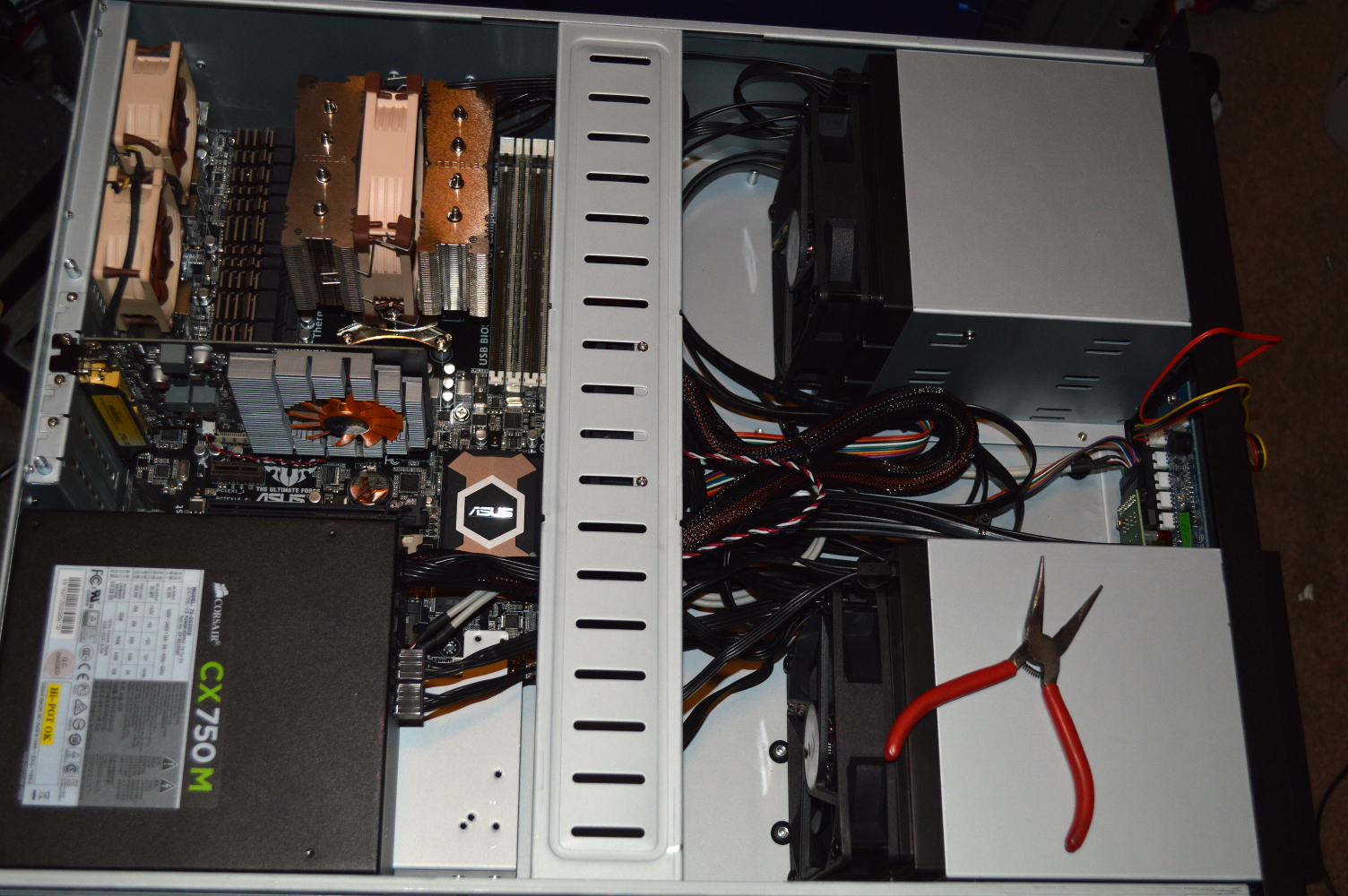
motherboard

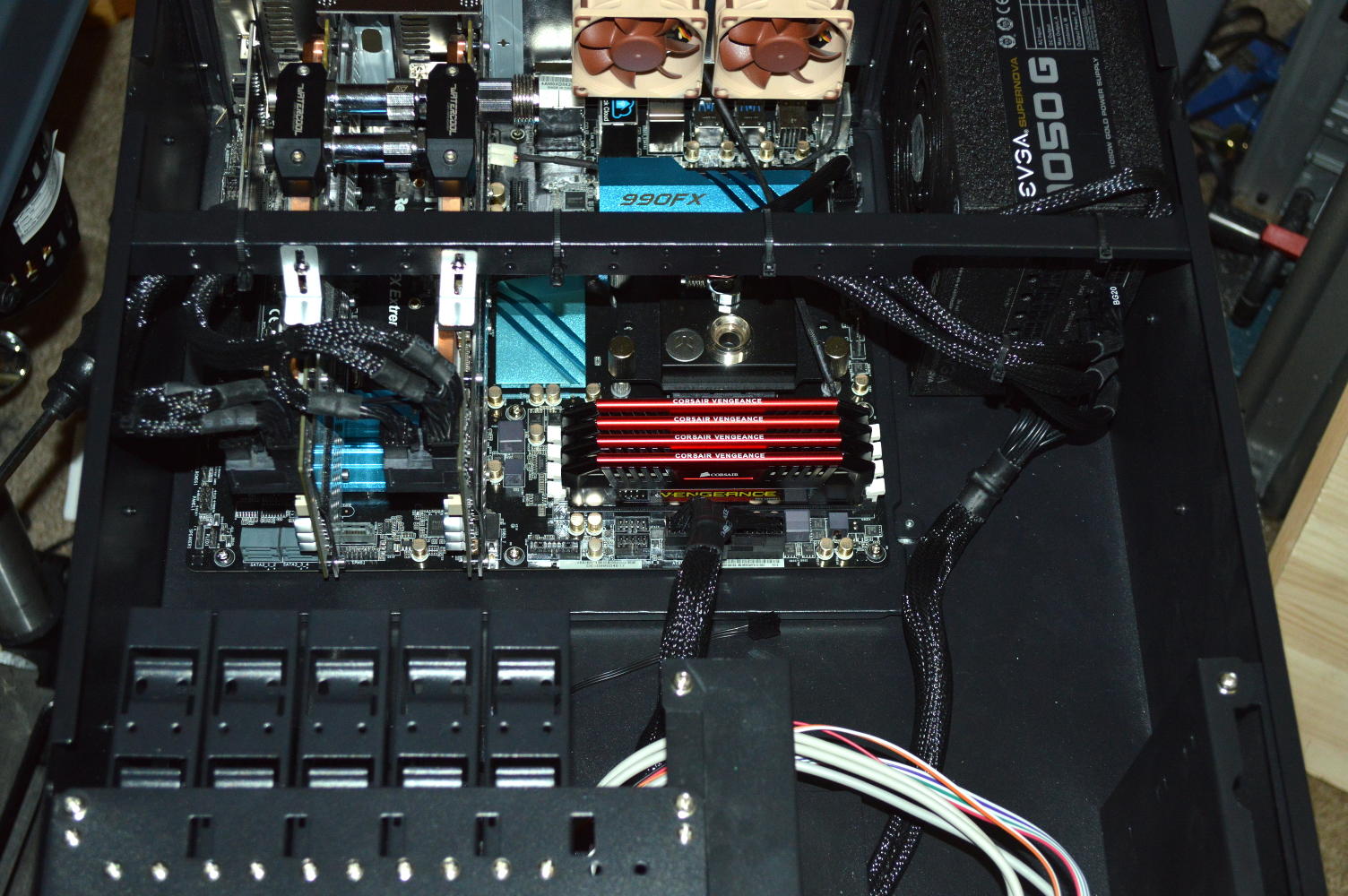
power_cables

The intent was to externally water cool the system, much like I did with Desert Sapphire, but only without building a cabinet just for that purpose. Instead I would build a setup virtually identical to Colony West: rack mount the system and use custom rack panels to mount radiators, a pump and reservoir. With the temperatures I observed with Desert Sapphire and Colony West, I was eager to get that moving.

Only that project never really came to fruition the way I intended. I blame my wife. No, seriously. But let me explain.

Not long after Desert Sapphire was delivered, I ordered a 4U aluminum enclosure. The intent here was to create a rack mount radiator box. While I said the original intent was to mount the radiators on panels identical to how I built Colony West, I ultimately decided against that idea with the intent of some more experimentation. Building the cabinet in Desert Sapphire is what gave me that idea and I started brainstorming.

While I was in the middle of building that up, though, I decided against using the radiator box for β Ori. and instead decided to see how well it’d work as a proof of concept. If it worked, then I’d actually transition Colony West to use the radiator box instead of having the radiator panels. This would take the water cooling in the rack from two 3U panels with a 2U panel between (8U total for those bad at math) to a 4U enclosure, giving room for mounting another system (or two) into the rack.

So what, then, for B Ori.?

Back to the Zalman chassis

Way back in the early phases of this build log, I noted that I mounted the system into a mid-tower chassis: the Zalman Z12 Plus. The intent then was just to be temporary and open up the Corsair 750D for test fits on a new water cooling loop. This time, the move may be permanent.

One of the reasons for that move is the water-cooling grommets on the back of the chassis. While these are intended for tubing to pass through, I discovered that the holes into which the grommets were set are just large enough for an AlphaCool bulkhead fitting. It’s almost like they planned them that way. Initially the 4U chassis was to be modified to mount pass-through fittings on the back panel and everything tubed up doing that. For the Zalman chassis, I was prepared to buy another set of Koolance QD3s to ensure that quick disconnects could still be used while having the tubing pass-through the grommets rather than removing them. But this made that unnecessary, and I could carry on as initially planned.

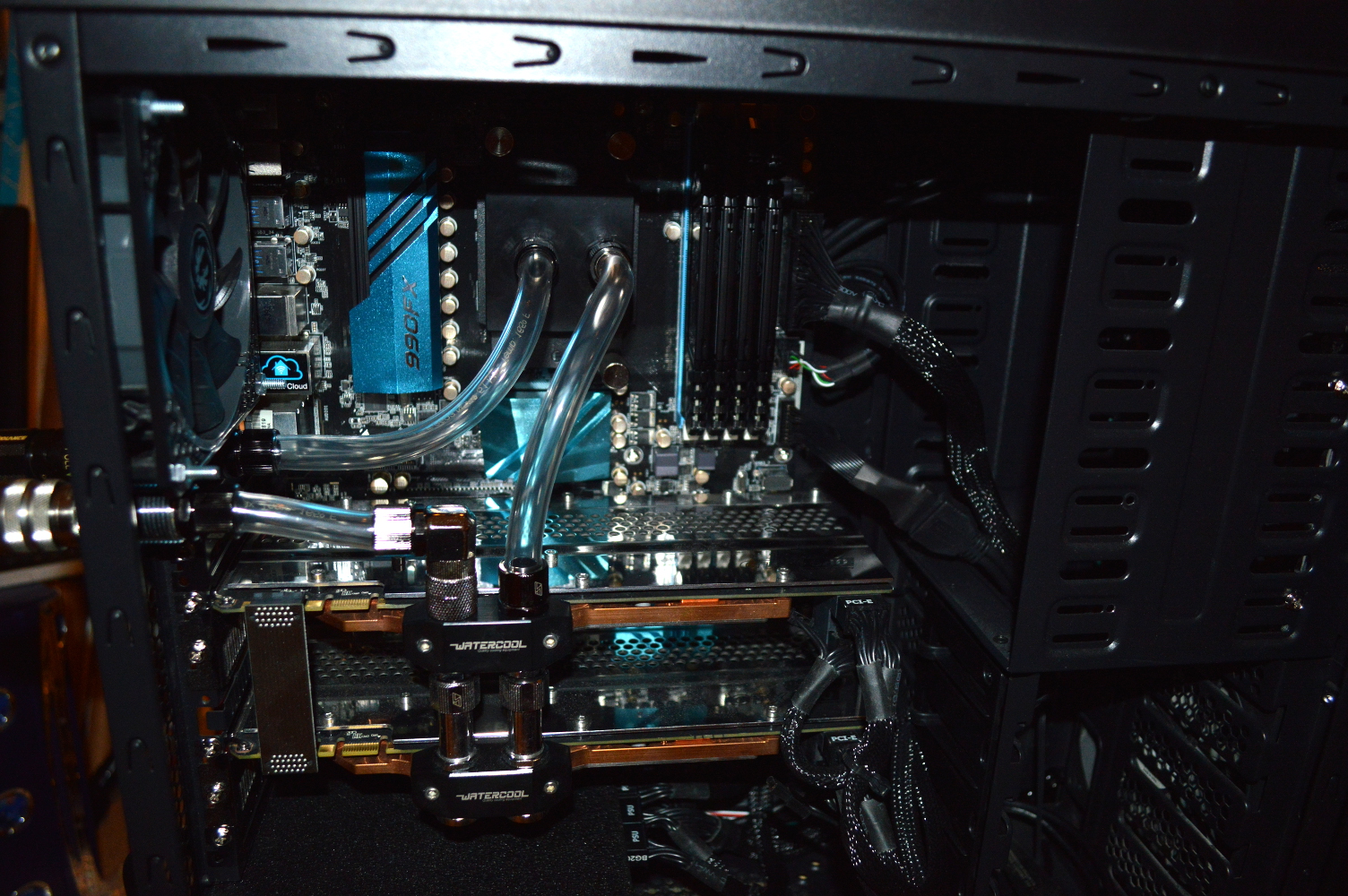
On the inside, that meant the tubing could run to Swiftech compression fittings in the way I initially intended for the 4U chassis. The tubing is Tygon clear 3/8″x1/2″.

zalman_bulkheads

zalman_tubed

So if the pump, reservoir, and radiators aren’t going inside the chassis — since there’s absolutely no room for it, even if I wasn’t using full-length graphics cards — how will this system be cooled? Well, externally as originally intended. Only somewhat different.

Radiator box

What initially got me interested in externally water-cooling a system is this video:

Full disclosure: I am a contributor to Singularity Computers via their Patreon.

While Danger Den went out of business in late 2012 (though their website is still active, for some reason, and they’ve also posted to their Facebook), the idea of doing something like this had not left me. Note that the video above was published in July 2011, but I didn’t see it until last year, if I remember correctly. Then came AntVenom’s video that I’ve mentioned a few times as well:

This is what really got me interested in the idea, though being in an apartment meant I couldn’t mimic his setup. But the idea of taking the bulk of a system’s heat out of the system via a coolant line to dissipate it through external radiators stuck with me. If you’re subscribed to Linus Tech Tips on YouTube, you might also know of their whole-room water-cooling project, which works on a similar concept.

I wanted to do something similar to the Danger Den radiator box. I wanted an external solution but I didn’t want to go rack mount. That is why I ultimately moved the system back into the Zalman chassis. I knew it had water-cooling grommets on the back and where they were, so I knew it would be a lot more conducive to such a project without having to drill holes or buy/use anything else. But then came the question of what to build and how.

The major problem here is that, with Danger Den out of business, it seemed no one was selling anything similar. Koolance has a fully-enclosed external solution, but it’s over 980 USD for the option with an aluminum radiator, over 1100 USD for the option with a copper radiator. Phobya makes a radiator box similar to Danger Den, but it’s not quite what I’m looking for. With the Danger Den radiator box, everything could be self-contained within the box. The Phobya radiator box is too thin to allow for that.

Off the shelf, kind of

I opted against just buying an aluminum box and using hole saws, jig saws, or what have you to build something, as I wanted to do as little modification and tooling as possible. Designing something in Protocase’s designer software for a quote led to a cost higher than I wanted to spend. So to land somewhere in between, I needed to go with something off the shelf, or about as off-the-shelf as I could get.

The closest I came to finding something similar was Mountain Mods and their “water barrel” products. While I didn’t want something near what those could provide — I’m not going to use eight (8) triple-120mm or seven (7) quad-120mm radiators — it gave me an idea.

I’ve written all about it here: Radiator Box. Temperature results are also in that article, but I’ll relay them here again. How long until Mountain Mods starts distributing one of their own?

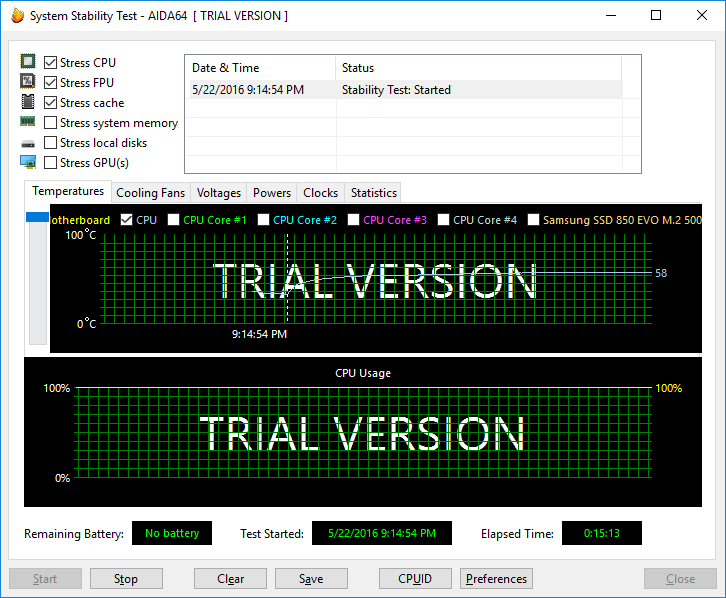
For the CPU testing I ran AIDA64 until the CPU temperatures leveled out. With the GPU testing, I ran Heaven Benchmark until the GPU temperatures leveled out. The CPU temperatures aren’t spectacular, but given the FX-8350 is a 125W processor, I can’t really have high expectations for it — perhaps the temperatures would be better with an FX-8320E. But the GPU temperatures are phenomenal.

aida64

heaven

Radiator box for PC water cooling

Build Log:

I’ve demonstrated in two projects how you can build an external water cooling solution, first with a cabinet with mounted radiators, and second with radiator panels. Time to show something a bit simpler.

Mountain Mods is a custom case and modding company based in Eugene, Oregon. I’ve gone to them before for some of their custom parts. They have a wide variety of custom chassis as well, which can be customized in multiple ways. And if you buy a custom chassis and decide to change something about it later, you can buy the panels individually to change it up however you want.

They also offer two products called “water barrels“: the Water Barrel 18, and Water Barrel 24. They are built to hold a massive amount of radiator capacity. The former is built for up to eight (8) triple-120mm radiators (24x120mm of radiator capacity), while the latter is built for up to seven (7) quad-120mm radiators (28x120mm of radiator capacity). Currently they don’t make one for 140mm radiators, likely due to inconsistencies in fan spacing on some models.

They also sell pedestals. They are 18″ wide and either 18″ or 24″ long, and 9″ tall. They also have “tower pedestals”, which are 9″x9″ and either 18″ or 24″ long. For this project, I selected the 18″x18″ pedestal. To hold the radiators, I selected a “Triple 360” panel. This panel isn’t (as of when I write this) available as an option for the 18×18 Hyper Modular panels. So I wrote in and they said to order the “Big Window” option and mention in the order comments that I want the “Triple 360”.

PEDESTAL

These two options will come to about 205 USD plus shipping, but it’ll give you almost everything you need for the radiator box. All that’s left is just some mods and the components that’ll be going into it.

If you want to use quad-120mm radiators, you will be building an 18″x24″ radiator box. For that, you’ll want the 18″x24″ pedestal option and the “Triple Quad” panel, which can be ordered without having to make a special request. Perhaps I’ll show that in a different project. Everything else will be the same.

In its default configuration, shown above, this pedestal comes with two triple-120mm side panels opposite each other (quad-120mm side panels with the 24″ long pedestal”). This is a perfect setup for creating airflow across the chassis.

Before getting into that, let’s talk about the rest of what was involved here. I’ll go over the hardware I used in this and why I selected those parts. Your selections may vary. Full parts list will be at the bottom.

Water cooling hardware

Radiators: I went with XS-PC EX360 radiators. I already had two of them, pulled from the rack water cooling setup I had previously. These radiators are one of the least expensive triple-120mm radiators available and are a great value. While they don’t perform nearly as well as Hardware Labs and AlphaCool radiators, don’t overlook them if you’re wanting to save some money. They typically go for 60 USD each, which is a great price for a triple-120mm radiator.

Radiator fans: I selected Cougar CF-V12HB fans for the radiators. They’re relatively quiet, virtually silent when undervolted, and inexpensive. They also compare well with Noctua fans in that they’re focus flow with about the same static pressure while costing less. Nine of them went into this build.

Case fans: Along with the radiator fans, I had three (3) Bitfenix Spectre Pro 120mm fans for airflow. Why only three? I’ll get to that in a little bit.

Pump/reservoir: I initially decided on a pump/reservoir combination for this: the PrimoChill CTR Phase 2, D5 enabled. And for the pump I went with the Koolance PMP-450S, which is a re-branded D5T Strong pump. But I couldn’t really mount this in any acceptable fashion, and the result was a persistent rattle that I couldn’t get rid of. So in the end I went with a separate reservoir, the Phobya Balance 150, and had the pump in an AlphaCool HF D5 pump top.

Accessorizing!

Okay so now that we’ve got those basics out of the way, let’s talk accessories!

Fittings: 90-degree fittings are necessary for connecting the radiators together. With the XS-PC radiators, I needed to use SLI fittings to connect them together due to how close the inlets and outlets are to the adjacent radiators. Even if the inlets and outlets were further apart, telescopic/SLI fittings are still a good, inexpensive option for this.

Tubing: The tubing is Tygon 3/8″x1/2″ flexible tubing. This means that I also used compression fittings, specifically Swiftech compression fittings. If you’re really up for it, you could use rigid tubing, but it’s gonna take some work if you want it to look good.

Bulkhead fittings: Because of supplier availability, I used EK bulkhead fittings on the radiator box and AlphaCool bulkhead fittings on the computer chassis. JayzTwoCents recently did a video where he discusses bulkhead fittings:

Quick Disconnects: In my opinion, there is really only one brand for this: Koolance. Specifically I used the QD3-MSG4 male fittings on the computer chassis, and QD3-FS10X13 female fittings for connecting to the tubing.

I need more power!

With all these fans comes a need to power everything. For the fans, I went with an NZXT Grid (not the Grid+ or Grid+ V2). It has ten (10) 3-pin connections and supports up to 30W (about 2.5A current at 12V). I used Phobya 3-way 3-pin fan splitters for each group of 3 fans, then plugged each of the splitters into the Grid.

It also allowed me to set up the fans to be undervolted down to ~9V using a Drok LM2596 step down voltage regulator, making all the fans virtually inaudible while not sacrificing temperatures due to the radiator capacity. Additionally I used a Drok 090030 voltage boost adapter to get above 12V for the pump. How high did I take it? I’ll cover that detail later.

Figuring out how to power this whole thing was interesting, to say the least. I went with a 5A OKGEAR power brick with a 4-pin Molex connector. There are other options available, but this seemed the most convenient for the power requirements.

For the “on-off”, I am using a vandal-resistant switch from the EAO series 82, which is also rated at 5A. And to connect that switch up to the power brick, I’m using a switch adapter cable from Performance-PCs. If you use that combination, here’s how to wire it up since I’ve never received a wiring diagram with mine. Luckily I had a multimeter I could use to figure it out.

  • cable marked + goes to NO or NC
  • cable marked – goes to the – pin for the button’s LED
  • one of the unmarked cables goes to the common (C) pin, and the other goes to the + pin for the LED.

Verify this with a multimeter before connecting everything just to be sure.

* * * * *

Building the chassis

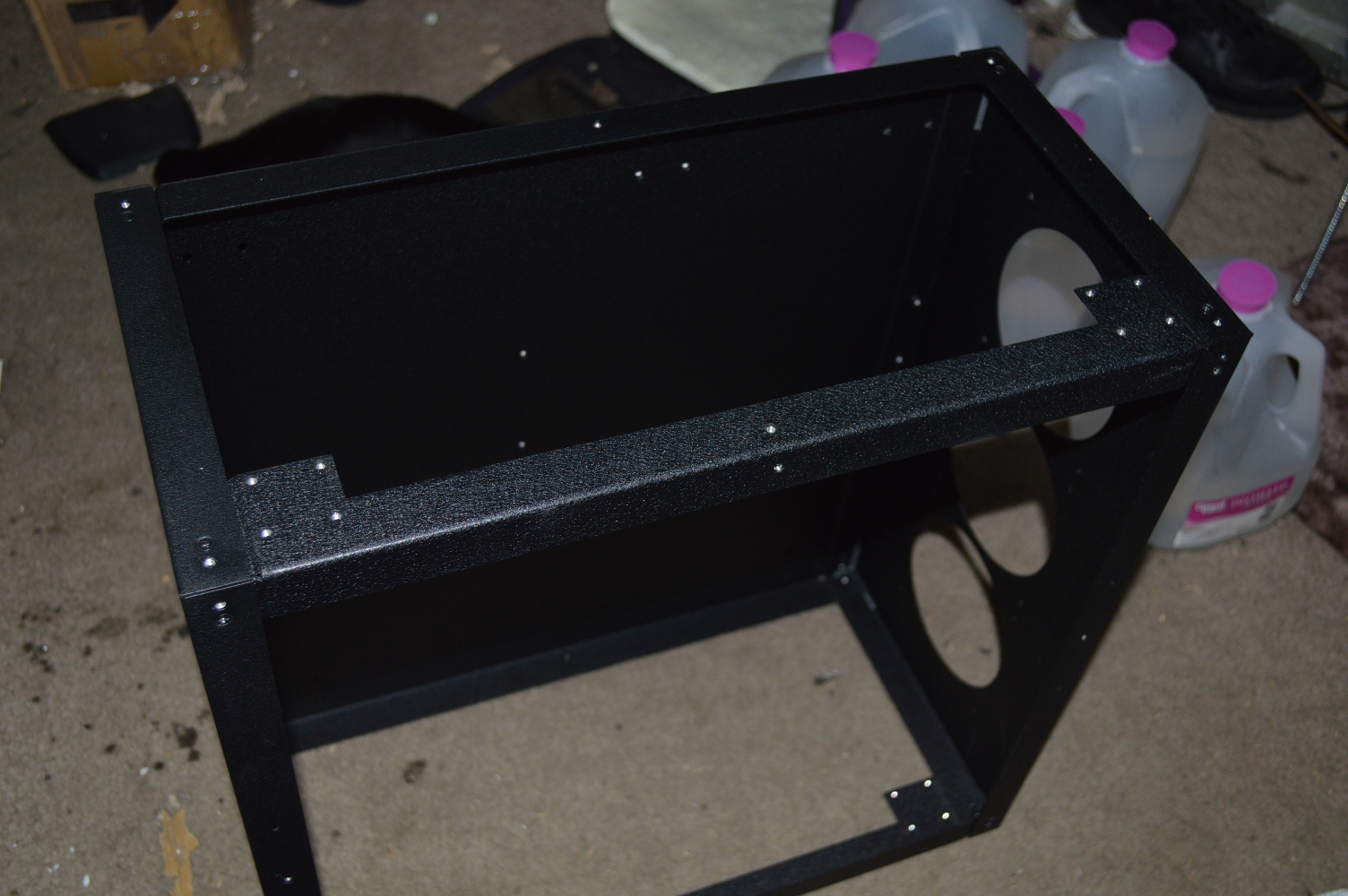
Assembling the frame is pretty straightforward. I left the side panels off initially. And there’s one thing to point out about the supports: I didn’t install them in the same way shown on the product page (picture above), but instead like this:

frame

If installed like shown on the product page, it’ll interfere with the radiators and make it impossible to install the radiator panel.

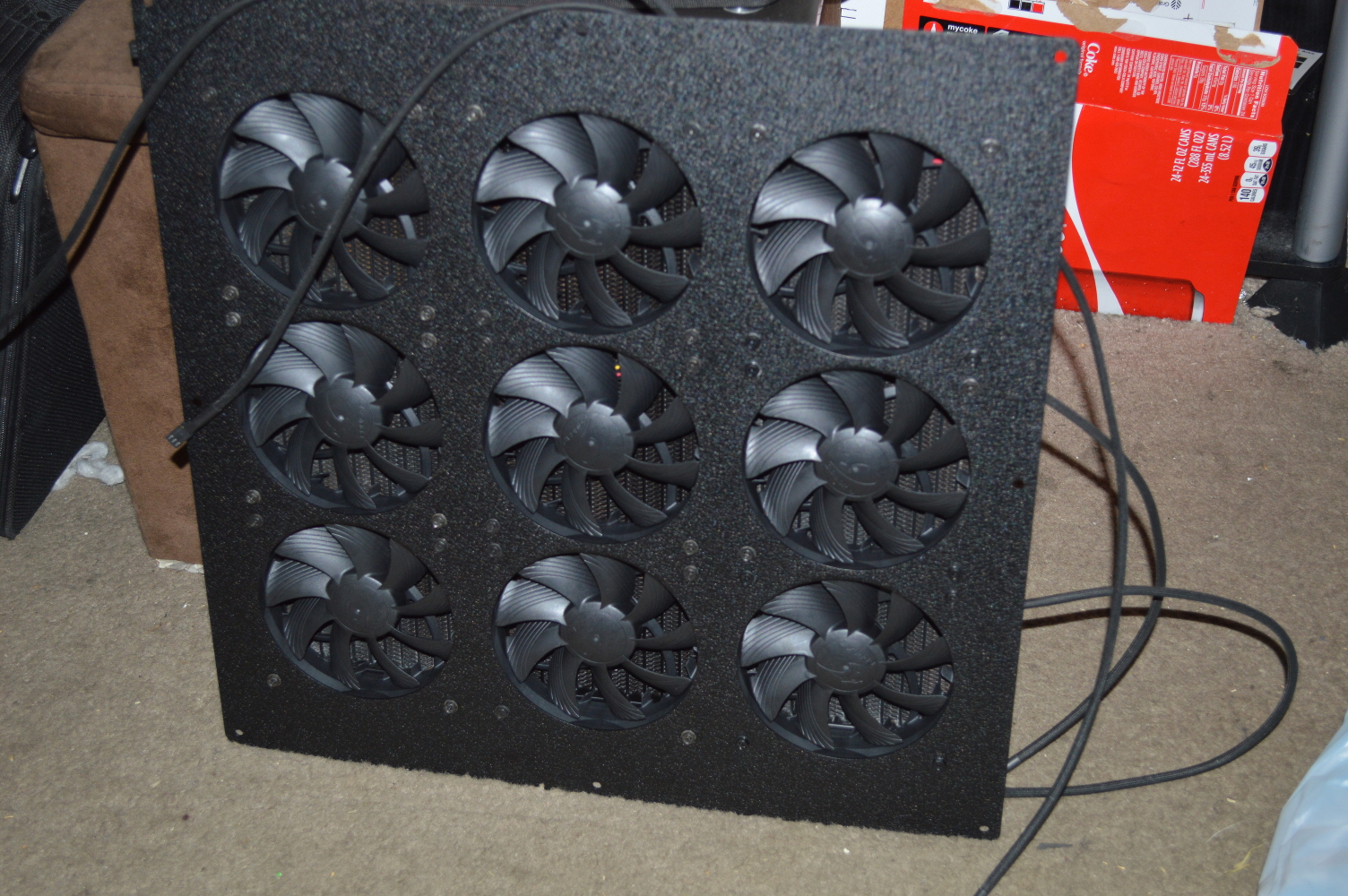
Push or pull comes down to personal preference. There’s not much difference between either, especially when you’re talking low FPI radiators like the XS-PC EX360. I chose push for this build since the fans are focus flow. Initially I went without fan filters as well because I was considering several options, and as of the time I published this, I still haven’t installed any.

fans_push

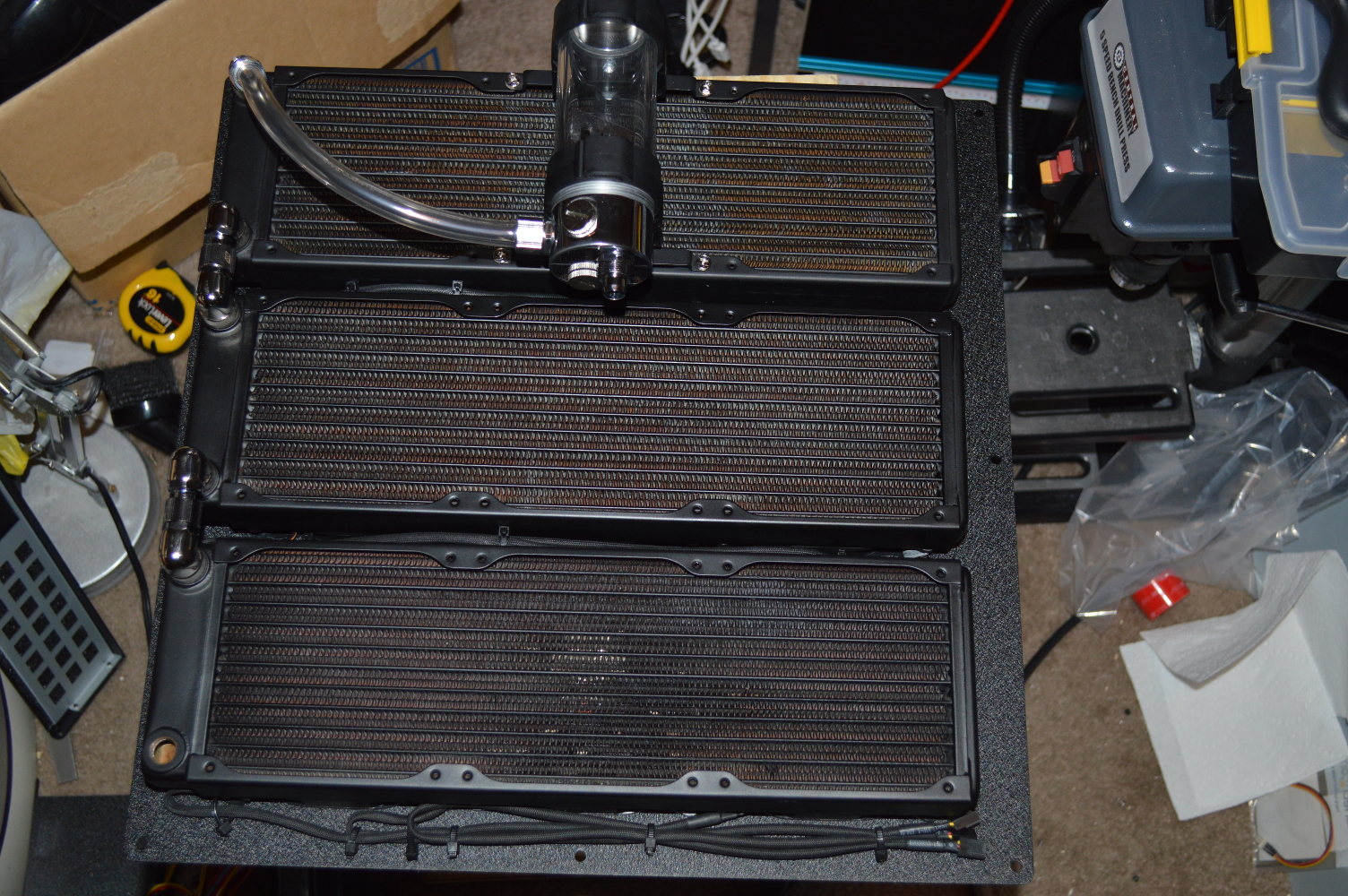
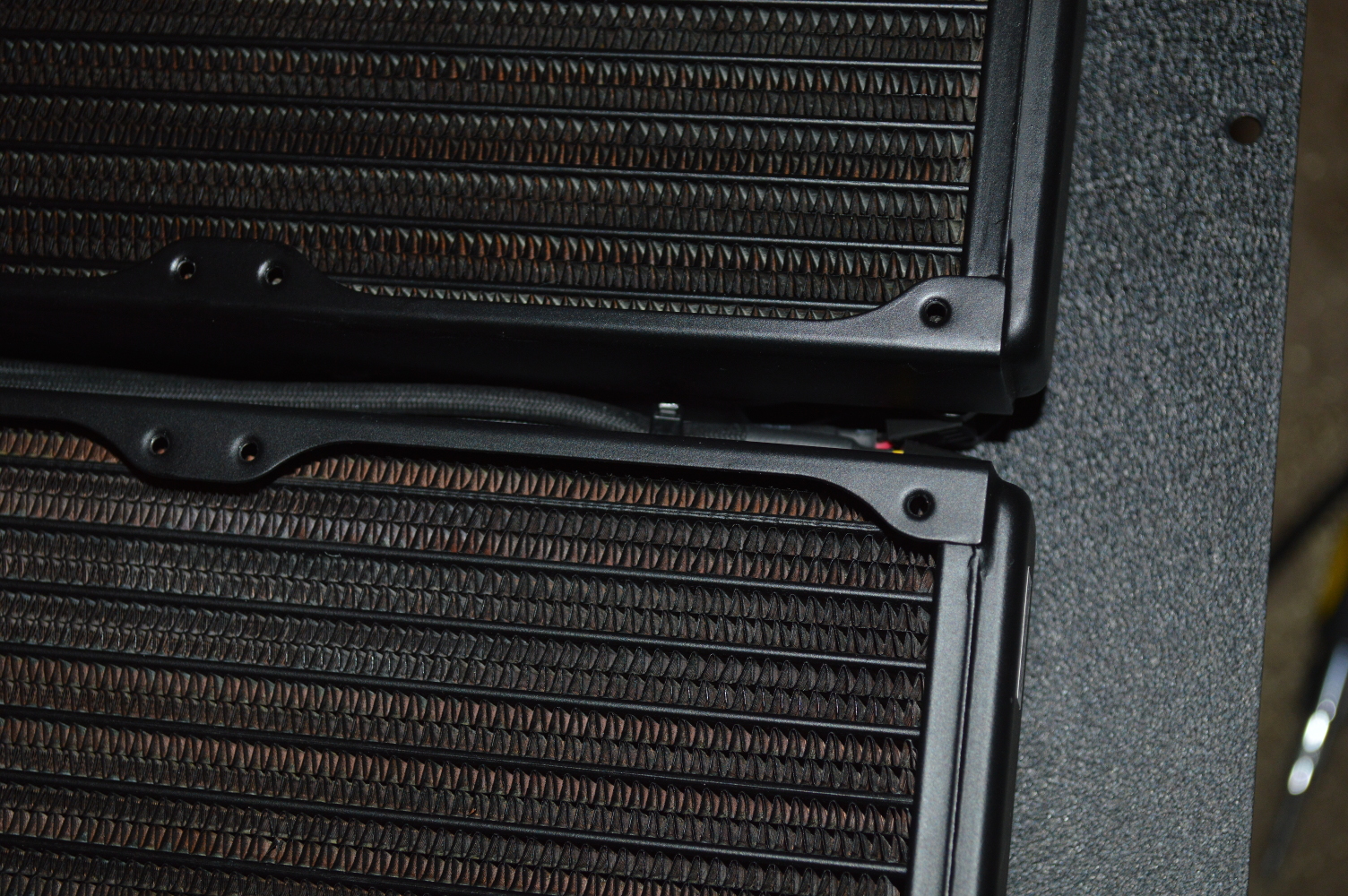
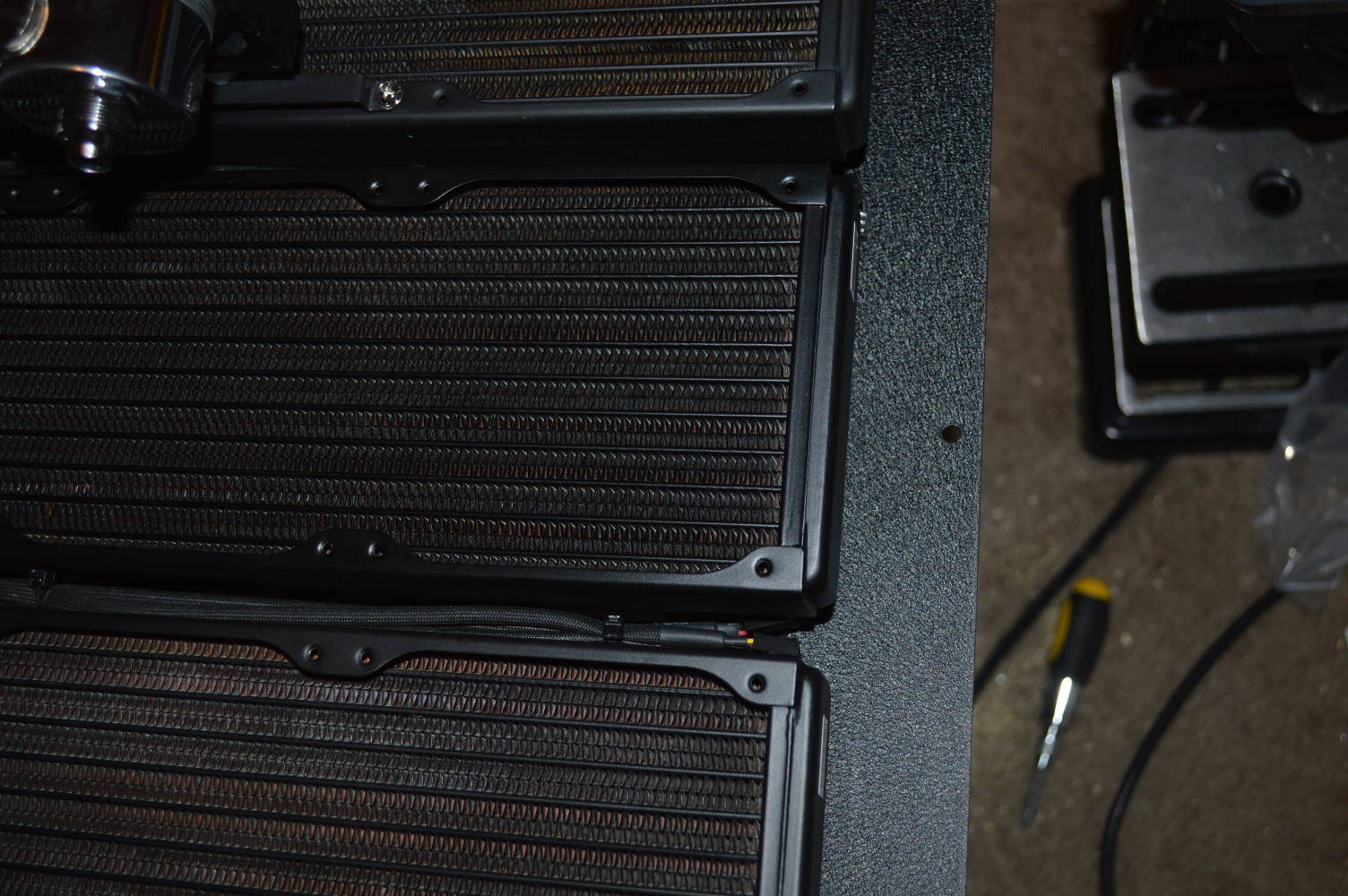
The radiators are also set to be aligned horizontal instead of vertical. This will make things a lot easier to bleed since the pump isn’t having to fight gravity to nearly the same degree, and it’ll give all the air a place to go. This means the flow through the radiators is moving from the lowest radiator to the top radiator back to the reservoir.

The fittings on the radiators will also be toward the back. Unfortunately there isn’t enough room to have case fans in the front and back, only the front or back depending on how the radiators are oriented. The front fans are more for ensuring the hot air from the radiators goes somewhere somewhat efficiently and aren’t necessary for cooling.

Here’s also where I really needed to focus on cable management. I actually made a couple passes at this, mainly because initially I wanted to cable manage the fans without having to buy anything else. Unfortunately it didn’t happen and I ended up ordering the Phobya 3-way 3-pin fan splitters I mentioned earlier.

And I believe I’ve found the best way to manage the fan cables to keep them out of the way. I lined up the power connectors on three fans and tied that with a zip tie. Then I went up the line and zip-tied the cables together until I had a small bundle I could tuck between the radiators.

cables1
cables2
cables3

The 3-way splitters connected to the fans basically made it so it was one cable coming from each radiator. And as the cables for the fans were tucked between the radiators, they’re completely out of the way of any airflow and virtually out of sight.

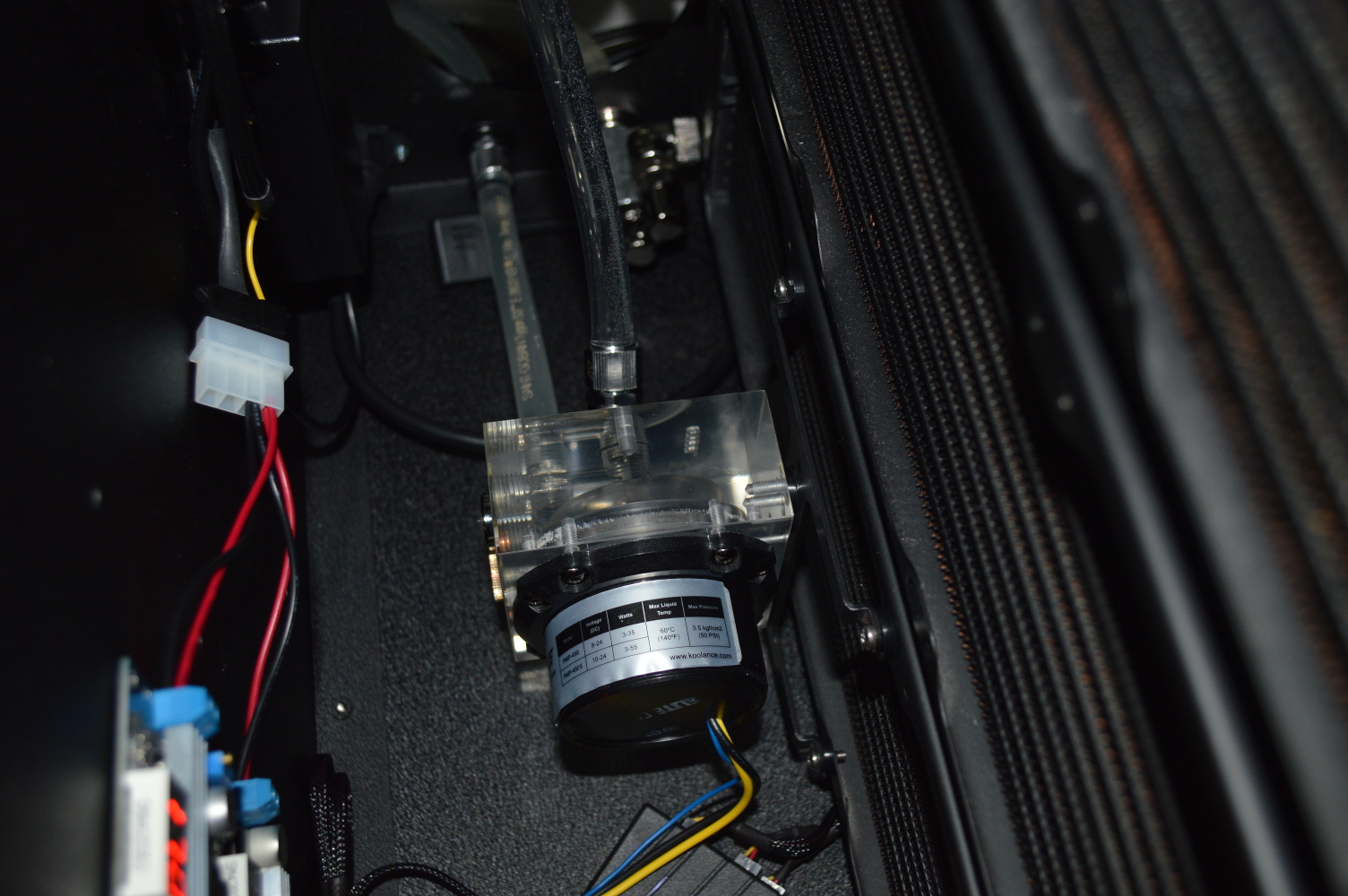
Since the reservoir is bottom-fill, I needed to mount the reservoir on the top-most radiator to ensure the shortest run between the radiator and reservoir. I mounted the pump to the lowest radiator on a UN Z2 bracket with 00 (that’s double-ought) rubber washers for vibration isolation. I’ve used this isolation technique before with D5 pumps and it works very well.

pump

The panel that would be the back panel were the only mods this chassis needed. Specifically I needed to drill two holes, 13/16″ diameter, to accommodate the bulkhead fittings. I also needed another 7/8″ hole to accommodate the vandal switch, along with a 40mmx23mm rectangular hole to accommodate a panel-mount AC power extension cable I was able to order from NCASE for about 10 USD (on their accessories category, select Power Cable and either “Left Angle or Right Angle”).

Now unfortunately the female connector on this cable is just a hair too short to remain firmly seated in the power brick I used, so I ended up having to also add a 12″ Tripp-Lite C13 to C14 extension cable.

Tubing routing and power

I would say the optimal flow direction would be from the pump to the outlet so the pump pushes the coolant to your system. On the return from the system, it should go into the bottom radiator (I have the radiators horizontal as mentioned earlier), and out the top radiator back to the reservoir.

Since I’m using an AC to 4-pin Molex power brick, I used a 4-pin Molex Y-splitter to push power to the voltage regulators, then from those to the pump and fans. Basically just snip each branch of the splitter somewhere in the middle, then strip the ends and attach to the regulators. Use a tool to remove the 5V connectors and its corresponding ground.

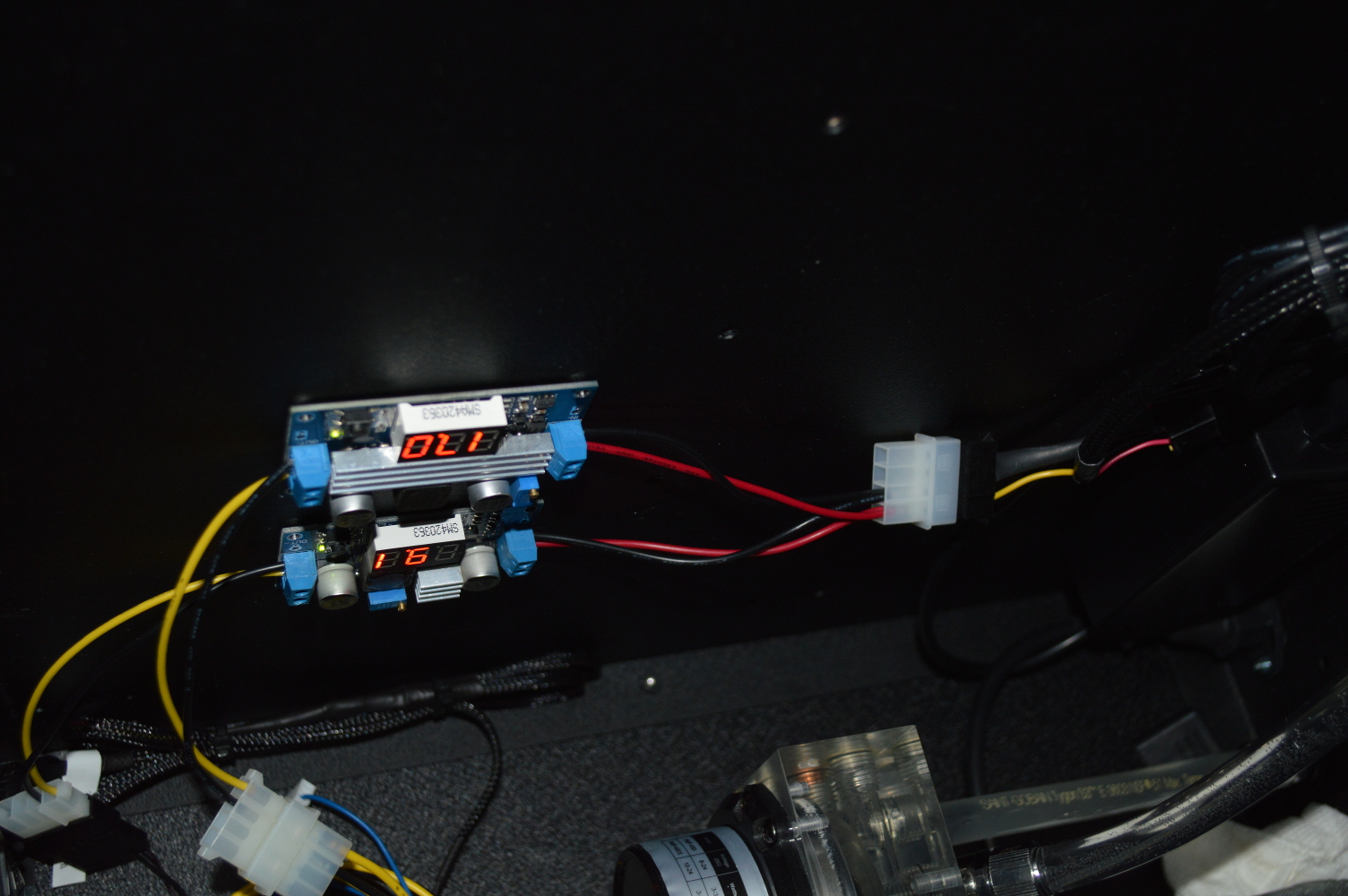
The regulators are attached to the side panel via 3M VHB double-sided tape. As the voltage converters have heatsinks over their regulators, I wanted these to be positioned so they’ll get airflow from the radiators. Plus it ensures the potentiometers on the regulators are easily accessible (requires a small flat-head screwdriver).

regulators

The AC power brick is also taped to the side panel with 3M VHB double-sided tape. Not because I needed airflow on it, but just so it’ll be out of the way.

Noise and Performance

The anti-vibration setup keeps the pump relatively silent despite being run at greater than 12V. The fans are barely audible sitting mere feet from the unit. The pump, I’m sure, is the only source of noise with this unit. And I don’t think there’s really anything I could’ve done differently to dampen the noise on this, and I don’t think there’s anything more I can do either, at least not without going outside the bounds of reason.

The system to which this was initially connected has these specifications:

  • CPU: AMD FX-8350 at 4.0GHz with EK Supremacy EVO block
  • Graphics cards: PNY GTX 770 4GB OC (x2 in SLI) with Watercool Heatkiller GTX 680 blocks
  • Memory: 16GB DDR3-1600
  • Mainboard: ASRock 990FX Extreme6
  • Power supply: EVGA 1050 GS
  • Storage: Samsung 850 EVO 500 GB M.2
  • Case: Zalman Z12 Plus

For initial testing, I used just plain distilled water to run the test. The pump was set to run at 17V and the fans were at 9V. I ran the System Stability Test in AIDA64 Extreme 5.70.3800 until the CPU temperature leveled out (about 15 minutes):

aida64

For the GPU test, I ran Heaven Benchmark with everything maxed out until the temperatures on the GPUs leveled out.

heaven

For the hell of it, I decided to take the cooling passive, just to see how well it’d work — plus I wanted to confirm that the pump was the source of noise in this setup.

Let’s just say that it’s not a good idea to leave this like that for long. After just one pass through of Heaven Benchmark’s scenes, the graphics cards topped out at 53C. I didn’t even try a CPU test. Plus the tubing, fittings, and radiators became noticeably warm to the touch.

* * * * *

Parts list:

Chassis:Mountain-Mods Pedestal with 18×18 “Triple 360” HyperModular side panel
Radiators:XS-PC EX360 (x 3)
Fans:Cougar CF-V12HB (x 9)
Bitfenix Spectre Pro 120mm (x 3)
Pump:Koolance PMP-450S, AlphaCool HF D5 clear acrylic top
Fittings:EK 90-degree rotary fittings (x 6)
EK 45-degree rotary fitting (x 1)
Swiftech 3/8″x1/2″ compression fittings (x 8)
Swiftech 20mm to 33mm SLI fittings (x 2)
Tubing:Tygon 3/8″x1/2″
Power:OKGEAR PA-AD-UL-12V5A
4-pin Molex Y-split
Phobya 3-pin to 3×3-pin fan splitter
EAO series 82 vandal-resistant switch
Performance-PCs pre-wired vandal switch cable assembly (with spades)
NZXT Grid
Voltage regulators:Drok LM2596 voltage step-down
Drok 090030 voltage step-up
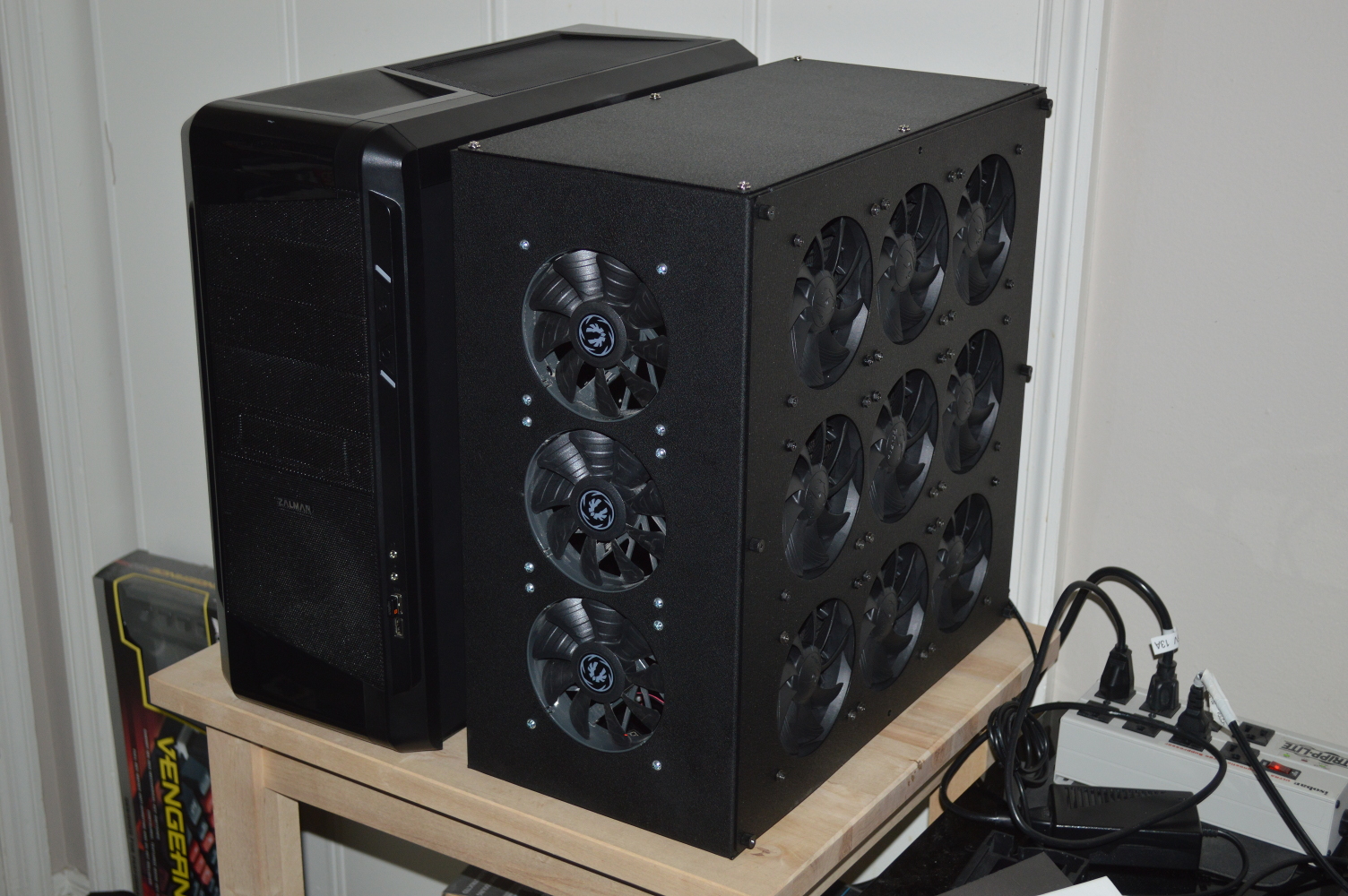
box_and_tower
switch2

Campus carry and academic discourse

If there is one area where I can give anti-gun advocates credit, it’s their ingenuity in devising arguments to use against the expanded recognition of firearm rights. One aspect of that expansion is “campus carry” — laws allowing those who possess a valid concealed carry permit to carry their firearms onto college and university campuses. A lot of people are skeptical of these laws for much the same reason they’re skeptical of concealed and open carry period. Not much new has been said against these laws.

And then there’s Sonja West over at Slate:

The debate over these laws typically centers on whether guns make schools more or less safe. But those arguments overlook the real threat of campus carry laws: the evisceration of academic freedom.

If you’re wondering what this means, let her next statement provide the clarification (emphasis mine):

For colleges and universities to be effective, educators must be free to teach and discuss ideas—even controversial or unpopular ones—without fear of government censorship or retribution.

Yes, retribution. Basically Ms West seems to be expressing a concern here that students will use their firearms as a show of force to push curricula decisions and academic discussions a particular direction:

Guns on campus might not, at first blush, appear related to a school’s academic mission. Yet they are integrally connected. University administrators and faculty members have argued that guns would discourage the teaching of sensitive issues and possibly lead to certain topics being dropped from the curriculum altogether. Students and faculty also might be chilled from expressing potentially controversial ideas and arguments, which is in direct conflict with higher education’s tradition of uninhibited academic debate.

If only there actually was uninhibited academic debate on college campuses. The erosion of academic discourse has already been occurring absent firearms on campus. And it’s been occurring for quite a while, but has only recently become more acute due to some high profile incidents when “social justice warriors” have been shaping and warping policies and discourse on college and university campuses.

For example, at the University of Missouri, recently-dismissed assistant professor Melissa Click is on video doing just that during a campus protest under the label “Concerned Student 1950”. After telling a student journalist they needed to leave a particular area of the university campus, which is public property, Click said: “Hey I need some muscle over here. Who wants to help me get this reporter out of here?” Those actions cost Click her job as well as subjected her to misdemeanor assault charges. Would a firearm have made that protest more volatile? Actually it would’ve given the student journalist an edge to protect his rights, even though the attempt would have been feeble if the mob was courageous enough.

And then there is the case of another student journalist on the Missouri campus during the same protest:

The crowd decided to basically plow over a student journalist trying to document what was going on. And somehow Ms West thinks firearms on campus will deter the discussion of controversial topics? There already has been a chilling effect on college campuses. The question is whether West can see it, or whether she is blind to it simply for being ideologically aligned with it.

Another great example occurred at Yale, as documented in another article on Slate by Katy Waldman:

“It is your job to create a place of comfort and home for the students that live in Silliman … Do you understand that?” one student shouts at Master Nicholas Christakis, after yelling at him to “be quiet” when he tries to speak. “Why the fuck did you accept the position? Who the fuck hired you?” When Christakis begins to argue, she interrupts: “Then step down! If that is what you think about being a Master, then you should step down. It is not about creating an intellectual space! It is not! Do you understand that? It’s about creating a home here! You are not doing that. You’re going against that.”

Later revealed is that the student who is shouting this was on the committee that hired Dr Christakis, and that she also comes from a very privileged background.

So will firearms on campuses only make campus tensions worse? I’m doubtful on that mark for several reasons, starting with the fact that those students who would be legally able to carry firearms will be in an overwhelming minority purely due to age limits.

For long guns you must be 18 to purchase and possess, but you really don’t have to worry about students carrying those around campus. No, seriously, you don’t have to worry about that. It’s completely impractical to carry a long gun around with you all day purely due to the weight of the firearm and the ammunition. And with pistols, the age of ownership is 21. And getting a concealed carry permit isn’t something most college students can afford.

So campus carry laws would be permissive to only a small minority of students called the “non-trads” — non-traditional students — and some juniors and seniors, along with those who are in the military reserves, provided all of the above have a concealed carry permit.

Further, the only students who would be able to carry concealed on campus would be those not living in campus residence halls. There is no indication that these laws would extend to requiring allowing students to keep firearms in on-campus residence halls. And even if they did, it’d still be only a minority of students able to do that.

Beyond that, though, the threat to discourse and free speech on campus won’t come from conservatives. I mean if you think that creationist students in a biology course are going to show up packing pistols to push biology professors to teach creationism, you’re worries are severely overblown. Indeed if firearms will do anything with regard to free speech on campus, it’ll open it up by giving students who would otherwise be suppressed a means of defending their own rights or assisting in the defense of others’ rights, especially against mobs who would seek to dissuade dissenters from speaking up.

Plus if a student really wanted to use a firearm on campus to effect a curricular change, there isn’t much stopping them currently. In fact it’s in response to students using firearms on campus — such as at the University of Virginia — that legislatures are considering allowing other students to carry as a means of providing an immediate response.

Threats to discourse and free speech already are, and have for a while been coming from neo-liberals, the regressive left, and social justice warriors. Some rather potent examples of recent attempts to shut down free speech on campus have already been presented above, and there’s plenty more where that came from. Those who want to play identity politics have already taken over, and free speech on university campuses has suffered for it, including at the campus where the 1960s Free Speech Movement began: UC Berkeley.

If firearms on campus will do anything, it’ll seek to preserve what discourse remains by defending those who wish to speak, regardless of their political persuasion, while also giving students a means of responding immediately should another situation like UVA erupt.

Wil Wheaton and free speech

I think it safe to say that many do not understand the right of free speech. Let’s add Wil Wheaton to that list:

I just watched this idiot reporter on KCAL questioning people who were protesting outside of the Republican State Convention in Northern California today.

They were, unsurprisingly, protesting Donald Trump’s rhetoric and message. They were largely younger people, and they were unhappy about his misogyny, bigotry, racism, and xenophobia.

So this stupid reporter, who either knows better and doesn’t care, or is so profoundly ignorant of what he’s reporting on he shouldn’t be there, starts asking the protesters, “Don’t you think Donald Trump has the right to free speech?”

Okay, stupid, let’s break this down for you because apparently any idiot can call himself a reporter these days and get hired by a network. The protesters aren’t government or law enforcement, or agents of the state, so they can’t abridge or prevent Trump’s speech. They aren’t using the apparatus of the state to interfere with his ability to say whatever he wants, so the question about his free speech is irrelevant.

This idiot is asking the wrong question because he’s lazy, stupid, unprepared, or being deliberately obtuse. The question is not “don’t you think Donald Trump has a right to free speech” the question is … well, just to pull three off the top of my non-professional-journalist head: “Why do you feel this way, why are you here, what do you hope to accomplish?”

This idiot did nothing to educate his viewers, and instead spread the false idea that challenging someone’s ideas has anything to do with that person’s constitutionally-protected right to free speech. This stupid reporter has conflated Free Speech with speech free of consequence, which is something I’d expect from a 12 year-old, not someone who is allegedly a professional television reporter.

The concern here is that Wheaton is limiting what he considers a valid interference of free speech rights to just the government. Unfortunately most seem to think that the right to free speech means only the government cannot interfere. No, it means no one can interfere. That’s why it’s called a right.

I left this reply:

So as long as the protesters are not interfering with those trying to get into the venue, and otherwise not interfering with Trump giving his speech, then they’re not interfering with anyone’s rights, merely exercising their own.

But to say that they “can’t abridge or prevent Trump’s speech” is not correct. They can’t *legally* do so, but that hasn’t stopped things like that from happening in the past — and oddly enough, it seems to be consistently coming from the radical left.

Bear in mind that many radical leftists have interfered with speeches and people trying to access those venues. This has especially been the case on college campuses. Chanty Binx (a.k.a. “Big Red”) comes to mind readily on that. A group of protesters at Ohio University interfered with a speech regarding due process rights on campus, labeling that speaker a rape apologist, with several rows of people standing to block his speech. And other interference with speeches has included disruptions during the speech and other attempts to drown out the speaker or otherwise prevent the speaker from giving their speech in a venue where they are authorized to speak.

And their justification for interfering with these speeches and access is by labeling the speaker a (an) [insert label of choice] and by extension saying that their speech is not protected by the First Amendment because they are [insert label here] and their speech is (without reviewing the notes or planned statements ahead of time) “hate speech”. Given you’ve just labeled Trump several things, many would feel justified (and likely have felt justified) in actively denying him his right to speak on those grounds or deny others the ability to access the venue where the speech was being given — the number of people arrested blocking roads shows this.

I’m sure you’re not unaware of all of this going on, and if you are, you need to educate yourself on this.

Again so long as the protesters do not interfere with access to his speech or him giving that speech, then no interference of rights has occurred.

While the First Amendment specifically enjoins the government, no person, whether civilian or law enforcement, has the right to interfere with someone giving a speech at their own venue or one in which they are authorized to speak, nor do they have the right to inhibit someone’s access to that speech.


13 things said by someone who likely never had student loan debt

Once again I need to focus my eyes on Credit.com, and specifically at Christine DiGangi and her article “13 Thing People with No Student Loan Debt Will Never Understand“. Let’s set aside the fact that the article should’ve likely been titled people “who have never had student loan debt” and instead get into these points that make me wonder if the author has ever had student loan debt. Seriously, she’s got some doozies here.

  1. There’s that falling-off-a-cliff feeling you get when letters start rolling in after you’ve left school, telling you it’s time to pay up.

And given that you have 6 months from the day you leave college before first payment is due, and that is mentioned in every disclosure you’re given about your loans (you did read those, right?), the letters informing you of your upcoming due date and, more importantly, the payment amount should not be a surprise. If they are, then you weren’t paying attention.

In those letters will also be instructions about getting deferments or a forbearance, so make sure to read them to understand the process. And call the customer service numbers if you have questions about those processes or need to initiate them.

  1. You quickly realize your disposable income is also going to fall off a cliff.

And again, given you have six months from the day you leave college before the first payment is due, that should be enough time to anticipate this expense and all other expenses you might have so you can create a budget.

  1. Then there’s the confusion of dealing with a loan servicer whose name you don’t recognize, because you borrowed money from the Department of Education.

This is provided you need to actually call in and discuss your standing with the loan servicer. With the small loan I had through the Department of Education (the bulk of my student loans were funded by Wells Fargo via the Stafford Loan program), I never had to call in.

  1. Once you log in to set up your account, you see your loan balance and think, “Holy crap, that’s way more than I borrowed.” Interest is a soul-crushing beast.

The only reason to be thinking that is if you ignored all the statements the loan servicer was sending you during the time the loan was in deferment. If you weren’t paying attention to that, you have only yourself to blame.

  1. You stress out every month about your payment arriving on time, even though you set up automatic payments.

If you set up automatic payments, you don’t need to stress about your payment arriving on time. If you set up automatic payments, the loan servicer isn’t going to hit you with any fees or penalties simply because their system didn’t initiate payment in time for the due date. That’s their fault, not yours. And if they do hit you with a fee, call in and tell them you have automatic payments set up — something they can easily confirm — and they should remove it.

  1. But when the payment goes through, you’re pissed because you just gave away another couple hundred dollars you could have saved for a down payment on a house, or to replace your run-down car, or for that emergency fund you know you need, or to take a vacation or a million other things you don’t have the money for.

And of course we can’t fault Credit.com for mentioning the fact you could’ve used that payment on other kinds of debt. Ugh… Seriously when my debt payments were going through, I wasn’t thinking about what that money could’ve been spent on. I knew I had obligations to pay, so I had to think about paying those obligations, not where the money could’ve gone had I not had those obligations.

  1. And if the payment gets screwed up, you get to frantically make phone calls to try and fix the problem, get late fees waived and hope a late payment doesn’t end up on your credit report.

If you screwed up the payment details, you have only yourself to blame. Seriously, how difficult is it to double-check the information you entered before saving it? Their systems won’t initiate payment against a bank account number you don’t provide them. So if you gave them the wrong information, or fail to update that information if you move your account to a different bank, you have only yourself to blame.

  1. There’s the sad familiarity you have with your student loan servicer’s phone number, because you’ve probably saved it in your phone so you know who’s calling you incessantly about paying your bills.

This should only be happening if you are habitually late or not making the payments at all. If you’re unable to pay your loans, you need to seriously reevaluate your standing and discuss that standing with the servicer. At the same time, if you’ve already gotten a deferment or forbearance, they’ll want you to provide periodic updates on your standing to them, and will call to obtain those updates. After all, you owe them money, and likely a significant chunk at that, so they’re not going to just go away.

  1. And even if you’ve been making payments for years, you feel like exploding at the sight of your account balance — because that pesky interest and decades-long repayment plan seems to keep you from making any progress toward getting out of debt.

And it’s your fault for borrowing so much. If you don’t want the hassle of paying it back, don’t borrow it to begin with. But since you’ve already borrowed and spent the money, welcome to the flip-side of the coin. I took about 10 years paying off over 14,000 USD in student loan debt. Thankfully being in the Stafford program meant I had a low interest rate, so the payments were easy.

But that wasn’t always the case, as I was unemployed for a long period at one point and had to play catch-up on those loans. Wells Fargo even offered a forebearance, which I turned down since I had a plan for catching the loans up — which required making about 1500 USD in payments in two months time with debt collectors breathing down my neck.

  1. But you keep paying anyway, because it seems like there’s no way out of repaying your student loans, even if the rest of your financial life collapses around you.

You keep paying anyway because you have an obligation to do so! And if the “rest of your financial life collapses around you”, then reevaluate your financial life to get things in order.

  1. Then, after you’ve gotten used to sending your payments to one place, your loans are transferred to another company and you have to set up everything all over again.

Yes, banks and loan providers will sell off loans in order to recover as much of the principal as they can up front rather than waiting for it to come in over the course of years, perhaps decades. And they typically take on a loss doing that. My student loans originated through Wells Fargo, then were sold to ACS Education Services, a division of Xerox Education Services. Right before I made the last payment on the loan, I got a letter saying they’d be transferred to another servicer. That’s just part of the business.

But how difficult is it to set up the payment information again? It isn’t hard. The only complication is having to retrieve the routing and account numbers for your bank account to make sure you enter them properly. Aside from that, you just enter the information into the online account and be done with it.

  1. Then there’s that moment each month when you’ve forgotten about how much you hate your student loans, only to get an email about when your next payment is due, or there’s a message you have to log in to read, or some other annoying bit of communication that’s probably meant to be helpful but you’re certain it exists solely to torture you.

That e-mail reminding you of your payment is also called your statement notification. And they’ll also send you e-mails whenever there’s a privacy policy update, among other notifications they may periodically send. You can opt out of much of that if you wish, or have them send paper copies in the mail. If you have automatic payments set up and don’t want the periodic e-mail reminders, you may be able to opt out of them. Instructions will likely be in the e-mail. But even then they’ll likely still send you an e-mail telling you they’ve initiated payment.

  1. And, eventually, there’s the ridiculous joy you feel when you make your last payment and you’re finally free of student loan debt.

I wouldn’t call it “ridiculous” to feel joy at paying off an account that’d been sapping your income for years on end. I remember paying off all of my other loans — student loans, my car, a personal loan. It was great watching those payments disappear from my budget so that money could be re-allocated, after having a little celebration. But there’s nothing “ridiculous” about that joy either.

* * * * *

I’ve gotten on Credit.com’s case before with regard to the tripe they publish. It’s all marketing materials. So naturally they’re going to over-inflate and exaggerate a lot of what they say simply because they can. At the same time, the fact they’re misleading people cannot be ignored.

Here’s the thing: there’s nothing special about student loans. It’s debt. These points could still apply whether you’re talking about a car loan, personal loan, or student loan. So why she chose to make these things people without student loan debt will “never” understand is beyond me, and it’s extremely misleading.

What the hell, Amazon?

Something must seriously be wrong at Amazon. In the past few months, I’ve had several orders screwed up, but the most recent one takes the cake. By far.

Recently I ordered the Shrek collection on Blu-Ray from Amazon. It shipped via the 2-day shipping (I have Amazon Prime), and it arrived Monday, April 4… without any wrapping around the box… and no discs in any of the BD cases. When I first lifted the box, it felt strangely light, and immediately I feared they had sent me an empty set. And when I saw it was unwrapped, I checked all of the BD cases, and, sure enough, all were empty.

shrek1

shrek2

Needless to say, I immediately made the replacement request — not refund, replacement.

I mean, the only way Amazon could’ve been worse on this is to send me an empty box — as in an empty shipping box with literally nothing in it. And hopefully by saying that I haven’t just jinxed myself.

And when they receive what they sent me, if Amazon tries to go after me with regard to the missing discs, attempting to accuse me of basically stealing the discs and manufacturing the story, I have a perfect response: that order also had the complete Hobbit Extended Edition Trilogy on Blu-Ray (though shipped separately), and it arrived in tact.

Nasira – Part III

Build Log:

This phase of the project starts with bumping the storage from 8TB to 16TB raw storage space, making it 8TB effective space. Given how much space is currently being taken up on the NAS, it’s probably going to be a long while until I buy the next pair.

The second pair was a pair of Seagate 4TB NAS drives. As planned, I replaced one of the WD Red drives with a Seagate, then created the second mirrored pair from the spare WD Red and the other Seagate. The first pair resilvered at an average rate of around 100 MB/s. At the time of the resilver I had 1.5TB of data, so it took over 4 hours to rebuild.

The drive replacement was straightforward — take the drive I wanted to replace offline, remove it, mount the new drive, tell FreeNAS to replace the one that was taken offline, and let it resilver.

* * * * *

And finally we’re to building the system, or at least migrating it.

As said in the previous iteration, I opted for the IPC-G3550 from PlinkUSA, which is a 3U, 21″ long chassis with two sets of three (3) 5 1/4″ drive bays in the front. Unfortunately with the mobile racks I couldn’t get them mounted flush, so they ended up sticking out a little bit. But they serve as 120mm fan inputs as well. Both mobile racks are installed and powered, even though only one is populated. The second basically acts as a 120mm intake.

nasira

Needless to say I’m not pleased with the cable management, but for now there really wasn’t much I could do about it. I’m looking around for short SATA cables to replace the ones that came with the drive racks. For the one behind the power supply, I’m think only 9″ at most is needed. For the one nearest the processor, 15″ will likely do the trick, but 12″ may be adequate as well. Unfortunately there aren’t options at my local Micro Center, so I’ll have to check online. Along with that, I think I need to replenish my supply of 3M Commander clips.

So once I have everything in I’ll tear apart the cabling and see how I can improve the cable management. Extension cables may also be in order for the 24-pin ATX and 8-pin CPU power connectors, or I can see about tying those to the cross beam overhead. So with come better cable management yet to come (hopefully), I’m not quite ready to call this done.

Bernie Sanders is correct

I’ll say this up front: “military weaponry” is a misnomer.

The exception to this is very, very limited, and one that many can readily recognize: fully-automatic rifles. These were clearly manufactured with a military intent in mind. But select-fire rifles are largely unavailable to anyone outside the military. Obtaining one requires going through the months-long NFA process, which includes a background check more extensive than required for my concealed carry permit, and local law enforcement (either county sheriff or local police chief) has veto authority.

And even if you obtain one, transporting the firearm even across county lines can be a hassle. There are so many restrictions on select-fire and full-automatic firearms that most won’t bother with it. I’m sure many would want similar restrictions on semi-automatic firearms. In fact, I know many want such restrictions. Just look at the number of people who keep citing Australia as a viable model with our Second Amendment.

Anyway…

Mark and Jackie Barden wrote a response letter to Bernie Sanders published in the Washington Post in which they explain their reasoning behind joining a lawsuit against firearms manufacturers. The Bardens are the parents to the late Daniel Barden, one of the 20 child victims at Sandy Hook Elementary in December 2012.

Bernie Sanders, candidate for the Democrat nomination and independent Senator from Vermont, said this during a recent debate with Hillary Clinton:

Well, this is what I say, if I understand it — and correct me if I’m wrong. If you go to a gun store and you legally purchase a gun, and then, three days later, if you go out and start killing people, is the point of this lawsuit to hold the gun shop owner or the manufacturer of that gun liable?

If that is the point, I have to tell you I disagree. I disagree because you hold people — in terms of this liability thing, where you hold manufacturers’ liability is if they understand that they’re selling guns into an area that — it’s getting into the hands of criminals, of course they should be held liable.

But if they are selling a product to a person who buys it legally, what you’re really talking about is ending gun manufacturing in America. I don’t agree with that.

And according to the Bardens, the Senator is incorrect:

We have never suggested that Remington should be held liable simply for manufacturing the AR-15. In fact, we believe that Remington and other manufacturers’ production of the AR-15 is essential for our armed forces and law enforcement. But Remington is responsible for its calculated choice to sell that same weapon to the public, and for emphasizing the military and assaultive capacities of the weapon in its marketing to civilians.

Again, “military weapons” is largely a misnomer.

If you want to be technical, I have two “military weapons”: a Glock 19 and a Mosin Nagant. The original design purpose behind the Glock 17 pistol — from which is derived their other lines of pistols including my Glock 19 — is in response to a call by the Austrian military for a new weapon. One of the requirements established in the RFP (request for proposal) is that the firearm should meet or exceed NATO specifications for the 9×19 parabellum round.

The Russians designed the Mosin Nagant rifle in the late 1800s, and its simplicity and effectiveness made it the go-to rifle for many militaries in Asia. Today the rifle is largely a surplus relic which can be obtained for a very inexpensive price — provided you’re willing to take on the cleaning that is necessary to make the rifle serviceable.

So by the focus on “military and assaultive capacities”, I have to wonder if their aim is to remove from the civilian market any firearm that was designed to military or police specifications. That would, in effect, remove almost every firearm from the civilian market. And I’m not being facetious or fallacious on that either. No firearm exists today that is not derived from some battlefield necessity. There is no firearm on the market today that is not derived from some military need or military specification.

The very popular 1911 pistol is a hundred-plus year-old design made by Colt Arms for the United States Army. The Beretta 92 pistol is the civilian variant of the Beretta M9, which is the current standard issue firearm in the United States Armed Forces, supplanting the 1911 about thirty years ago. The military is currently looking for a new firearm to replace the M9.

Smith and Wesson (S&W) has designed several firearms with military and police focus. After the infamous 1986 Miami FBI shootout, the FBI partnered S&W to develop the .40 S&W round and pistols to support it. The round was largely adopted by Federal, State, and local police agencies all across the country, and it is also a popular round for concealed carry (the 9mm is the most popular round). Though S&W developed the round and the first firearms to support it, the Glock 22 is the pistol more likely to be deployed in police service.

And with rifles, most of what exists today is derived from military development.

The need within the military to “reach out and touch” the enemy from a long distance led to developments that are highly beneficial to civilian hunters and target enthusiasts for similar, peaceful reasons. Developments in body styles for rifles to improve platform stability, thereby increasing shooter accuracy and endurance, that provide for the “military style” bodies that give us the M4 and other military rifles developed in Europe gave us the body style we see in the AR-15. The body style became popular in part because of its association with the military, but also because the body style is effective as a shooting platform.

And it’s a body style for which you can also thank the Russians, since they developed it first, though it’s been improved upon immensely. The AR-15’s popularity is more in its modularity than its look.

But again, I have to wonder if the aim of their lawsuit is to remove from civilian circulation any firearm that has a military link. I mentioned the Glock earlier, but no one tried to sue Glock after Jared Lee Loughner employed the Glock 19 in his rampage that left six dead, including 9 year-old Christina Taylor Green, in an attempt to assassinate Gabrielle Giffords. Indeed Christina’s parents have just as much incentive to sue Glock as the Barden’s in their lawsuit against Remington and the Phillips’ in their lawsuit against Lucky Gunner.

Yet the Greens haven’t sued Glock. None of the other victims or families have sued Glock either. Or the retailer that sold Loughner the Glock. Rather curious. After all, as mentioned previously, the Glock was developed with a “military” purpose.

Indeed the idea to sue a manufacturer or seller for the illegal use of a legal product seems to be a very new development. And since it has the potential to sink firearms manufacture in the United States with fear of litigation, anti-gun liberals have taken it to heart as part of their political platforms. If they can’t ban firearms, then go after the firearms and ammunition manufacturers and sellers via fear of litigation. And as the Courts have provided one hell of a roadblock with DC v. Heller and McDonald v. Chicago, they need to find a way to sink the firearms industry without being so blatant.

So in the end, Bernie Sanders was actually correct. The aim of the lawsuit, based on the Barden’s own words, is to basically end civilian firearms manufacture in the United States by sticking on them the fear of litigation:

Remington and the other defendants’ choices allowed an elementary school to be transformed into a battlefield. Our case seeks nothing more than fair accountability for those choices.

No actually it doesn’t. The lawsuit is based entirely on emotion, not reason. The words chosen in the response letter show this.

And I’ll pose the question: Would you have sued an auto manufacturer if your son’s life had been taken via a car accident involving a high-performance vehicle?

Nasira – Part II

Build Log:

Responses to my previous iteration in this build log led to me digging up some information that could prove useful to those who want to build a NAS. As I said in the previous, if your spare hardware doesn’t support ECC, then don’t really fret too much about it. There are ways to detect and avoid data corruption that I’m sure many don’t really think about, but which come in handy for backing up data that is very important. I’ll get to that later.

First, let’s talk about hardware.

Power supply. A commenter on the Linus Tech Tips thread where I’m cross-posting this build log called into question my choice of power supply:

Only real bit of input I have is a suggestion at looking at a more efficient power supply for a NAS, while not crucial, it’d be nice to get better inefficiencies [sic] wherever possible.

On several forums, the CX line of Corsair power supplies gets a bad rap. And if I didn’t already have the CX750M, I would’ve selected something else. The CX750M is bronze rated, so I’d prefer something with a better 80+ rating and better reputation. But since I already have it, and I don’t need it for anything else, I might as well use it. This project is really another step in a goal of putting spare hardware to use.

ECC vs. non-ECC and AMD v. Intel. Thankfully this wasn’t nearly as controversial. Or my previous iteration could already be getting badmouthed behind my back on the FreeNAS forums for all I care. Instead there was merely some up-in-the-air questions about what supports ECC and what does not. First, Intel has a very featured archive where you can find all of their product specifications, including desktop processors that support ECC. All Xeons support ECC, but only a handful of their desktop processors do as well. Just make sure your motherboard supports ECC as well.

For AMD, the field is a little wider, but only so much. All Bulldozer processors support ECC — this includes the AMD FX lineup. And all Opteron processors, regardless of architecture, support ECC. They’re built for servers, so obviously they will. But from what I could discern, the only other classes of AMD processors that support ECC are the Phenom II and the K10-class Athon II.

So if you want to go with hardware that supports ECC, options are available off-the-shelf without having to go with server hardware. However, if you want to go server grade without spending a ton of cash, there are companies that sell refurbished workstations where you can get Xeon systems for pretty cheap, such as refurb.io and Arrow Direct, so shop around. eBay is always an option as well.

* * * * *

Backups and data integrity

So how can you detect when non-ECC RAM has corrupted your data? It’s quite easy, really, provided you’re consistently proactive.

One concept in data integrity and data security is the message digest, also called a hash or cryptographic hash. There have been several algorithms for this over the years, including the once-popular MD5 and SHA-1 algorithms. The computer security industry has currently settled on the SHA-2 standard as defined in NIST FIPS 180-4. The standard defines four secure hash algorithms: SHA-224, SHA-256, SHA-384, and SHA-512. Of these, SHA-256 is the most popular.

Publishing message digests with files for download has been a popular, though inconsistent practice in the open source community. Publishing the message digest provides a way to verify the file you downloaded is what the publisher intended and that the data didn’t get corrupted. Going along with that has also been the practice of PGP signing a text file containing the published message digests, further protecting that file against corruption and tampering.

It should hopefully be clear the direction I’m going with this. If you’re backing up files to a NAS, it can be worth your while to create a list of message digests for the files you are backing up for archival storage. Of the algorithms to use, I’d recommend SHA-256 simply because it is faster and widely used.

I personally use the sha256sum utility distributed with Cygwin. There are other utilities available, some of which are going to have a graphical user interface instead of being reliant on the command line. Ahead of copying the files to the NAS for archive, you’d want to create a text file in each folder and subfolder. This text file will list the SHA-256 digests for each file in that folder — let’s say it’s called sha256.sums:

sha256sum -b * > sha256.sums

Then once you have the files copied onto your FreeNAS box, you can verify the values listed in the files using the shasum utility (where [file] is the file containing the digests and filenames) that is installed with FreeNAS:

shasum -a 256 -c [file]
shasum_check

This will easily uncover whether some memory error has caused some data corruption since any message digests created on the source system will not match the message digests on the NAS. Okay that’s not 100% true, as there’s a slight, slight, slight, slight, slight, slight (highlights, copies, pastes that 100 more times…) chance that the data will be modified in such a way as to produce a hash collision, but you have a far, far, far, far, far, far (highlights, copies, pasts that 100 more times…) better chance of winning the lottery.

So regardless of whether you’re using ECC or non-ECC RAM, this is a way to verify that what you intend to archive is what FreeNAS actually writes to disk. If there’s any kind of memory or data corruption going on with your NAS, either due to fault memory or faulty hardware of some kind, this will in general uncover it, provided you do this consistently. You could then re-upload the failed file to see if the problem resolves itself, which if it’s one file that fails that should do the trick. If multiple files fail, something more serious is going on.

Speaking of backing up data…

* * * * *

Off-site “cloud” backups

If you have a NAS and you don’t have an off-site backup solution for backing it up, you really need to find one. There are a lot of options out there for backing up data “into the cloud”. I looked at quite a few. And many of the options weren’t really all that great for backing up servers. The service either didn’t support it, or didn’t support anything except Windows servers. And I’m not going to set up a Windows client just to synchronize backups with a cloud solution.

Of the options that support FreeBSD, the fee schedules can be rather confusing. Starting with Amazon Glacier.

Amazon Glacier. Not only is Glacier laden with confusing fees, they don’t provide a client for communicating with their service. Rather than provide the details, I’ll let someone else summarize it. Hashbackup is a third-party backup utility that supports, among other services, Amazon Glacier. But they’ve deprecated that support, and they’ve summarized quite well why and why you shouldn’t consider it as an option.

Google Cloud Storage. This one is a similar option to Glacier, and they provide three tiers of storage. Of what’s offered, the best storage price is their Nearline service, which charges .01 USD/GB (approximately 10 USD/TB), but they also charge .01 USD/GB for retrieval. Their other options don’t have retrieval fees, but do charge more for storage. They do have a free trial as well.

Rackspace Cloud Files. They are the most expensive of the ones I’ve considered at .10 USD/GB for the first TB, then .09 USD/GB after that till you get to 50 TB (which I’m not getting near). So that’ll be 100 USD for the first TB, and 90 USD/TB for each TB after that. And recovery is .12 USD/GB, or 120 USD/TB. Yikes! To their benefit, they do say they provide triple-redundancy, so perhaps that additional cost might be worth it. For me, for storing several TB of data, I’d rather buy another car for that monthly fee.

Dreamhost DreamObjects. They also appear similar to Google’s offering, but priced a little higher. They charge .025 USD/GB, twice that for retrieval, but they also offer pre-paid plans at a per-GB discount that’s still more expensive than Google, but still less expensive than Rackspace.

Backblaze B2 Cloud Storage. Backblaze has been in the news recently after a report they published about HDD reliability led to a class-action lawsuit against Seagate, and they are facing a class-action lawsuit for how they ship external hard drives. Which the ability to ship your data on an external drive as opposed to trying to download it all back to your NAS is certainly a nice feature.

Like Glacier, Backblaze does charge a per-transaction fee for their API calls, but it’s only .04/10,000 requests for downloads, and .04/1000 requests for everything else. Unlike Glacier, they have a very clear fee schedule, and a page on the account dashboard showing you a tally.

Ultimately I went with Backblaze for the time being since they also have a free tier providing 10GB of free storage. It’s more than enough for figuring things out. Google does provide a free trial, but it’s time limited as opposed to capacity limited. Same with Amazon Glacier — again, though, avoid that option — and Dreamhost. Rackspace doesn’t appear to offer any kind of trial.

Backblaze also provides their own Python scripts for interacting with their service. I played around with one called the B2 Python Pusher. It’s pretty straightforward in how it works. Only downside is it’s slow to upload data. 490MB worth of pictures took about 45 minutes. Their web interface with Firefox, though, took only about 15 minutes to upload the same files. I currently have about a half terabyte sitting on the NAS, so I need something that will be a bit faster.

I mentioned Hashbackup earlier. Let me just say the uploads are significantly faster, taking only about 4 1/2 minutes to upload about 490MB of data. It is a little interesting to set up, though, and you’ll need to get familiar with the command line to do so.

I’ll run a few more tests with it with regard to cron jobs and see what it can really do.

* * * * *

New chassis

So which chassis did I settle on? After a bit of thought, I opted for the IPC-G3550. I considered the longer chassis not for its 120mm fans, but out of concern for clearance with regard to the mobile rack. But after having the rack in hand and taking some measurements with it, and noting the measurements for the Sabertooth mainboard, I decided on the shorter chassis. It’s a little less expensive but still supports a full-size ATX power supply.

So let’s get to building. That’ll happen in the next iteration. For now, I’ve got a few other projects on my plate.

Affair-proofing a marriage

I’ve written before about trust and communication in relationships, especially marriage. Yet many articles on marriage and relationships published by popular sites seem to rarely mention it. Infidelity is discussed. How to avoid it, or how to make your marriage/relationship “affair proof”.

Don’t get me wrong, the topic is worth discussing. But I feel infidelity is a sign of an existing problem with a relationship, not a problem unto itself. Infidelity flourishes in relationships where trust and communication are difficult to find. Yet when it comes to relationships and infidelity, people tend to look for easy solutions and easy ways to prevent infidelity, even if they accept that no relationship is immune to it.

Not helping matters is the fluid definition of infidelity and strict definition of fidelity. There is little to no allowance given to the couple in question to have their own definition of infidelity. No two relationships are the same. Each couple can have their own definition of infidelity that strays from the normative definitions — including allowing for what is commonly defined as adultery.

Fidelity means adhering to promises and duties. These can change over time. A partner can release someone from their promises or duties, or renegotiate them. If there is ample communication and honesty between them, there is plenty of leeway allowable while still being able to maintain a prosperous relationship.

With that said, let’s talk about “signs your guy will be faithful” or “ways to affair proof your relationship”. In general they boil down to a few simple concepts while taking away the need to think about and pay attention to your marriage and relationship. Checklists you can use to determine how “affair proof” your marriage or relationship is. Provided you’re honest with yourself about how applicable the points therein are. They also tend to make the analysis all about him without affirming that infidelity can come from either the guy or gal, husband or wife. While men may be more likely to cheat than women, women aren’t too far behind.

Let’s look at one such list as an example. This one comes from YourTango: “If your guy does these 15 things, he’ll always be faithful“. Always? Really?

1. Your partner keeps his/her word in other areas.

Again, fidelity is adherence to promises and duties. If they make a promise, do they keep it? And if not, was there a justifiable reason for it? Does he promise to replace the garbage disposal but instead spend the money elsewhere?

But this one is a given: if you cannot trust their word, can you trust them?

2. The person likes your friends but keeps a respectful distance.

The article clarifies that “Researchers found that nearly half (45 percent) of men and more than one-fourth (26 percent) of women are attracted to friends of their partners and are tempted to act on it.”

If you’re attracted to his or her friends, be honest about it.

There is nothing wrong with the attraction. Indeed there is little if anything you can do about it. You can lie about it. You can lie to yourself about it. And you can lie to your significant other about it. And I think the reason most people lie about it is out of fear their significant other will think they are attracted to the friend more.

I have female friends from college and earlier in my life with whom I keep in touch on Facebook, and sometimes I’ve said in response to photos “I’m a married man, I’m a married man” or “Dammit, why won’t this [wedding] ring come off my finger?!?” I’m just being playful. At the same time, whenever my wife has seen them, she finds it amusing. She knows I’m not serious. But she sees right away that I do find the person in question attractive. And she doesn’t care!

But at the same time, your significant other saying one of your friends or family is attractive/hot/sexy should not be intimidating. Don’t act in a way that gives the impression it intimidates you — such as by asking trapping questions like “Do you think she’s hotter than me?” Don’t assume that the attraction means he or she will stray.

3. Your partner does not keep secrets.

I am drawing a line here. We all have secrets. Little ones. Big ones. It is not necessary, nor practical to tell your partner everything. Indeed there may be some things, such as past events, that you may not even want to disclose to him or her for legitimate reasons.

But there are certain areas where you do not want to keep secrets, two of which are finances and sexual history. Disclose anything that can have a direct impact on your relationship, but not until it’s relevant. For example, if you’ve only been dating a month, it’s not necessary to mention that you have had a repossession or foreclosure. If sex is not yet a consideration, then there is no reason to mention a past treatment for an STI due to a one-night stand you had in college.

When you do mention these items in your history, though, bear in mind your partner will question you about them. Don’t be evasive. Don’t be willfully dishonest.

Quoting the article, “small secrets can blossom into big ones”. We hear all the time how secrets can destroy relationships, but I disagree. It’s not the secret or the small lie that destroys the relationship, but a pattern of secrets and lies. One secret or lie can be the seed of that pattern, but only if you let it.

4. He/she is aware of the danger zones. 

“High-way to…. the danger zooooooooone!” Sorry, just had to… If you have no idea what that’s from, you’re living a sheltered life.

This might as well have been titled, “He/she can control him/herself”. Quoting the article, “For instance, business trips are particularly troublesome: 36 percent of men and 13 percent of women said they gave in to temptation on a business trip.”

Again, though, this comes down to self control. When you can trust yourself, there is no “danger zone”. If you cannot trust yourself, or don’t feel you can trust yourself, you need to evaluate why. At the same time, I wouldn’t let this be one of those secrets you keep from your significant other, either.

5. Your partner has extinguished old flames.

Again, this comes down to self control:

Many people look back on past relationships with fond memories, and some even maintain friendships with past loves. But wise individuals guard against too much interaction with an ex. That’s because 32 percent of women and 21 percent of men who admitted to acting on sexual temptation said it was with a former boyfriend/girlfriend.

If you cannot talk with an ex without thinking about hopping in the sack, you need to curtail your communication.

6. Your love is invested in maintaining a friendship, as well as a romance, with you.

Obviously the health of a relationship requires more than just attraction and wanting to woo each other. You need to be able to live with each other, so you’d better have more going for your relationship. The initial lust and “butterflies in your stomach” will wear off, so you’d better make sure there’s more there to maintain the relationship.

But there’s nothing wrong with having a purely physical, monogamous relationship. If you want more than that, both of you need to build that. This requires a mutual understanding, which requires this little thing called “communication”. If you want more but he or she is fine just hooking up for sex and doesn’t want more than that, then you need to accept that. Sure he or she may decide they want more, but don’t force it.

7. The individual maintains proper boundaries with coworkers. 

Again, this comes down to self control. Depending on the coworker or colleague in question, ethics concerns may arise as well, along with the possibility of making for a less-friendly work environment.

8. He/she feels appreciated.

This requires communication between you and your partner. If you don’t communicate, you cannot know that there is any loss or lack of appreciation. And if you don’t know a problem exists, how can you solve it?

9. The person is not a narcissist.

The only concern I have with this item is how much gets labeled as being narcissistic that isn’t. Being “self-aborbed” isn’t necessarily a bad thing, so long as that isn’t a primary quality. We all get self-absorbed, self-centered. We act as if the entire world doesn’t matter and that only we are important. It’s when that becomes a common trait that problems can arise.

If your partner seems to have become self-absorbed or self-centered, hopefully you’ll have developed a level of communication with each other that you can voice the concern and discuss it, figure out why it’s cropped up and what can be done about it.

10. Your partner knows the importance of a satisfying sex life. 

Again, communication.

A couple years ago, I responded to a woman who created a list (yet another freakin’ list about relationships) of things to not buy a woman for Valentine’s Day, one of which was a “sexy” costume. What caught me wrong is that her significant other gave her such a gift, and she took it as a sign that he was unhappy with their sex life.

The only way to know that you are not happy with your sex life is to talk. And you need to be open. Very open. I said this in my response: “Sex should be a topic you can discuss without feeling any kind of embarrassment, being discrete where necessary of course. Even a notion as simple as buying a bottle of personal lubricant from Wal-Mart should be easy to discuss.”

And later in the same: “If you are genuinely unhappy with your sex life, unsatisfied in what you are getting, then dialogue must be opened. After all, your significant other won’t know that you’re unhappy unless you say you are unhappy. And if you are unhappy, there are plenty of suggestions of what can help once the root of the problem is found – which can really only occur with an open dialogue.”

Knowing the importance of a satisfying sex life is quite different from having a satisfying sex life.

11. He/she doesn’t have an excessive need to be admired and liked.

How do you define “excessive need”? Everyone needs appreciation. Everyone wants to be liked. Some much more so than others. This speaks a little toward the narcissism mentioned earlier.

But if you don’t feel you have an adequate level of appreciation from your significant other, communication is your best friend on that. If you feel your significant other downplays major accomplishments, talk about that. It could be that you are inflating how important such an accomplishment might be. Or he or she may show her appreciation in ways that aren’t so overt.

For example my wife shows her appreciation for my skills in selecting parts and building her a gaming computer by, well, gaming on it and enjoying it.

12. At the appropriate time, your partner will be completely open about finances. 

This speaks to point no. 3 about keeping secrets, and contradicts it in a few ways:

Since money disputes are the number one cause of divorce, psychologists have coined the term “financial infidelity,” in which individuals deceive their partner with hidden debt, secret credit cards, and undisclosed shopping sprees.

This goes both ways: not only must your significant other be open with you, but you must be open with them.

My wife knows the current status of our finances. I disclose large purchases to her, and we plan out these things in advance where possible. Smaller purchases my wife knows she can make without much of a problem.

We plan large purchases. And when I make them, she knows beforehand. When she makes a large purchase, I know about it as well. We anticipate it, plan for it. Though I manage all the finances, which gives me a hell of a lot of leeway to be secretive, I can’t do that or we’ll end up back in the same financial hole we climbed out of about 2 years ago, a climb that took 4½ years.

13. Your lover doesn’t flirt with anyone but you. 

Quoting the article, “Flirting or checking out other people is disrespectful to you, and disrespect is a step toward unfaithfulness.”

No, no, no, no, and NO. Oh, did I say “NO”? Because I mean to say “NO!!!” See my previous point about being attracted to others, because it applies here.

Flirting is defined as acting amorously without serious intentions. This means that if there is any motivation behind the flirting, it’s not flirting. It becomes seduction at that point. And seducing another while you’re in a relationship, regardless of whether it results in sex or any kind of physical contact, is the problem. Flirting is not seducing, so stop equating it as such.

“Checking out” others is natural. He’s going to look. She’s going to look. Don’t deny it. Don’t treat it as a problem. Showing any kind of attractiveness toward another is not a sign that he or she will stray.

Flirting is harmless. I’m a natural flirt. My wife will attest to it. I flirt with other women all. the. time. Even in front of my wife, I’ve flirted with waitresses and other women. It happens. My wife doesn’t try to suppress it by chiding me for it for one simple reason: she trusts me.

Too many people equate flirting with sex. Flirting is not about sex. It shouldn’t be about physical contact of any kind. Flirting is purely about fun. It can lead to more, if both allow it, but that isn’t the motivation behind it. Most women with whom I’ve flirted I have no interest in getting into bed.

If you see him or her flirting with someone, don’t jump to conclusions. Don’t intervene either because then you are getting territorial. The same if you confront him about it — “Why the hell were you flirting with her?”

For example, let’s say you and your significant other are at a bar, and you notice he is flirting with the female bartender. If you assume he is trying to get her number, you have the problem. If his flirting with another woman offends you, then you are the one with the problem. And if you confront him on it, you will demonstrate that you have the problem.

14. The person is realistic, knowing no one is immune.

Quoting the article, “One of the biggest dangers is thinking ‘it could never happen to me.’ Approximately 69 percent of people who cheated never considered it a possibility before it happened.”

And a lot of those who were cheated on likely never thought it could happen either. Absolutely no relationship is immune to infidelity, and it is naive to think such. Even relationships that could be cast as “perfect” or “happily ever after” could break from infidelity. While there are ways to lessen the likelihood he or she will stray, the likelihood will never be zero.

At the same time, you need to also be realistic. Don’t over-think things. Don’t speculate or jump to conclusions that are completely unwarranted.

15. Your partner’s strong emphasis is “we,” not “I.” 

Again, this goes both ways: “Faithful partners recognize the value of preserving the relationship’s love and intimacy—and will take measures to protect the special bond they share.”

At the same time, though, you or your partner will recognize when “taking measures” becomes “bending over backwards”. We all have only so much patience. Your partner can recognize when you are not reciprocating what he/she is giving. And I don’t mean on the short-term, which can happen for various reasons, but when it becomes a pattern.

Relationships, especially marriage, should never be adversarial. A relationship that is not adversarial will have a strong emphasis on “we”. But it will also have an emphasis on “I” because you will recognize that you are still individuals with individual desires and needs. You lose the emphasis on “we” when one person is constantly ceding their desires and needs to the other, when the relationship or marriage becomes less about compromise and more about submission:

Submission shouldn’t exist in a marriage. Instead what needs to be there is communication and compromise. Compromise may look a lot like submission when it is being exercised, but there is a huge difference. In submission, one always cedes their wills and desires to the other. In compromise, both cede their wills and desires to come to a mutually-beneficial decision.

Now which do you have in your marriage, submission or compromise?

This allows the relationship to become adversarial, two sides working for exclusive interests instead of mutual gain. And when that happens, you open the door to infidelity, and it’s likely to be the one who perceives their relationship has having adversity who will be straying.

You keep the relationship from becoming adversarial through — say it with me, all together now — communication.

* * *

In short these traits are more likely to determine how faithful he or she will be in your relationship.

1. Honesty

Quoting an article I wrote about “standards” of commitment:

It is not necessary or practical to inform your significant other of everything, but you should not and cannot be willfully dishonest or deceitful if you are questioned about something. In general you need to be honest with each other about damn near everything, even if that honesty may provide for hurt feelings.

While absolute honesty is, as I’ve already said, impractical, what characterizes honest is not being evasive or willfully dishonest. You can certainly question the relevance of your significant other’s inquiries, which sounds like evasion, but don’t make that a habit. And don’t lie in response to the question either.

2. Communication

Back in 2013 Seth Adam Smith wrote an article called “Marriage isn’t for you“. It is, in my opinion, not viable marriage advice. If you read the article with a critical eye, instead of just falling wistfully into his poetic allegory, you’ll see the problems in his marriage resulted from a major communication breakdown.

He was also blaming himself. He said he had become selfish. He did not recognize the communication breakdown and how he ceded his desires to his wife so she could pursue her graduate studies, even moving to an different part of the country to do so. He used the word “sides” to describe his marriage, evidence that his marriage was adversarial. You can read my response here.

Communication is key. If something your significant other has planned worries you, or if something about your relationship worries you, you need to voice that concern. If there is something coming up that has you excited or worried, you need to talk about it. Don’t do anything major without your significant other knowing about it, and make sure there’s an opportunity to voice dissension since that voice could open your eyes to things you didn’t consider.

3. You’ve demonstrated he or she can be faithful to you

Too many presume that fidelity becomes automatic when you start calling yourself a “couple”. A couple is just two people. Fidelity requires commitment. We are giving up something in the hopes of gaining something more. This is where I said that a relationship should always be about mutual gain.

When a relationship stops being about mutual gain, there is no longer any reason to be faithful. Don’t presume that calling yourself a “couple” or “married” means fidelity is due and payable. It isn’t. We need reason to be faithful to you, just as you need reason to be faithful, and those reasons should not involve fear of any kind — such as the quip from Representative Dick Armey following the Clinton-Lewinsky scandal.

Indeed infidelity, I feel, is a symptom of a greater problem in a relationship, not the problem in a relationship. It will result from a communication breakdown — wherein the perceived existence of a problem is not discussed or is downplayed — or a loss of trust, which can have several causes. Infidelity doesn’t destroy trust, in my opinion, but comes after trust is already eroded.

4. Self control

How many items in the original list come down to self control? About a third of them, I think, perhaps one or two over that.

Temptations abound. I mentioned before that I flirt. A lot. And many women (and men) would say that my flirtatiousness is setting up my marriage for infidelity and doom. Except my wife and I have been together for over 11 years as of when I write this, married a little over 4 years. And we’ve been monogamous the entire time. And that comes down to, among other things already mentioned, self control and acknowledging that I will be attracted to other women, my wife will be attracted to other men, but not acting on it.

And for my wife, it means that she has the self control to not assume that I will act on my attractions to other women. And for me, it means that I also have the self control to not assume that she will act on her attractions to other men.