Reply to Lee Siegel regarding student loan default

When one person defaults on their debt, it isn’t the end of the financial world. But as we saw in 2008, when a lot of people default on their debt, it can bring down entire industries. When a lot of people defaulted on their mortgages, it created a crisis in the housing market from which we still haven’t recovered — and has led some economists to actually suggest that we need another housing bubble like what predicated the 2008 recession.

So what would happen if a comparable number of people defaulted on their student loans?

Bear in mind that the number of people who defaulted on their mortgages was not a significant percentage of the entire population of outstanding mortgage notes. But it was large enough. And if many do what Lee Siegel has done, chaos just might be the result.

Most do not know how loans and our monetary system work. If they did, they wouldn’t think it conceivable to not pay back their debts unless they just flat out had the inability to do so. Not only do you have a moral duty to pay back your debts, it’s a legal duty as well secured by a contract. So let’s get into what Siegel wrote in his New York Times piece called “Why I Defaulted on My Student Loans“.

His story is not uncommon: taking on massive loans to attend a private college before transferring to a lesser expensive public college closer to home. After college, he was left with massive debt for which repayment is now being demanded.

I could give up what had become my vocation (in my case, being a writer) and take a job that I didn’t want in order to repay the huge debt I had accumulated in college and graduate school. Or I could take what I had been led to believe was both the morally and legally reprehensible step of defaulting on my student loans, which was the only way I could survive without wasting my life in a job that had nothing to do with my particular usefulness to society.

I chose life. That is to say, I defaulted on my student loans.

While default just means you are no longer paying within the bounds of what is required by the contract, it is clear in the remainder of the article that Siegel just stopped paying altogether. So rather than trying to do what many other writers have done and do his writing on the side while trying to make a living enough to repay his debts, he chose to just not repay his debt.

The one thing rather intriguing about Siegel as well: he’s almost as old as my parents. He’s not some guy in his 20s to early 30s who just decided he’s had enough with his student loans and is refusing to pay them, and his words give the indication he never put a dime toward them.

Having opened a new life to me beyond my modest origins, the education system was now going to call in its chits and prevent me from pursuing that new life, simply because I had the misfortune of coming from modest origins.

And here we start to see the entitlement mentality whose origins is actually when Siegel was in college. These are the trains of thought that included being entitled to a free post-secondary education. And he is exercising that mentality by evading his student loans. He readily admits to being a deadbeat and acknowledges the consequences his default may be having on his credit. Yet I can’t help but find his attitude disgusting.

Or maybe, after going back to school, I should have gone into finance, or some other lucrative career. Self-disgust and lifelong unhappiness, destroying a precious young life — all this is a small price to pay for meeting your student loan obligations.

We can’t all get what we want, and when we have obligations to fill, sometimes we just need to bite the bullet, acknowledge our standing, and do what is necessary.

In The Simpsons, for example, Homer walked away from his job at the nuclear plant to take a job at a bowling alley. When Marge becomes unexpectedly pregnant with Maggie, Homer at first did what he could to make the bowling alley more profitable so he could get a raise. It didn’t exactly work, so Homer knew what he had to do, even if he didn’t want to do it: he went back to the nuclear plant to see if he could get his job back. And the next 20 years following that episode is history.

Yet Siegel chose to default on his debt because trying to repay it meant taking an employment path he wouldn’t want. He easily could’ve been writing on the side while taking some kind of worthwhile job to repay his debts and trying to at least make some kind of living until writing could be his living. After all, that’s what Stephen King did.

Sure he’s not Stephen King. And neither am I. I highly doubt this blog will lead to a living as a writer — especially since I tend to get a little long winded when I write (no doubt, herein as well). But the question needs to be asked: what if writing never panned out for him? What if he was never able to make it as a writer? Well, for one, I wouldn’t have the subject matter for this article — what a great loss to society that would’ve been — but at the same time, would he have swallowed his pride and found some kind of worthwhile work to pay his debts and support his family?

Or would he have wallowed in the pools of his shattered dreams and lived a mediocre existence trying to figure out why it just didn’t work out while still refusing to pay back his debts because he didn’t get the career he wanted?

Let me guess that you, dear reader, probably think this is a bit of a stretch to be implying. If that is your thought, re-read the above quote and read his entire article if you haven’t yet.

And he spouts off against the economically privileged as well despite living in a pretty well-off part of the country. If Wikipedia is accurate, he lives in Montclair, New Jersey, which has a median income higher than the State median, and a housing value that is significantly greater than the State median. Given that, I really hope his wife is the one who handles the household finances.

When the fateful day comes, and your credit looks like a war zone, don’t be afraid. The reported consequences of having no credit are scare talk, to some extent. The reliably predatory nature of American life guarantees that there will always be somebody to help you, from credit card companies charging stratospheric interest rates to subprime loans for houses and cars. Our economic system ensures that so long as you are willing to sink deeper and deeper into debt, you will keep being enthusiastically invited to play the economic game.

Yes because where there is demand there will be supply. There are many loans that are issued that never should have been — of which the loans this guy took out to go to school are easily on the list. But to call all of American life “predatory” is absurd.

But the “reported consequences” of having no credit or destroyed credit aren’t “scare talk” to any extent. They are very well documented. For instance I’ve paid off many previous debts, including my student loans, yet I was recently viewed as a deadbeat simply because all of the defaulted and charged off debt, all of which is paid off, hasn’t fallen off my credit report yet. The consequences associated with the possibility of obtaining future credit are also very well documented.

Here’s one consequence of that student loan that Siegel may not have considered: the government may put a claim against his estate after death. They could take everything bearing his name and put it on the auction block to recover what they believe they are owed, and can probably produce the promissory notes backing up what they want to do. If the online court system for Essex County, NJ, wasn’t down for maintenance as of when I write this, I’d try to see if there have been any lawsuits against him and any default judgments regarding his defaulted loans.

From here, though, we see that Siegel actually has higher motives in mind in acting self-righteous about his defaults.

I am sharply aware of the strongest objection to my lapse into default. If everyone acted as I did, chaos would result. The entire structure of American higher education would change.

Actually, so long as banks or the government were writing loans that paid for post-secondary education in this country, it wouldn’t change. It wouldn’t have any incentive to do so. What it would do is starve the loan servicers of the money they would need to stay afloat and fund additional loans — not just student loans, mind you. This, in turn, would cause post-secondary education in the United States to basically collapse, as the Federal and various State governments would also be starved of tax dollars from all the people put out of work from the collapse of one segment of the financial sector.

The government would get out of the loan-making and the loan-enforcement business. Congress might even explore a special, universal education tax that would make higher education affordable.

And the government should get out of the loan business entirely. The only involvement should be through Courts in enforcing contracts — like the contract that Siegel signed in the first place. Certainly the easy availability of funds for post-secondary education has put us in a precarious situation with regard to post-secondary education in the United States. And many have looked to Europe as a means of salvation. Perhaps we can mimic them, provide a free post-secondary education to all students, like Europe? Like the Europe that is currently not far from eating itself alive from the inflation they are experiencing caused by debt crises in EU member nations.

What we really need to do is get away from the “a 4-year degree is absolutely necessary” and ask the question of whether post-secondary education is absolutely necessary. Like what I have done here on this blog, and what Mike Rowe does through his organization.

Instead of guaranteeing loans, the government would have to guarantee a college education. There are a lot of people who could learn to live with that, too.

The government, in actuality, shouldn’t be guaranteeing either. Again this shows that Siegel is now speaking to a higher agenda regarding why he defaulted on his student loans. He’s taking his own personal protest and trying to turn it into a national pattern, which will not be good for the economy or the financial sector — regardless of what you think about it, and about the bank, if they sink so does our entire nation, and it won’t be pretty.

And then there’s the message many are starting to believe, one which is being espoused by plenty of people, and implied in Siegel’s article: I don’t have to repay my student loans if I don’t get the career I want. And that is a dangerous message indeed, because it places the burden on loan writers and colleges to not only guarantee an education, but guarantee a future career for the students.

And, again, many students are already believing that is what should be happening.
Homo wifius

“And here we are today on the trail of the elusive creature, Homo wifius, also known as the American wife. It’s late in the morning, but it’s still early for the breed of his creature we’ve heard reports could be found in this very house, and that is the Kansas City Christina wife.”

I walk down the hall to the bedroom.

“As you can see, this particular individual has taken up homage under this twisted mass of fabric colloquially known as blankets. Apparently this individual either has issue keeping control of body heat while sleeping, or it just likes sweating out enough to overflow the Great Lakes. Whichever way, I’m sure this isn’t typical of all individuals of the Homo wifius species.”

The cat appears at my feet and meows at me.

“Ah and my trusty cat Lucas is here to help me with this individual. I hear rousing them from their sleep can be quite a dangerous idea indeed. Many who have attempted to rouse Homo wifius from sleep have lived to tell about it, but always mention close encounters with the grips of death in telling their tales. Perhaps Lucas can distract the creature a little as I attempt to rouse it.”

The blankets shift as the alarm goes off. I look down at the cat. “Lucas, will you sacrifice yourself to get my wife out of bed?”

The cat looks to his side a moment, toward my wife, then looks back up at me and gives a single mew, before turning around and walking away. Whoever says housecats don’t understand what we say has never owned a cat.

“Coward.”

* * * * *

I originally wrote this about three years ago and just never published it anywhere, so enjoy. “Lucas” is my cat Charlie, who actually died back in 2013. “Christina” is my wife (not her real name, obviously). Based on actual events.

Revisiting racism and guns – liability insurance

Here’s a question: what ideas have the anti-gun left devised that will not adversely affect the poor and minorities?

One idea that’s floated around a bit is liability insurance. The idea is that since you’re required to carry liability insurance to drive, a gun owner should also be required to carry liability insurance. And if Representative Maloney of New York has her way, that’ll become law — fat chance in the Republican-controlled House, though.

Setting aside the fact that driving is a privilege while gun ownership is a right protected by the Second Amendment, it is an idea that will adversely affect the lesser fortunate. This becomes especially true for those who live in higher-crime areas, as insurance premiums could be higher simply due to location. This, again, will adversely affect the poor and minorities, concentrating the exercise of gun rights in the better-off and white populations.

So, again, I ask: who is racist, gun control proponents or gun rights advocates?

Gun owners are not just white people living in well-off areas. Yet many of the policy ideas seem to think this is their assumption. When you make it more expensive to exercise a right, those who are lesser-off will be less likely to exercise their right. That’s exactly how poll taxes used to work, yet because we’re talking about guns, no one is seeing it the same way.

In short I think that much of the ideas that require financial output on the part of a person to exercise their Second Amendment rights are about disarming blacks and other minorities, since they are the ones most likely to be lesser-off financially and less likely to exercise their Second Amendment rights before considering some of the ideas by Democrats that would only make it more expensive, thus making it more likely that even fewer blacks and minorities will do so.

Treated like a deadbeat

My wife and I had decided that we were going to be moving out at the end of our lease and finding a new place to live. Now any apartment complex is likely to pull your credit report — it’s one of the reasons they charge an application fee. So you should be sure of what is on it. And I know my credit history. I knew my credit history before we went applying.

We whittled our list of properties here in Kansas City down to two: The Ethans off Barry Road, and Oakbrook at Newmark off North Oak Trafficway. We liked The Ethans and originally filed application. Then we toured Oakbrook, liked it more, and backed out of The Ethans to file application. Then the day after Memorial Day we got a phone call saying they were denying our application due to my credit history.

Oakbrook went through a company called RealID to get my credit history, which pulled from TransUnion. The Ethans, however, went through a company called SafeRent, which pulled from Experian. The Ethans also gave us a chance to include an explanation of negative marks on our credit report with our application. They approved us relatively quickly.

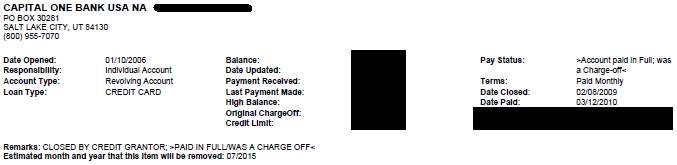
There are five (5) charge-offs on my credit report, and one debt buyer listed that bought one of the charge-offs. All are paid off — the last one was paid off in 2013. Experian reports them as paid very plainly. They still report them as charge offs, but they report them as paid.

Experian - paid in full Experian - settlement

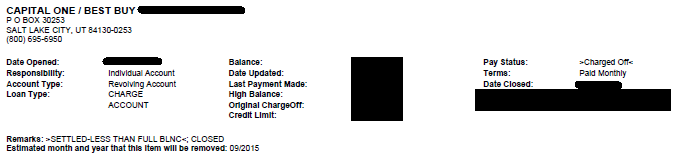
TransUnion doesn’t make it so clear. Well they do for the accounts paid in full, but not for the settled accounts.

TransUnion - paid in full TransUnion - settled

The second account listed, the one that was settled for less than full balance, shows a “pay status” of “Charged Off”.

And unless the person pulling the credit report pays attention to the remarks that TransUnion includes with the credit entries — provided TransUnion provided those remarks and the company pulling the report forwarded them — then things look worse than they actually are. The Oakbrook manager kept saying “That’s not what I have on our side” when referring to my assertions that the accounts were paid. The TransUnion report shows in the remarks “PAID IN FULL” where the balance was paid in full, and “SETTLED” where the account was settled. And in the case of the repossession doesn’t have any remark showing the balance is paid off — I’m not planning to correct that, though, and I’ll explain why in a moment.

And if those remarks were with the information that RealID provided to Oakbrook, then the manager was lying to me when he said I’d be approved if I got statements from the creditors showing the charged-off accounts were paid, as he already had the information in front of him showing the accounts were paid or settled.

So TransUnion makes my credit look worse than it actually is. And the Oakbrook manager would not look at the copy of my Experian credit report I had with me when I tried to talk to him. And I’m sure even if I had my TransUnion report with me (I debated on taking it as well but didn’t), it likely still would’ve been ignored: “That’s not what I have on our side”. I don’t know what information they had, and they wouldn’t provide specifics, not to me directly and not in the rejection letter. I really wish he did instead of constantly being so cryptic.

Here’s what makes this all the more disheartening.

Four (4) of the charge offs, including the debt buyer, are estimated to fall off my credit report in July, as in less than two months from when I write this. The other two, one of which is the repossession, fall off in September. Had our lease been expiring later this year instead of at the end of July, my credit report would’ve looked almost as clean as my credit actually is.

Had RealID pulled Experian instead of TransUnion, or the manager considered my Experian report when I brought it in, I probably wouldn’t even be writing this article. Instead I’ve got a money order for the security deposit I need to try to get refunded, and we’re going to be signing another lease at our current apartment complex.

Flat ears, wide eyes

I need to find a picture or GIF of a child frightened beyond tears for whenever someone posts pictures of a cat or kitten that is obviously frightened and stressed while calling it “cute” and saying “aww, ain’t this adorable”.

A frightened animal isn’t cute, and every time I see something like that on Facebook or another site, I automatically think that either 1. the person has no clue about feline emotions and how to read them, or 2. the person posting it is a sadistic jackass.

For those of you who fall into category no. 1, a cat with wide eyes and flattened ears is either 1. about to attack a threat or 2. frightened and trying to flatten down.

Perked ears is a sign the cat is stalking and about to pounce — play involving a toy or laser pointer brings this out quite readily. Flat ears means the cat feels threatened or angry, and will probably respond aggressively if the threat gets too close — if the cat is doing this in response to you, that is your indicator to back down. What you might think is cute is actually a warning.

If the cat is not moving, or, worse, is visibly shaking and/or has stopped purring, the animal is frightened or stressed, but still may respond violently to any contact. Kittens will be more likely to respond to a potential threat by flattening down since they really aren’t capable of fighting back — they rely on their mother for their defense.

And those who post pictures of cats or kittens in such postures are either sadistic — since they are frightening a kitten or adult cat for a “cute” picture — or need a lesson in feline body language.

Due process and the Second Amendment

In his FAQ on violence, question 15, Sam Harris said:

It now seems to me that there are two ways of approaching this [discussion about guns and gun rights] that may, in fact, be irreconcilable.  The first is to consider the ethical and practical case for guns as a means of self-defense… The second approach is to consider society as a whole, emphasizing the statistics on gun violence.

It is a sentiment I have seen myself time and time again. And I am convinced it is more accurate to say that those against the rights of individuals to own and carry a firearm — colloquially called “anti-gunners” — are actually against individual rights in their entirety. This isn’t to say they are against the idea of rights. What they are against is the individual assertion of rights, that rights are instead to be owned and asserted by a collective, not individuals.

They have no problem with (certain) groups of people having firearms — typically only the police and military. They do have a problem with individuals having firearms.

Recently this sentiment came back to me through a YouTube comment section in which another person was arguing for greater restrictions on firearms using the very common assertions we’ve seen time and time and time and time and time and time and time and time and time…. again. Things like “We just want to make it harder for those intending to do harm to obtain a firearm” and the like.

What’s somewhat unusual is this sentiment: “And with that said, I would gladly give up my ‘right to bare [sic] arms’ if it ment [sic] fewer people to hold me at gun point.” This was at the tail end of a response to me when I said, essentially, that a newer interpretation of the Bill of Rights does not make it de facto wrong, as many anti-gunners argue in light of the fact that the Second Amendment being interpreted to allow for an individual right to bear arms only came about in recent vintage.

But why would you not want to make it harder on that person who will kill? It’s unrealistic to say you can save the world, but if keeping a gun out of the hands of someone who will kill less without one is possible, I am for it.

What this person is again not understanding, or is refusing to understand, is that you cannot restrict firearms to keep them out of the hands of those intending to do harm without removing them first from those who want or need them for self defense. This is why I have said that gun control punishes the innocent more than it protects them. This is why I have said time and again that legislation cannot protect people, especially when you take into consideration the fact that you are not entitled to police protection.

This means that, as the vast majority of people are law-abiding, meaning they won’t circumvent the law to obtain a firearm, gun control leaves those who need a firearm for protection at a complete disadvantage.

Don’t get me wrong, I would certainly like to see it made more difficult for those intending to commit violence. But there are other rights coming into play here. How do you identify those people and take away their right to a firearm without also violating their right to due process? How can you make it more difficult for those intending to commit violence without also making it more difficult on those with a need or desire to defend themselves? In both questions, the answer is quite simple: you cannot.

Due process comes into play here quite well, something few seem to consider. And the fact that, in law, many anti-gunners wish to treat me the same as James Holmes or Adam Lanza is not only categorically unfair, but downright disgusting.

My opponent’s response to this sentiment was quite telling:

I am being realistic. I carry a knife on me at all times, and I can buy a bat for 25 bucks if I need to. In a world where guns have more restrictions, you no longer need to have one for protection. A world with more restrictions on firearms is not an unrealistic one. I am really tired with all this focus on your own freedoms. I am more worried about the safety of the wider population. It’s harder to kill with melee weapons. Period. Even for self defense. Just because you can kill someone in self defense, doesn’t mean you should. Even a scum bag thief has the right to live and be judged in a court of law for their crimes.

First, criminals and outlaws by definition do not obey the law. Restrictions only apply to those willing to obey them until law enforcement can identify and prosecute those who are not obeying the law. And a baseball bat is not a good choice for a defensive weapon. It can be good as a threat, but not as an actual means of defense. Swing from the shoulders and you’ll be clumsy. Swing from the elbow and you won’t have nearly as much force behind it, making it easier to dodge, block, or catch.

But the sentiment that really pissed me off: “I am really tired with all this focus on your own freedoms.”

Tough. Fucking. Shit.

There is one major reason I so adamantly defend individual rights: I must defend them for others to maintain them for myself. There is no way around that, something I have made quite clear. The example I provided to my opponent is similar to what I say to everyone who, in the context of Holmes or Tsarnaev, says the equivalent of “just take ’em out back and shoot ’em and be done with it”:

After all since you’re clearly not worried about my individual rights, you won’t mind being locked up for endless periods of time without trial and without charges being filed. After all the police took you into custody, so they’re certain that you committed the crime, so I’ll believe them so we don’t need to worry about a trial. We’ll just lock you in jail.

What’s that? You have a right to a trial? Well the right to a trial is an individual right. And you don’t seem to care about individual rights, so… Tough. Fucking. Shit.

Our rights are intertwined. Many have said that the Second Amendment is what defends all other Amendments — i.e. the individual right to bear arms is necessary to defending all other rights. This is true only to the extent that our rights are subject to violent threat. Few assert their rights when they’re not being attacked — whether by government or external threats.

At the same time, the right of due process means simply that you cannot be stripped of your liberties without first being adjudicated in a Court. The Sixth Amendment means you have the right to have those accusations heard in a Court while heavily implying a right to be presumed innocent. This means that you cannot lose your right to keep and bear arms without first having been convicted of a felony (pleading guilty or nolo contendre is the legal equivalent of a conviction, as is a dishonorable discharge from the Armed Forces). You can also lose your right to bear arms if you’ve been adjudicated by, quoting ATF form 4473, question 11f, “a court, board, commission, or other lawful authority that you are a danger to yourself or to others or are incompetent to manage your own affairs”.

Yet many, again, seem willing to just abrogate due process. They say that we need to severely restrict firearms to protect us from the “next James Holmes”, which, as I’ve asserted before (here, here, and here), has the effect of punishing the innocent.

So to lay the gauntlet, I’ll put out this question: if you’re unwilling to defend my Second Amendment rights, why should I defend your First, Third, Fourth, Fifth, Sixth, Seventh, Eighth, Ninth, Thirteenth, Fourteenth, Fifteenth, Sixteenth, Nineteenth, Twenty-Fourth, and Twenty-Sixth Amendment rights?

Anne Wheaton, you’re an idiot

Anne Wheaton, wife of famous Star Trek alum Wil Wheaton, recently announced that for every hateful tweet coming from “Gamergate”, she’d donate $1 to Feminist Frequency. (Archived version here since it appears she deleted it)

Others soon joined in on it, agreeing to match or multiply what is donated. A phrase comes to mind: A fool and his money are soon parted. Though in this case, it’d be a fool and her money are soon parted.

If you could reduce your opponent’s cash by $1 by merely typing 140 characters or less, how many tweets would you write? Apparently Wheaton found out the hard way as she had to cap her donation at $1,000. That ended quickly. On Facebook, Wil made the comment that Anne is a “BOSS!” Sorry Wil, but if she commits to parting ways with her own cash over hateful tweets, she’s an idiot.

Parting with your own money every time your detractors send a hateful tweet? Yeah that’s really showing your detractors who’s boss. But The Mary Sue was implying that they had somehow tricked “Gamergate” into donating money, as if those within “Gamergate” were the ones actually donating money, not Anne. Talk about misleading all around.

The reason she had to cap her donation is quite simple: her detractors would’ve forced her to drain her bank account keeping her promise. I’ve said before: if you sacrifice your livelihood to make a point, you lose your livelihood but don’t make your point. Anne Wheaton’s willingness to part with her money every time her detractors sent her a nasty tweet was a recipe for disaster. They wouldn’t have cared that the money went to Anita Sarkeesian. They would’ve seen it as a quick way to show Anne Wheaton how stupid she is being.

Let’s put it this way: if she had instead said “For every rape threat Gamergate sends me, I’ll donate $1 to a rape prevention charity”, she would be flooded with rape threats — from both her supporters (through sock-puppet accounts) and her detractors (likely also through sock-puppet accounts). The same would have been if Anita Sarkeesian had tweeted that she’d donate $1 to a domestic violence shelter for every rape and death threat she received through Twitter from “Gamergate”. You would’ve had “Gamergate” detractors making sock-puppet accounts in droves to flood them with threats — virtually none of which would be taken seriously — in order to get more money flowing toward charities they support while making “Gamergate” look worst in the process.

As such, it makes me wonder how many of the nasty tweets, now possibly falsely attributed to “Gamergate”, actually came from her supporters, knowing that another dollar was going to Anita Sarkeesian, “Gamergate” was going to look a little worse, and all it took was a few keystrokes, meaning no actual effort or financial loss on their part. Now “Gamergate” detractors can say “Look at all these nasty tweets Gamergate sent to Anne Wheaton”.

Now let’s not rule out the possibility that nasty tweets did also come from “Gamergate” supporters (possibly also through sock-puppet accounts), simply because they’d know that those tweets would cause Anne to commit to parting with another dollar for each one. An organized campaign could’ve caused her to commit to donating her annual income in a matter of hours.

I wonder how quickly someone managed to alert her to that possibility, since it took her only 5 minutes from commitment to cap. Lesson learned. Hopefully.

Hopefully next time anyone thinking of trying this will put a little more thought into this. I’m guessing her decision was spur of the moment with few actually putting any critical thinking skills behind the idea to see if it was a good idea. I think she learned it isn’t.

Rack mount server – another followup

Build Log:

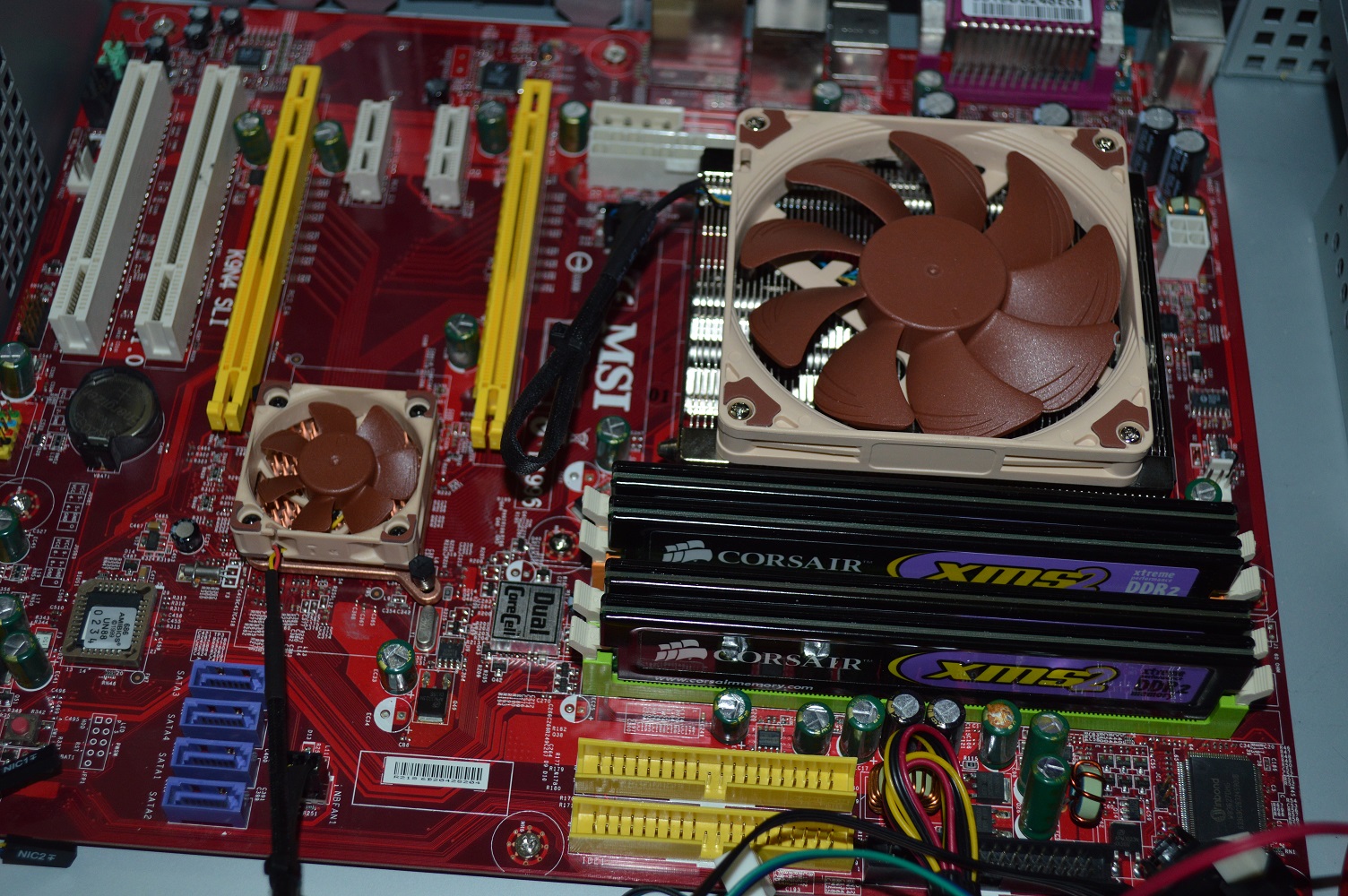
So where I last left things, I said that I had ordered a replacement northbridge cooler for the mainboard. I replaced the 40mm fan that came with that northbridge cooler with a Noctua 40mm fan as well to help things get a little more quiet.

Along with that, we had device upgrades at work — basically trading in my older laptop to get a new one. The one I had was a Lenovo W520, which is a great laptop. And one thing I both liked and hated was its 128GB SSD. Liked it because of its speed (initially), but hated its capacity — when you’re an engineer, storage is your friend.

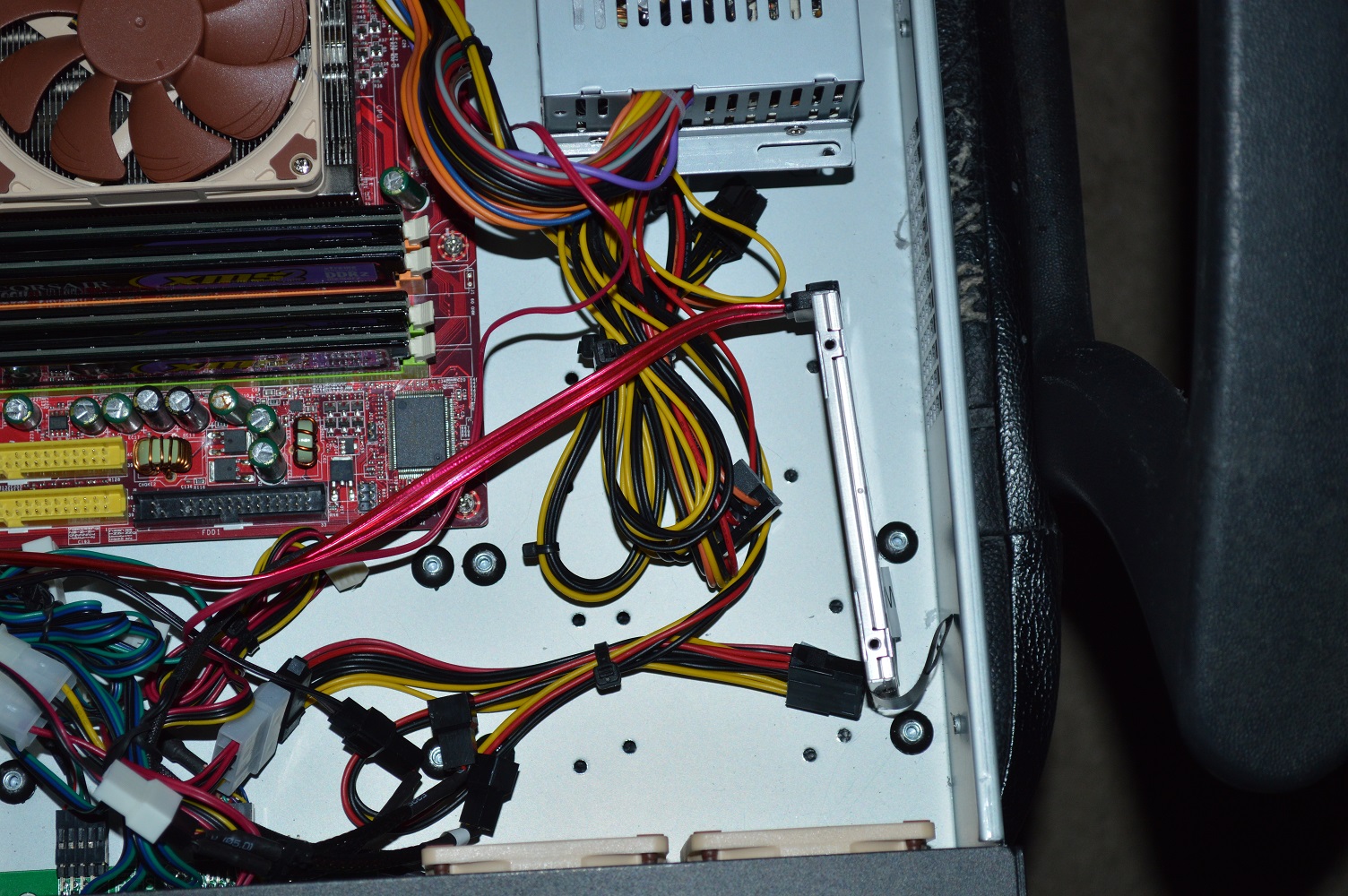
But I was given the option of purchasing my old laptop, and I did. First order of business with it after getting everything configured and updated was to swap out the SSD for a 1TB HDD. It boots slower as a result, but I wanted the storage space. I took the SSD and moved it into the server since it’s smaller than the 3½” HDD that was in there previously while having double the storage space. Storage isn’t as huge a deal with this system, but the SSD just freed up a ton of space in front of the two 60mm fans, allowing for much better airflow onto the power supply.

DSC_0010

And if it weren’t for the PSU fan, the server would probably be dead silent. Perhaps I’ll remedy that later. For now it’ll have to do. It was all the other noise that I alleviated that absolutely had to go, since all of that in concert was too much to bear. But at least the fans on the mainboard match.

DSC_0009

Follow-up (May 21, 2015): I replaced the power supply with the Seasonic SS-250SU. The power supply was advertised as having a 25 dB/A fan, meaning it would be quiet — and it’s supposed to also have a zero-RPM mode. After replacing the PSU, the first boot on the server was barely audible with the Noctua and Enermax fans plus the PSU. Pulling up Prime95 to get some kind of heavy load on the CPU still didn’t cause the PSU to get any noisy.

As I write this I’m sitting a few feet away from the server with it running and can barely hear it over the fans on β Ori. and Absinthe.

It’s not about your daughter’s shoulders

A recent blog article is getting a bit of press by yet another person who is declaring that dress codes are… misogynist with a lovely article titled “The Apparently Immoral Shoulders of my Five Year-Old“. Take it away Mr Rouner…

Last Monday morning was a little colder than I expected, so I made sure that there was a warm change of clothes in my daughter’s backpack in case she wanted to change. She’d had her heart set on wearing her rainbow sun dress since the weather warmed up so I finally acquiesced and let her. Still it wasn’t too surprising to me to see her walk out of school that afternoon with her T-shirt on over the dress and her jeans on under it.

Okay, so at first it wasn’t surprising to see her wearing a T-shirt — albeit the how on that is a little odd. But when your daughter says the reason is that the dress she did wear was against the rules, this is what you wrote:

I’m not surprised to see the dress code shaming come into my house. I have after all been sadly waiting for it since the ultrasound tech said, “It’s a girl.” I didn’t think, though that it would make an appearance when she was five years old.

Here is the dress code from the student handbook you linked in your article (page HB-37):

Students are not to wear clothing that is tight, loose, sagging, baggy, revealing, spaghetti-strap, backless, low cut or short.

Dresses – must not reveal underclothing, midsection, torso, back, chest, breasts, or cleavage and must be mid-thigh in length or longer

So the dress is clearly in violation of the dress code. So what’s the complaint about?

Have you ever stopped to think how weird a school dress code really is? I went and checked out the one for my daughter’s school district and it’s amazing in how hard it tries not to say what it actually means. There are literally no male-specific guidelines anywhere on that list. I mean prohibitions against exposing the chest or torso could hypothetically apply to boys except that they don’t. Not really. They don’t sell boys clothes that do that. There’s nothing that is marketed to boys that is in anyway comparable to a skirt or a sun dress. Essentially, a school dress code exists to prevent girls from displaying too much of their bodies because reasons.

So basically he is alleging that there is nothing that boys can wear “normally” that would violate the dress code for the district. And if he is actually going to stick to that claim, he’s extremely short sighted since there is something rather common for boys and men to wear that would violate this dress code without a problem: a tank top!

The dress code frowns on sandals as well, preferring closed-toe or tennis shoes. Send a kid to school wearing sandals showing advanced foot fungus and they’ll likely have him change — and yes I meant to say “him” since boys do actually contract foot fungus more than girls. Pants must be “fitted at the waist or upper hip and must not reveal underclothing”. Gee, I wonder who typically wears pants in a fashion that deviates from this? It certainly isn’t girls. Head coverings aren’t allowed as well — again something worn more by men and boys than women. And all students “must wear appropriate underclothing”. It ain’t only girls who like to go commando — though that would also apply to bras for women.

And when thinking of gang members, who typically comes to mind? I’m going to guess men. In particular, black men. So dress code provisions that prohibit gang-related paraphernalia will apply virtually exclusively to men. Sure women can be gang members as well, but they are certainly a small minority, outnumbered by as much as 9 to 1.

In actuality, what I wear to work would actually violate the dress code. I wear a collared shirt with a t-shirt underneath. Technically the t-shirt is “underclothing”, so if I wear a crew-neck t-shirt and don’t have the collared shirt buttoned up entirely to hide the t-shirt, I’m technically in violation of the dress code. A V-neck t-shirt with an unbuttoned collar shirt would also violate the dress code. But given how common that attire is in business and professional settings, they’d likely let both slide.

But you then go from calling all dress codes sexist to the dress code, in not allowing certain forms of dress, implying your daughter’s dress came from a sex shop:

I didn’t pick up my daughter’s dress at My First Stripperwear. It’s not repurposed fetish gear from a store for very short people. It’s a dress from a mall chain store in her size.

chan

You know what really grills my cheese about it? It’s not even the shirt they made her put on over her top, it’s the pants they made her wear underneath. It’s a full-length dress that she has to hold up to keep from getting wet in uncut grass. She even had a small set of shorts underneath because it was gym day. But because the top part of her dress apparently exposed the immoral sinfulness of her bare shoulders she also had to pull on jeans even though her legs remained completely covered as part of her punishment.

Perhaps she forgot to mention she had shorts on under the dress, or perhaps they never asked her about it. To think that school professionals are trying to sexually shame a 5 year-old is beyond absurd, Mr Rouner. You’ve completely lost it by that point in your article. Plain and simple the onus is on you to know the dress code (as the student handbook states), just as the onus is also on you to know the dress code for where you work.

This is still going in 2015. It really is. We still live in a country where someone can decide the shoulders of, and I can’t stress this enough, a five-year-old girl are so distracting that they must be sent away and decently hidden. God knows what could possibly happen to her if not.

No. Those were rules that were established as a base standard over the entirety of the school district. Get over yourself! They’re not trying to shame your daughter. They’re not trying to say that her shoulders are “immoral”. Their dress code specifically says no spaghetti straps, so rather than creating exclusions for certain age groups or grade levels, they just apply it to the entirety of the district. That’s typically how these things work, and it’s how they worked when you and I were in school.

But given the lengths to which you’ve gone in your article, sir, the fact you’re implying they are trying to sexually shame a prepubescent girl… Give me a fucking break.

So hey, go ahead and act like an annoying brat of a child if they try to turn your daughter away again. I’d love to read about how many nights you spend in jail for it — particularly if you also show up in a dress. You’d really be setting a lovely example for your child. Actually you already are, by basically teaching her that dress codes are sexist, so she doesn’t have to abide by them.

Beta Orionis – Part XVIII: New power supply and quieting things down

Build Log:

The new power supply is installed and so far has been running steady without any problems. The only minor concern about the EVGA power supply is its PCI-E power connectors in that they include only two 6+2pin PCI-E cables instead of four, and I would also prefer the single-connector cables be full 8-pin connectors as well instead the 6+2pin. Getting that, however, appears to require going completely custom, whether I do it myself or pay someone else to do them.

Given the direction graphics cards are going, however, and the reputation EVGA has among enthusiast builders, it’s something they should consider doing. Continue including the 2×6+2pin PCI-E cables, which I currently have connected to my graphics cards, but also include 8-pin PCI-E cables with a single connector and 6-pin PCI-E cables with a single connector.

At the least, make them a purchase option so I don’t have to buy complete cable kits to get what I want. Currently it appears I’d have to do just that or go completely custom — and currently Ensourced appears to be the only place through which I can order the custom cables I want, to the tune of about $36 per pair, provided the G2 cables work with the GS power supplies.

So now it’s a matter of figuring out what to do with the AX860.

* * * * *

In building out the HDD enclosure project, I used an NZXT Grid to control the fans. To make the fans virtually inaudible, I modified the 4-pin Molex to 3-pin female connector to be a 7V step-down, making the fans virtually silent.

Liking the result, I decided to try something like this for Beta Orionis.

It made the system virtually inaudible, but I wasn’t comfortable with the temperatures. The CPU temperature climbed over 70C running Prime95 on small FFT, and the copper tubing was becoming very noticeably warm to the touch, telling me the coolant temperature was easily in the upper 40s — note the pump has a maximum rated temperature of 60C. Interestingly the GPU temperatures didn’t go up all that much compared to running the fans at stock voltage while running a Bitcoin miner in benchmark mode.

So a higher voltage was needed. 7V would be great for the system at idle, but not under load, but 12V is loud when you’ve got a lot of fans — you know, like having 9 of them in my system (and I know of those who have still more). My thoughts settled on 9V, which should undervolt them enough to keep the system quiet but also cool enough under a decent load. An initial test on that was a 9V battery, or it would’ve been if a 9V battery could supply the proper current (~1.2A for all of the fans) — but even if it could supply the current, it would discharge so quickly that I wouldn’t be able to adequately test things.

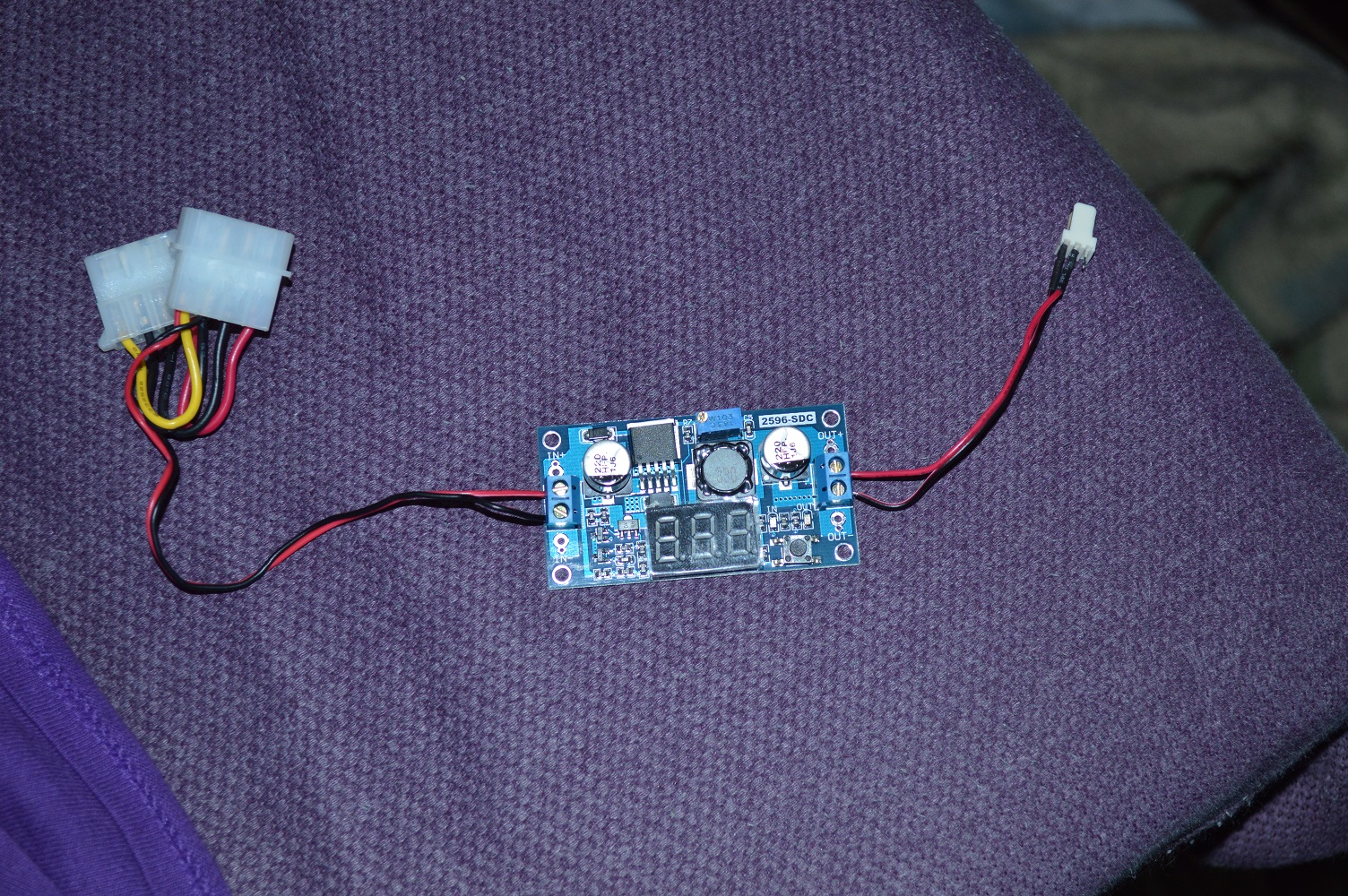
So instead I would have to order a voltage regulator. I bought this one by DROK to test various voltages to find the ideal voltage that would give quiet fans but still good cooling before ordering a static voltage regulator for a 12V input and the proper voltage output.

Now I can already hear this question: why not just use a fan controller? I considered it. Fan controllers, though, come in two varieties: you either have to manually change the fan speed, or program it to automatically change it. I didn’t want to do either, so I went for some kind of middle ground. I still have the Phobya fan controller that was originally in my wife’s build. On the front of automatic controllers, I looked at the Aquacomputer poweradjust 3 Ultra, and I still might ultimately end up buying one since it can be used with a temperature sensor — such as a coolant temperature sensor.

I might look at creating something from an Arduino or equivalent if I decide to go that direction — I’ve considered it in the past. With fans that aren’t PWM, voltage regulation is still needed to control the speed.

But for now, I wanted something inexpensive that would allow for a silent running that would still keep temperatures reasonably under control. And an inline voltage regulator was the best way to do this, once I found the right voltage that would give me a good balance, and it’s something I don’t have to muck with after it’s installed.

Now testing things was pretty straightforward. I took a spare fan adapter (4-pin Molex to 3-pin) and modded it to cut off the 3-pin part, split the wires apart and stripped the ends. With the voltage regulator between the PSU and the fans, the voltage is tuned using a small flathead screwdriver. For the first test, I took the fans to my intended target voltage of 9V and opened up Prime95 with HWMonitor running alongside to watch the temperatures. I also backed off my overclock as for some reason Prime95 was giving errors trying to run initially.

During the testing the ambient temperature was about 25C.

As expected, 9V kept the system quiet — the hard drive was louder than the fans. And the temperatures while running Prime95 climbed up to the 50s relatively quickly, but once it hit 55C the climb slowed down, hovering at each one above that for at least a minute. When the temperature hit 56C, I decided to drop the voltage to 8V. Now the system was virtually inaudible. It reached 59C (138F) at about 8 minutes into the Prime95 test and held at that temperature for about 5 minutes more before poking to 60F and then going back and forth between the two.

To throw more heat into the coolant, at about 15 minutes into the Prime95 test, I pulled up a Bitcoin miner and ran it alongside Prime95. The GPU temperatures soared into the mid 40s fairly quickly while the CPU temperature stayed at 60C. The extra heat caused the CPU to start climbing toward the mid 60s while the GPUs held at around 50C. At about 18 minutes into Prime95, the CPU reached 65C while the GPUs sat at 52C. I turned the fans back up to 9V.

The temperature on the CPU topped out at 67F after 20 minutes of Prime95 combined with about 8 minutes of the Bitcoin miner before I stopped Prime95. The copper tubing had started to become noticeably warm to the touch. The CPU dropped down to 53C and held.

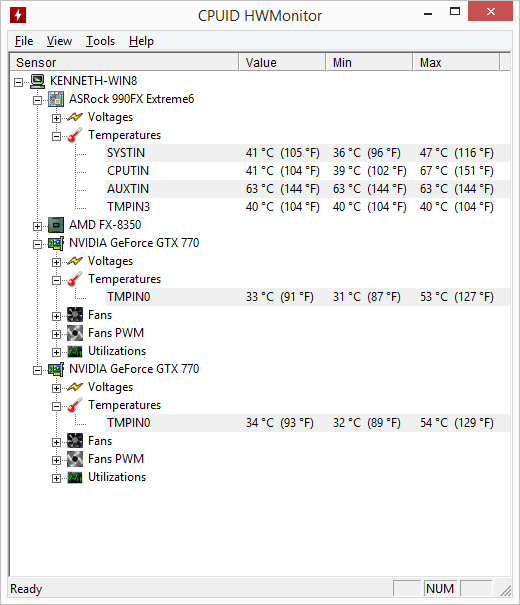
9V fan speed running Prime95 and BFGminer

I stopped the Bitcoin miner after 10 minutes and let the system cool down, turning the fans all the way up to bring the temperatures down a little quicker — the regulator has a max output voltage of 11V. When the CPU bottomed out at around 40C, I dropped the voltage back down to 8V, reset the temperatures in HWMonitor, and fired up F.E.A.R. Online while waiting for Bioshock Infinite to download and install.

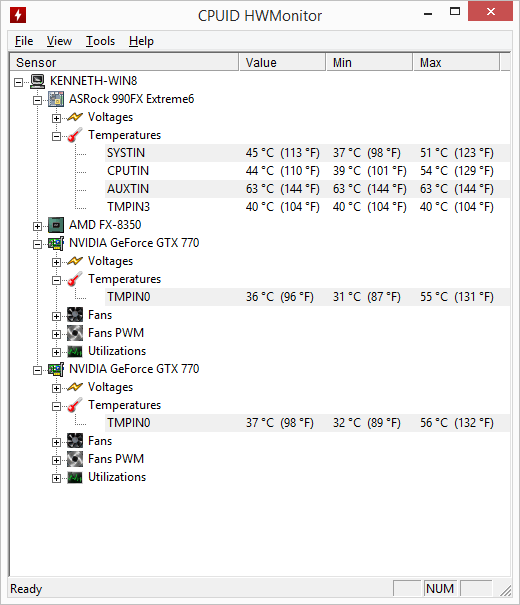
The CPU topped out at 45C during F.E.A.R. Online — the game isn’t SLI enabled, so only one of the graphics cards saw a temperature increase to 44C. In Bioshock Infinite, after about 30 minutes, the CPU temperature topped out around 54C. I turned the fans backup to 9V during the play as well.

9V after Bioshock Infinite

So that’s pretty good given how quiet the system is now running, so I think I’ll lock the fan voltage at 9V. And I’ll be doing a similar experiment on my wife’s machine, Absinthe. But in the mean time, I’ll be doing some more temperature monitoring with the fans set at 9V, possibly 8V, to make sure this is how I want to leave things.