Several United States Senators recently introduced the “Adoption Tax Credit Refundability Act”, which aims to make the entirety of a family’s adoption expenses refundable via a tax credit. Now why is this relevant?
The maximum amount you can claim for an adoption tax credit, in addition to any other tax credits, is limited to your tax liability. The remainder, however, can be carried forward for up to five (5) years. See IRS Topic No. 607 for details. By changing the tax credit so it is refundable, you can claim all adoption expenses in the calendar year in which they occurred.
Absolutely this is a good thing. I applaud this bill and hope it goes through, as it’ll make the tax credit easier to claim.
But let’s not lie to ourselves about it either.
There is an oft-repeated notion that tax credits and deductions make something more affordable. And Senator Blunt’s press release perpetuates that fallacy with its headline: “Blunt, Casey, Inhofe Introduce Bill to Make Adoption More Affordable for Families”. And also with this statement from the press release’s first paragram: “Making the tax credit fully refundable will ensure that more families can benefit from this critical support.”
Again this perpetuates the oft-repeated fallacy that tax credits (and deductions) aid affordability. They don’t. On Facebook I made this analogy: “This is about like a friend saying they’ll help you buy a car by reimbursing part of what you paid up front several months later.” And back in 2013 I wrote an article about several tax breaks in which I pointed out the catch-22:
Taxes are always going to be a financial catch-22, because reducing your tax burden almost always requires you taking on a major expense or reducing your take-home pay – i.e. the only realistic and legal means of reducing your tax burden involves you giving up money.
Adopting or giving birth to a child comes with plenty of tax benefits. You can adjust your W-4 withholding following the adoption or birth, reducing how much money comes out of your paycheck for Federal and State taxes. You may even be able to adjust your Federal W-4 withholding to declare yourself exempt from Federal income taxes (as opposed to FICA taxes) for the rest of the calendar year, depending on how much you had to pay out. I wonder how many who adopt actually consider doing this. Make sure to read through the IRS publications and do the math with your paystubs before you actually do this, though, to make sure you can actually do that.
Plus you get to claim the child as a dependent for the whole year even if the adoption was only finalized in December. Marriage works the same way, something that worked very well to mine and my wife’s advantage (read: big tax refund!) when we married in December 2011.
But the tax benefits only occur after you’ve shelled out who-knows-how-much money to adopt the child, meaning they do not and cannot make the process more affordable. Again, it is analogous to a friend or family member saying they’ll help you out by reimbursing part of your out-of-pocket expenses after you’ve already incurred them.
If our representatives really wanted to make adoption more affordable, they would find ways of addressing the up-front cost rather than acting like a tax credit you can only get after the adoption is finalized is somehow making it more affordable.
Which one way to make it more affordable is allowing the IRS to loan money to taxpayers to cover qualifying adoption expenses that can be repaid with the fully-refundable adoption tax credit. That addresses the up-front cost while still providing for the offset in tax liability the credit already provides. The taxpayer gets all of the benefit of the tax credit without having to wait months or even a year or more (depending on when the adoption is finalized) to claim the tax credit and receive the commensurate tax refund.
Over at the New York Post, Sara Stewart penned an article about the classic movie Forrest Gump that shows she did not understand the movie. She basically went into watching it with a very clouded lens, and interpreted it completely from a modern, SJW-ish context. And she must also be completely unaware the movie is based on a book of the same name.
For starters, its protagonist is the worst. Not because he’s mentally challenged in some never-defined way (although this type of role is one of the most cloying members of the Oscar Bait family), but because he’s a relentless narcissist.
I’m guessing you’ve never been around many, if any, people with autism.
In the book it’s made clear that Forrest is an “idiot savant”, meaning he’s also likely autistic. And one feature of autism is narcissism. So much so that narcissistic personality disorder and autism can actually be confused for each other.
My brother is autistic (Asperger’s specifically). And back over 20 years ago I worked in fast food with a man who was also on the spectrum – and he didn’t need to tell me for me to see it. And some characteristics of how an autist’s brain functions could be seen as “annoying” to others, such as engaging in seemingly pointless conversation. Or in the case of Forrest Gump, broadcasting his life story from a bench at a bus stop to anyone who would listen.
His first victim, a black woman who is very clearly not interested, keeps attempting to bury herself in her magazine while Forrest tries to remember his first pair of shoes. Out loud.
The poor lady’s side-eye is all the more understandable when he tells her the origins of his name: His ancestor is Nathan Bedford Forrest, Confederate army general and a founder of — I’m not making this up — the Ku Klux Klan. “The Forrest part was to remind me that, well, sometimes we all do things that don’t make no sense.”
No shit you’re not making that up. At the same time, I need to question the quality of your history education. Nathan Bedford Forrest (right) was a real man, a Lt. General in the Confederate Army. But he wasn’t one of the KKK’s founders. The first KKK was a small, fledgling group that he came upon one night and decided to join.
He would later become its first real leader (“Grand Wizard”), giving people the impression he founded the organization. That’s one detail where the movie fumbles.
Yes, Forrest Gump’s mother (Oscar winner Sally Field, no less) explains away the KKK by saying everybody just does random stuff sometimes. She might as well have said there were good people on both sides.
And of course, no discussion of white supremacy would be complete without a dig at the President.
Gump’s mother said the name was to remind him that “sometimes we all do things that don’t make no sense”. That’s not dismissive of the Klan, nor does it mean “everybody just does random stuff sometimes”. It speaks to the senseless acts of violence the Klan would become known for under Forrest’s leadership for the short time he led the group.
Though the violence against blacks in the South didn’t start with the Klan and didn’t stop when the Klan was successfully suppressed by Federal law enforcement in 1871, the Klan gave a name to which people could readily attach and associate the senseless acts of violence against blacks.
After its suppression, members of the Klan and sympathizers formed similar paramilitary groups under different names in the South. You can read about the Klan’s history on its Wikipedia page.
Forrest’s mama also gives him weirdly misleading advice. “Vacation is when you go somewhere and don’t ever come back,” she tells him at one point. Again, what?
That isn’t advice. And you completely forgot the context of that quote. Given the rest of your article, I’m starting to question whether you actually watched the movie.
Here’s the context. Earlier in the movie, Forrest’s mother is sitting in the principal’s office when the principal asks “Is there a Mr. Gump, Mrs. Gump?” In other words, where is his father? And she replies “He’s on vacation.”
When she’s reading Forrest a book at the end of the night, Forrest asks “What’s vacation mean?”, indicating that he’d overheard them. Needing to give some kind of answer, she says “Vacation’s when you go somewhere, and you don’t ever come back.”
But your misrepresentation of the movie doesn’t end there.
But Hal Ashby’s movie [“Being There”] was a brutal political and cultural satire; Zemeckis’ is an all-out, red, white and blue celebration of ignorance, making the argument that there’s more virtue to be found in following orders, being generally incurious and spouting aphorisms than in being politically active or ambitious in any way or, God forbid, adventurous (especially sexually).
Wow… talk about a very inaccurate derivation of the entire movie.
Because let’s talk about Forrest’s ostensible love interest, Jenny (Robin Wright, another great performer saddled with a misogynist dud of a role). The childhood friends are “like peas and carrots” (does anyone over the age of 5 actually like this culinary combo?), but once they’re adults, she goes on to try her hand at being a singer and a Vietnam War protester, both of which she’s punished for. The former sees her playing naked at a strip club, the latter, having a pinko boyfriend who hits her.
And you’re drastically overlooking one key aspect of Jenny’s life that in part explains the direction she goes. Again, did you actually watch the movie?
Jenny had an abusive and controlling father. And she often sought refuge in Forrest’s home at night so she could sleep peacefully. Sure she ends up bouncing between assholes in her teenage and adult years and not having that great of a life. In large part because she didn’t have that great of a start.
For all of Forrest’s faults, and being in a fatherless household, he at least had a somewhat stable upbringing. Jenny, most certainly, did not.
Later in life, she becomes… experimental. LSD. Cocaine. One scene shows her sniffing some lines of coke and then, after looking at herself in a mirror, stepping out onto a balcony and nearly falling over to the busy street below.
She eventually comes crawling back to her hometown in Alabama, and when Forrest takes her in, she has pity sex with him after being told he’s “not a smart man, but I know what love is.”
Re-watch this scene and feel all the icky chills as Jenny rather unenthusiastically strips off her nightgown to sleep with a man whose emotional intelligence still appears to be around age 10.
She doesn’t exactly come crawling back to where they grew up. Jenny returned to Alabama as part of wanting to clean up her life. She’d hit rock bottom, nearly committing suicide while in a cocaine-induced high, and wanted to, basically, start over. Throughout her life, Forrest was more-or-less a known stable point. During her youth, she could rely on Forrest as a retreat from her father, so she knew she would be able to rely on him as a starting-over point.
It’s during that stay that Forrest works up the courage to propose marriage to her. His mother is gone, his father was completely absent from his life, provided he was even alive. Aside from Lt Dan, Jenny was the only living connection he really had. And it’s during that proposal that Forrest says that line: “I’m not a smart man, but I know what love is.”
I wouldn’t exactly call it “pity sex” either. And given the nightgown Jenny was wearing and how she took it off, I’d like to see you try to do that “enthusiastically”.
For good measure, she gets pregnant, doesn’t tell Forrest about it until their son (a tiny Haley Joel Osment) is several years old and then conveniently dies of AIDS.
Conveniently dies of AIDS? That’s a rather… cold and incomplete way of describing it. For one, THEY GOT MARRIED! A bit of time passes between when Forrest meets his son and Jenny dies. They appeared to live a somewhat happy life, about as normal as possible, until she succumbed to her illness.
At the same time, Jenny didn’t tell Forrest she was pregnant to protect him, not even wanting to seek out child support from him, even though that would have more than guaranteed a very comfortable living given Forrest’s wealth. And we see that Jenny made the right decision given how Forrest reacts upon learning he’s a father. That scene, along with the night Forrest proposed to Jenny, also showed that Forrest understood his mental limitations in asking whether his son is smart, or like him.
The film’s treatment of race, following Forrest’s name origin, isn’t any better. In one of many brushes with history, Forrest is there when Alabama Gov. George Wallace rails against integrating schools. When a redneck hisses at Forrest that they want to let “coons” into their schools, his initial response is, “When raccoons try to get onto our back porch, Mama just chases ’em off with a broom.” Hilarious!
Okay this reduction pisses me off royally. Here’s the full scene in question:
Forrest asked one of the students standing nearby what was going on. He misinterpreted what was said, “Coons are tryin’ to get into school,” as raccoons trying to get into the school building. Raccoons are commonly called “coons” in rural areas, still are even today, and they’re known for trying to get into houses and farm buildings.
He also couldn’t at first see what was going on, so until the student clarified he was referring to the black students, “Not raccoons, you idiot, n*****s,” he didn’t know what the student was referring to. And likely still didn’t even after that given what happens next: when one of the black students drops a book, Forrest runs up to pick up the book and hands it back to the student.
Talk about a blatant misrepresentation of that scene, Sara! It sounds like you’re trying to treat Forrest as a white supremacist or old-fashioned southern racist when the movie clearly shows he was not.
At the same time, the movie’s treatment of race went on how race was largely treated in the United States during the depicted eras. Something you seem to casually forget. Again, what was the quality of your history education?
He blithely goes through his war buddy Bubba’s family history of slavery with a montage of black women serving shrimp to white men. And when he strikes it rich with his shrimping business — which was entirely the late Bubba’s idea — he pats himself on the back for giving Bubba’s family a cut of the proceeds.
And he started the business – the Bubba-Gump Shrimp Co. – to honor Bubba’s memory! You know, the friend who DIED IN HIS ARMS! The friend he would’ve started the business with had he lived! The friend to whom he made a promise to start that business!
And it was in Bubba’s memory that he decided to send to Bubba’s family a very large amount of money, “Bubba’s share” of the company, enough that Bubba’s mom “didn’t have to work in nobody’s kitchen no more”. A scene, by the way, in which Bubba’s mom, a black woman, was being served shrimp by a white servant!
Seriously your attempts to paint the movie as racist are falling very, very flat.
He’s less concerned with politics: When reporters ask him if he’s running for world peace, or the environment or any other cause, he shrugs it off: “I just felt like running.”
He has an IQ of 70! Why would you expect someone with an IQ of 70 to be concerned with politics to any degree? And yes, he got up and started running for the hell of it. Just jumped off the bench on his front porch and started running. And kept running. And running. And running.
Yes, just for the hell of it.
Sometimes we all do things that don’t make no sense. That actually describes a lot of what Forrest does, hence why he continually has to field being called “dumb or just plain stupid”.
Anyone, really, who sets foot in the political protest arena is a loser, from Jenny’s abusive boyfriend to the bloviating Black Panthers they meet, to the amputee veteran Lt. Dan (Gary Sinise, yet another fine actor doing his best), who’s portrayed as a hot mess until he stops being so gosh-darned angry about the war that put him in a wheelchair. Once he makes “his peace with God,” he turns up with new titanium legs, a partner and a big smile. See, everything’s better if you just go along and don’t complain so much!
Setting aside that you included Jenny’s abusive boyfriends in that list, let’s go over the other two. First, the Black Panthers are barely shown in the movie. One scene from what I can find. I also do not recall there being any indication they were portrayed inaccurately. Though they definitely accurately portrayed what Vietnam protesters called those in the military when Wesley calls Forrest a “baby killer”.
Now let’s talk about Lt Dan.
First of all, he’s not “angry about the war that put him in a wheelchair.” He’s angry that he didn’t die in Vietnam like he was “supposed to”:
You cheated me. I had a destiny. I was supposed to die in the field! With honor! That was my destiny! And you cheated me out of it! You understand what I’m saying, Gump? This wasn’t supposed to happen. Not to me. I had a destiny. I was Lieutenant Dan Tyler.
And yes, he spent the next several years basically wallowing in self-pity over his disability. But he discovers new purpose in life when he joins Forrest as the first mate on his shrimp trawler. Though he did display bouts of temporary insanity even then, such as when they were going through the hurricane. The hurricane that would wipe out virtually all of their competition and allow them to make “more money than Davy Crocket”.
But to look at Lt Dan’s progression in life, to the point where he gets “new legs”, and say “everything’s better if you just go along and don’t complain so much”… How did you deduce that from the movie?
Lt Dan’s disability paralleled Forrest’s disability with the leg braces in many ways. Like Forrest eventually ran himself out of the braces and away from his adversaries – something he had to do a lot – Dan eventually overcame his own adversities, namely the chasm of self-pity he flung himself into after his medical discharge.
Rather than “living off the government tit”, he started making something of himself as Forrest’s business partner, to the point where both of them “don’t have to worry about money no more.” He easily could’ve lived and died a bitter, broken veteran. Instead he turned himself around and lived a prosperous life after becoming Forrest’s business partner.
Now does that sound like someone who just stayed in line?
The movie even makes a case for the virtues of bullying: Being chased both as a child and a teen by awful classmates makes Forrest a terrific runner, and eventually gets him a football scholarship to college. It’s a perfect illustration of the retro belief that being bullied builds character.
Yes having to run from bullies made him a good runner. But to say that means his bullying got him onto the college football team is… even Elastigirl couldn’t stretch that far!
You’re also overlooking one key detail: “Bear” Bryant was the only reason he was able to turn running away from bullies into a ticket to college. He was conveniently sitting in the stands when he runs into the football stadium to escape bullies chasing him in a truck.
It was pure chance. He got lucky. Indeed luck defines a lot of his fortunes in life.
And finally, oy, the sayings. “Stupid is as stupid does” does not, at its core, really mean anything. “That’s all I have to say about that” is kind of rich coming from a guy nobody asked in the first place.
The first quote, “stupid is as stupid does”, was Forrest’s retort to people calling him stupid. Which happened a lot. And on the second, again, you’re rather dismissive of a guy with a mental disability.
But the “Gump” quote that’s best known, the one about life, is especially vapid. Every box of chocolates comes with a guide — so you only “never know what you’re going to get” if you don’t learn how to read.
Ever bought a box of hand-selected chocolates from a chocolatier, or received one as a gift?
For me, I last purchased a box of chocolates from a chocolatier over 10 years ago at Chocolaterie Stam in West Des Moines, Iowa, at Valley West Mall. The chocolates we selected were put in a plain box. No labels for anything as to what any of the chocolates were, though we did get a reference card with them so we could tell what we had as we went through them. But the chocolates weren’t neatly arranged with labels on the lid showing what was where.
Mass produced boxes of chocolates didn’t really become commonplace until the 1950s, about the same time that a lot of things once considered luxuries started becoming commonplace in society. Forrest’s mother coined the phrase that Forrest repeated through the movie. She would’ve lived through the 1920s. When you typically bought a box of chocolates from a chocolatier, hand selecting what you wanted, not a mass produced box of chocolates at a grocer.
So no, you didn’t know what you were getting when you received a box of chocolates in that era.
* * * * *
Now there is plenty about Forrest Gump that warrants criticism. But Sara didn’t criticize the movie. She completely, and I believe willfully and knowingly misrepresented the movie and everything that happens therein. As I’ve shown above, the movie is not how she portrays it.
I’ll leave you with this from the original book, which also sums up the movie pretty well, too:
I may be a idiot, but most of the time, anyway, I tried to do the right thing– an dreams is jus dreams, ain’t they? So whatever else has happened, I am figgerin this: I can always look back an say, at least I ain’t led no hum-drum life.
You know what I mean?
And this little gem from Gump & Co., the sequel to the original book:
So I tole him a little bit about my checkered career, an after he listened for a while, Tom Hanks says, “Well, Mr. Gump, you are sure a curious feller. Sounds like somebody ought to make a movie of your life’s story.”
Recently I had routine service on my Jeep Compass at the dealer where I purchased it – State Line Chrysler Dodge Jeep Ram in Kansas City, Missouri. It didn’t exactly go well. I sent this e-mail to them via their contact page.
Good day,
This morning I was in to have my 2018 Jeep Compass Latitude serviced. Oil change, tire rotation, and cabin air filter replacement. I was there for around 2-1/2 hours. Checking in at around 8:30am, and not leaving till 11am. For an oil change, tire rotation, and cabin air filter change… When checking in I was told it “shouldn’t be long”.
After I’d been there for well over an hour, nearly an hour and a half, one of the desk attendants told me they didn’t have the cabin air filter in stock, so had to acquire one from someplace nearby. Okay, fine. Except they should have told me as soon as they realized they didn’t have the air filter. After that update… almost nothing. I walked out into the service area at one point and overheard them talking about the Compass and how it should be done soon.
Needless to say, I was growing more impatient and angry as time passed.
Then came the actual check out at about 10:45am, paying for the cabin air filter service, and being told that my vehicle should be brought up front “shortly”. Only to be waiting *another* almost 15 minutes before [REDACTED] *finally* brought my vehicle out and I could actually leave. Another customer in the waiting area saw me check out and commented she thought I was done, and I could only respond with “so did I”. She actually left almost immediately after that exchange as they’d actually brought her vehicle out as she was checking out. Meanwhile mine had yet to be brought forward so I could leave.
To summarize, despite not being short-staffed, I was still there for nearly 2-1/2 hours for routine maintenance that was delayed due to not having the cabin air filter in stock, and not being told about that till, I presume, after they acquired one from someone else in town. And, making matters worse, I was still waiting for my vehicle to be finished and brought forward for nearly 15 minutes after I’d paid and, presumed at that point, would be able to actually leave.
This isn’t the first time I’ve had service take an inordinate amount of time. But the previous time that occurred, I was told up front they were unexpectedly short-staffed. And they comped me on the tire rotation for the inconvenience. This time, I was told they had plenty of staff, yet what should’ve been simple, routine service still took an amount of time that was, in the kindest terms, unacceptable.
Now I do want to point out that this was likely unusual. Typically when I have my vehicle serviced, I drop it off on a weekday morning and have my wife drive me back home, and I work from home during the day – one of the perks of my current employment. And then I pick it up some time in the afternoon. I typically avoid Saturdays since everyone brings their vehicle in on Saturday.
And a thought I had after sending this e-mail, regarding being told they didn’t have the air filter in stock, I should’ve been given the opportunity to not have the filter changed rather than waiting for them to get one, and then the inordinate amount of time I had to wait on top of that.
But given the numerous shortfalls of this service encounter, and the fact customers who checked in after me were leaving before me, I just had to write in about it.
As of this article going live, I have not received any kind of response.
A couple months ago, Gillette got the bright idea to make an ad that allegedly portrayed much of their customer base as… toxic. I learned about the ad but haven’t seen it. Don’t really care to watch it either.
Marketing teams will make stupid messages. That’s been the way of it since the dawn of marketing. Just do a Google search for “worst marketing campaigns” (without quotes) and you’ll find lists others have compiled of various marketing campaigns through the years. The Gillette ad may be on a future list – depending on who compiles it. Now, count how many of those companies folded or suffered a serious financial setback as a result of those marketing campaigns. Hint: very few.
It is rare for marketing blunders to take down companies, or take them from profitable to not. And in cases where that does happen, it is to companies that were already on the rocks. It almost doesn’t happen to established, profitable brands.
Even the adage “get woke, go broke” has yet to hold true. I’ve yet to see a major brand adopting social justice messages and then folding or no longer being profitable as a result of that. As such I don’t buy the report from RedState that “Gillette is Feeling the Financial Burn” due to the ad. For one the headline doesn’t fit the content of their article:
But sales of grooming products, including Gillette, slipped 1%, continuing a long string of declines. Margins disappointed.
In other words, it was already on a downward slope before the ad.
Market Watch notes that this may be a grooming product problem overall due to the relaxation of workplaces and the emerging popularity of beards, as well as online brands such as Dollar Shave Club gaining larger footholds in the market.
Instead RedState and others outraged at the ad are hoping the Gillette brand is suffering from that marketing blunder. But there’s no evidence saying it is. That didn’t stop RedState from stating outright it is. And even if that is true, there likely never will be that kind of evidence, simply due to how marketing works. Here’s a hint: no established brand ever has only one marketing campaign active at any given time.
Prior to the “toxic masculinity” ad, I thought it was only the social justice warriors hell bent on policing every message coming from every company. So I now stand corrected.
I largely ignore advertising and typically do not buy based on any advertising. I don’t really care about advertising or what a company says in their ads. I care more about the products.
As such, I have not joined the “boycott” of the Gillette brand. And won’t be. I have my reasons.
About 9 or so years ago, I started evaluating a LOT of shaving options after using an electric for quite a while and deciding that I was done with it. And I was done as well with trying to maintain a beard. I looked at various wet shaving options to find something that would work. I tried options from Bic, Schick, Gillette, and even purchased an Edwin Jagger safety razor to try with different blades – and yes, I ordered it direct from the United Kingdom.
After a lot of trial and error, over the course of… a couple years, with my skin just loving it the entire time, I settled on using “traditional” shaving cream and a Gillette Mach 3 Turbo. Specifically I use C.O. Bigelow, which is available readily at Bath & Body Works for $10 (buy 2 get 1 free), a badger shaving brush (recently acquired a silver tip brush), and a scuttle.
The razor I’m not about to give up merely because Gillette made a marketing blunder. I don’t let others dictate my purchase decisions.
And I’m not so small-minded that I’ll abandon a product or brand over one bad marketing campaign.
With the ongoing measles concern in the United States, and compulsory vaccination orders being issued by city and municipal governments, libertarianism has come into the fray. And the old misconceptions of libertarianism along with it.
The chief misconception being the conflation of libertarianism with anarchism, or that libertarianism means you can’t ever force anyone to do anything.
So is compulsory vaccination incompatible with libertarianism? Yes and no. It depends heavily on nuance.
Back in the 1940s when the last pockets of smallpox were being eradicated in the United States, compulsory vaccination was part of the arsenal. For context, smallpox killed 1 in 3 of everyone who contracted it, and left another 1 in 3 horribly maimed. The smallpox vaccine protocol was developed and published back in 1798. I won’t go into details, but that protocol is the only reason smallpox is, today, “extinct in the wild”.
But given the history of smallpox and that it killed so, so many people, mandatory vaccination orders were issued whenever any outbreak occurred.
So how can I say that compulsory vaccination is compatible with libertarianism? It comes down to the misunderstanding that libertarianism means all force is bad. And that. is. not. true. Instead the person or government wanting to use force must justify that force before exercising it.
When there is an outbreak of a vaccine-preventable illness, compulsory vaccination becomes justifiable, depending on the illness in question and the risk that illness poses to a population not vaccinated against it. And for compulsory vaccination to be justifiable, the virus or bacteria in question typically must be very contagious and pose a high risk of great bodily harm or death.
Compulsory vaccination on a mass scale against influenza, for example, would be very, very difficult to justify. Influenza for most people is a few very bad days. Hospitals, however, are perfectly within their right to compel influenza vaccination among their staff, simply due to being around people for whom influenza poses a much greater health risk.
Measles is much different. So compulsory MMR/MMRV vaccination against measles is perfectly justifiable. To an extent.
During the smallpox outbreaks that were still occurring in the 1940s in the United States, the compulsory vaccination orders applied only to those areas where the outbreak occurred. The Federal government did not, nor did it have the power to compel vaccination on a nationwide scale, nor could any State government justify vaccination on a State-wide scale. And compulsory MMR/MMRV vaccination orders being issued today apply only to those places where the measles outbreaks are occurring.
And as measles outbreaks become more frequent across the United States, something I predicted nearly 10 years ago would happen, compulsory vaccination orders will become more frequent.
And there is nothing about them that is incompatible with libertarianism.
90% of those exposed to measles will contract it unless they have been successfully vaccinated against it. Measles isn’t something to scoff at either. Complications include
pneumonia
bronchitis
seizures
encephalitis (swelling of the brain)
corneal ulceration (which can lead to corneal scarring)
acute ear infections (otitis media) and hearing loss
immuno-suppression lasting for several weeks or months
Like with most viral diseases, supportive care is the only option once someone contracts it and symptoms present, which can take nearly two weeks from contraction. Meaning a person who contracts measles has a very miserable week to 10 days ahead of them. If they develop complications, it’s a very miserable hospital stay. In quarantine. The mortality rate used to be nearly 1 in 3 about 100 years ago, but better treatments of symptoms and control of complications have dropped the mortality rate to under 1% of those who contract it.
The virus can survive for a rather inordinate amount of time outside the human body as well. Measles is a very serious public health threat.
So compulsory vaccination is perfectly justifiable and compatible with libertarianism simply due to the risk to the public that measles poses. The greater harm that is abated through compulsory vaccination well offsets any harm to personal liberty.
Two years passed since I last looked at Desert Sapphire.
I was supposed to do maintenance on it last year, but some badly timed food poisoning (when is it ever not badly timed?) on the day I arrived in Boulder City, Nevada, kept me from doing it. And the system’s owner never did anything with it for lack of knowledge. Meaning the system looked no less than disgusting when I got my hands on it to disassemble it.
Most coolants NEED to be cleaned out of a system every year, whether you’re using soft or hard tubing. And the previous coolant was Mayhem’s X1 Clear, mixed from the concentrate.
The owner also never properly kept the system free of dust and debris. He lives in a house with animals, but he kept the system near the floor. I wondered how the system was able to avoid massive thermal issues given the amount of dust and fur trapped between the fans and radiators. It was very, very bad. Never took pictures of it, though it would’ve been good having them as examples of now to NOT maintain a system.
Had I had the time, I would have individually flushed the blocks and radiators with a gallon of distilled water each before reassembling the loop. I did take the time to disassemble the CPU block, though, scrubbing it with dish soap – metal polish would’ve been better.
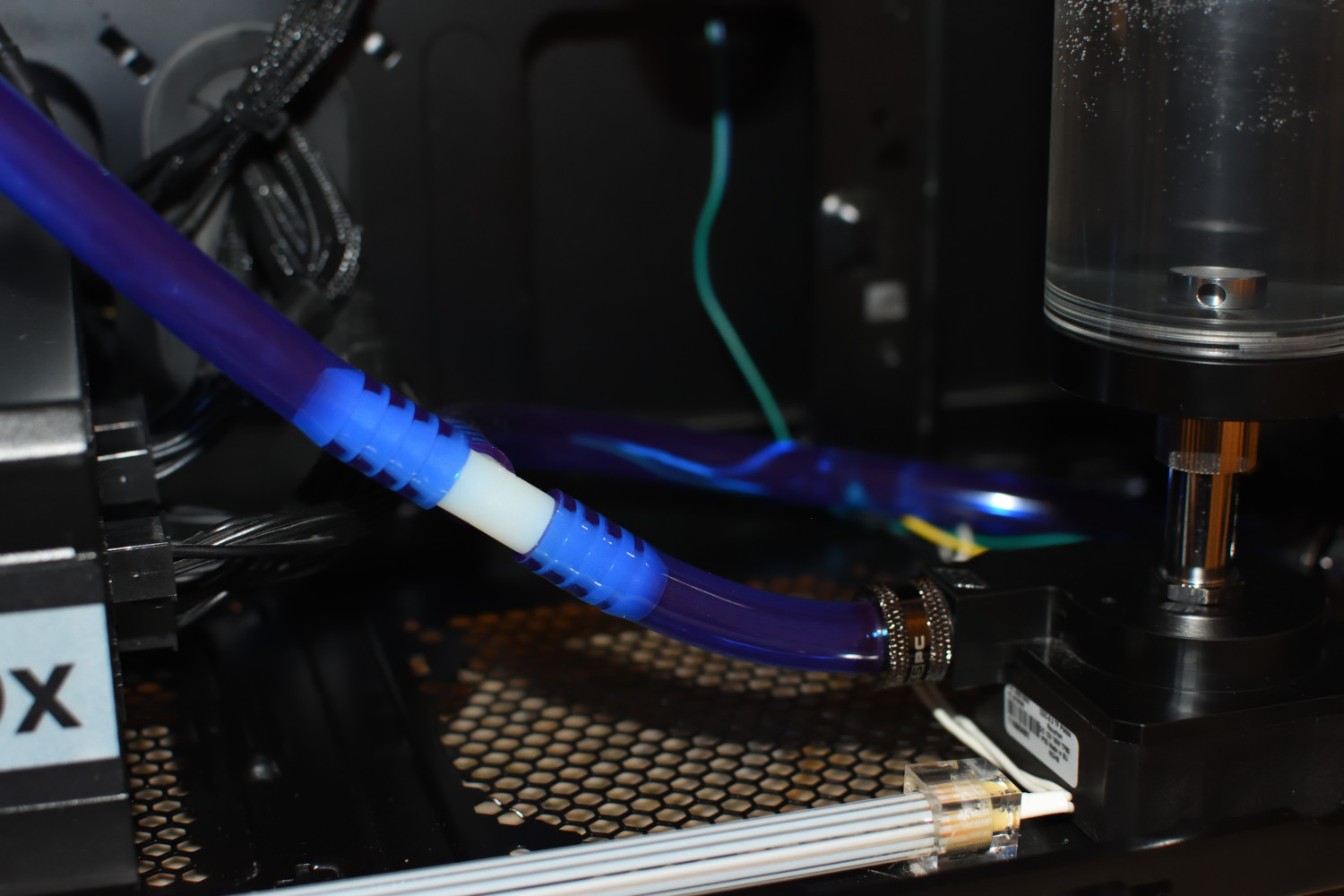
Before the overnight cleaning with Primochill System Reboot, I attempted to flush the system with distilled water. It was during the push flush that I discovered a couple fittings had developed leaks as well. Both of them were fittings on the pump and drain setup. That needed to be replaced, so I opted for a much simpler setup.
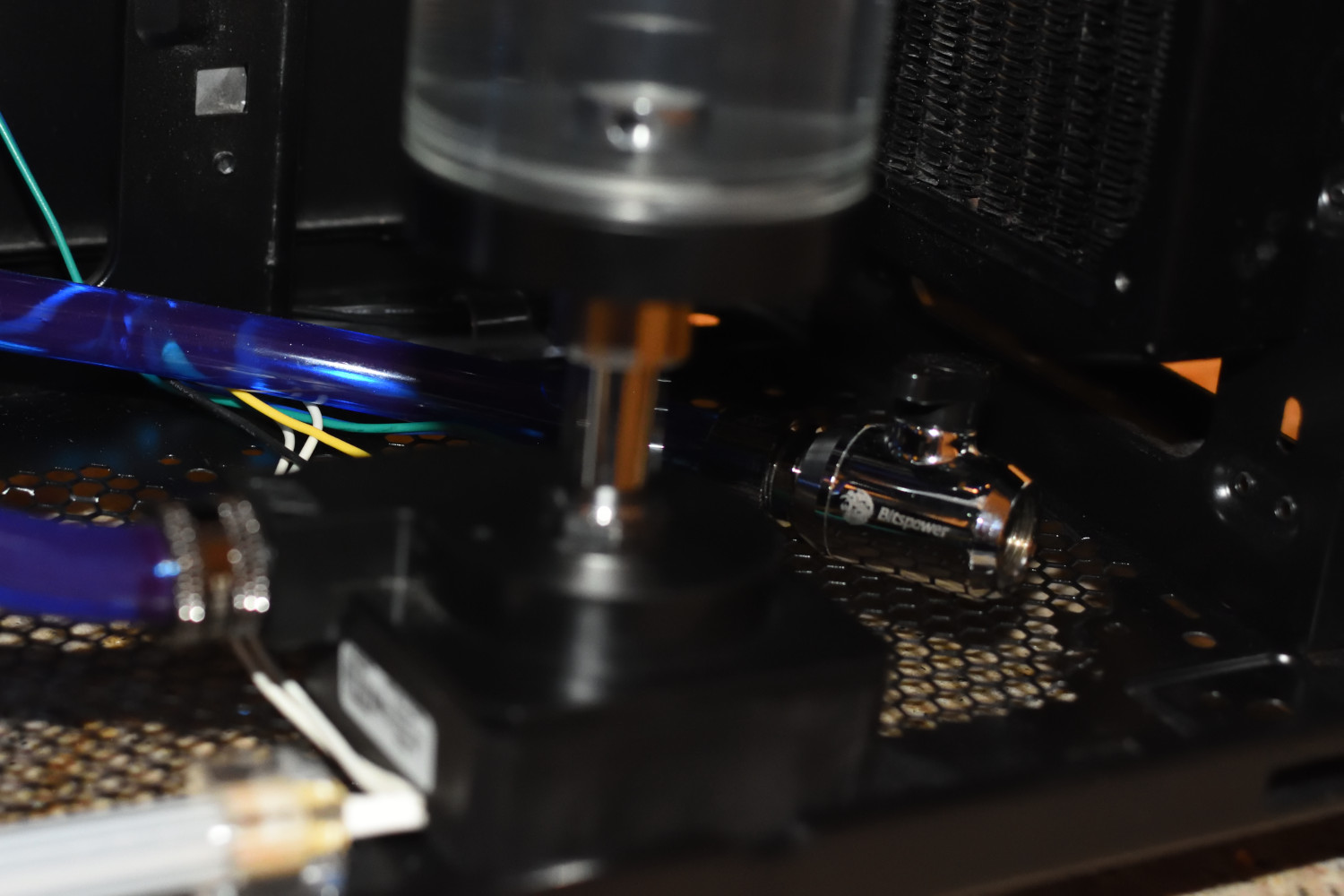
I bought that T-split from Home Depot for under $3 (plus tax). That with a length of tubing and a spare compression fitting I had formed the new drain with the Bitspower valve. I would’ve preferred finding a brass fitting, but the white plastic fitting was all I could find. Sure it doesn’t look the greatest, but it works, and is much, much less expensive compared to a two (2)male-to-male rotary fittings and a 3- or 4-way fitting to make the split for the drain. Brass would’ve looked better, but, again, they didn’t have it in stock.
For the overnight cleaning, I connected the pump directly to the GPU block, then bought the needed components the next evening to finish the assembly. To drain the loop, I had it spill out through the grate below it. I did not have the power supply installed at the time, so there was no danger – all pictures were taken of the final system before it was delivered back to the owner. I followed up by having the return from the radiator go into an empty jug for a distilled water rinse, doing my best to drain as much of the water out as possible – using the syringe to push air through the loop to displace the water.
Wow I really missed focus with that picture…
The rest of the loop looks about the same as before, following the same path. The only exception being the return from the front radiator to the reservoir. Note in one of the pictures above that I have a Swiftech SLI fitting between the pump and reservoir. This lowered the reservoir down such that I could have this type of direct return.
The system is otherwise back in operation and working as expected. Again given what I saw when I started working on it this last time around, I’m really surprised he wasn’t having any kind of thermal issues. But I also directed the owner on how to avoid that becoming an issue in the future. And he also said he wouldn’t have the chassis so close to the floor.
So this is likely to be the last iteration on this project depending on what the next year or two brings, and how well the owner keeps up on maintenance. This last visit was an opportunity to talk him through how to maintain the loop, and what he will need in the future – the plastic T-fitting will need to be replaced with the tubing.
I’ve enjoyed working this project as I’ve learned a lot over the last couple iterations maintaining it. And hopefully the owner will be able to maintain it on his own.
The Constitution grants to the House of Representatives the “sole Power of Impeachment”. And later in Article II states that the President, Vice President, or any officer of the Executive Branch “shall be removed from Office on Impeachment for, and Conviction of, Treason, Bribery, or other high Crimes and Misdemeanors”.
In the history of the United States, only two Presidents have suffered impeachment and a third came pretty close – Andrew Johnson, Bill Clinton, and Richard Nixon, respectively.
One thing I feel a lot of people forget about the Constitution is simply that it grants powers and lays a framework for the Federal government. Granting that power, however, does not imply an obligation to exercise it – but when does a government ever refrain from exercising power it’s granted (and even power it isn’t legitimately granted)? There is very little of Congress’s enumerated powers that it is obligated by the Constitution to exercise. As an example, Congress was under no obligation to declare war against Japan following the Pearl Harbor attack. And Congress, conversely, could declare war on anyone absent any justification if it so desired.
Yet when it comes to impeachment, in particular impeaching President Trump (and previously with President Bush), suddenly this power becomes an obligation, merely because those wanting to see Trump impeached are declaring it such.
I’m not for impeachment. This is news. I’m going to give you some news right now because I haven’t said this to any press person before. But since you asked, and I’ve been thinking about this: Impeachment is so divisive to the country that unless there’s something so compelling and overwhelming and bipartisan, I don’t think we should go down that path, because it divides the country. And he’s just not worth it.
Cass Sunstein, widely recognized as a constitutional expert, doesn’t seem to think the House of Representatives has any choice in the matter. That having the power to impeach the President means they have zero discretion and must act.
Yet when they must act is largely up to interpretation!
Under the Constitution, the grounds for impeachment are “Treason, Bribery, or other high Crimes and Misdemeanors.” Suppose that a president commits a clearly impeachable offense — by, say, committing treason or by using the apparatus of government to violate people’s rights and liberties. Suppose, too, that the president’s party remains intensely loyal to him, thinking, “True, he’s a jerk, but he’s our jerk.”
In those circumstances, the Constitution does not license members of the House of Representatives to refrain from impeachment, on the ground that it would not be “bipartisan” and would “divide the country.”
The Constitution absolutely and always licenses the House of Representatives to refrain from impeachment. They are POWERS, not obligations. And exercising power requires a degree of responsibility.
Let’s go back to the idea that Congress could declare war against any foreign power, for any reason or none. The Constitution doesn’t say Congress has the power to declare war only with sufficient justification. It says simply that Congress has the power to declare war. Full stop. Exercising that power is entirely up to Congress and their discretion.
In this light, it defies belief to think that the impeachment process is purely “political” — or that the House of Representatives may decline to proceed against a president who has engaged in treason, produced “the most extensive injustice,” or otherwise committed a clearly impeachable offense.
Except the impeachment process IS political since it is entrusted to a political branch rather than the Courts. In the two instances in which it has been exercised against a President, it occurred for political reasons, regardless of the evidence or justification behind the charges.
President Clinton demonstrably perjured himself, but his impeachment is continually misrepresented as having been about his affair with Monica Lewinsky. Despite the demonstrable perjury, though, that it was a Republican-led House that impeached him shows it was political. A Democrat-led House would not have considered impeachment.
Republicans in both instances of impeachment passed articles against a Democrat President. And a Democrat-led House pursued impeachment articles against Nixon. In no instance has a House of Representatives considered impeachment articles against a President with the same party.
So how is impeachment not political? Though I’ve said that impeachment is not to be used as a substitute for political or electoral failure, it is wielded by a political branch of the government, making it de facto political.
And to say the House of Representatives has zero discretion when it comes to impeaching a President goes against the very wording of the Constitution. Nowhere in the Constitution does it say the House has any obligation to impeach a President who has committed “treason, bribery, or other high crimes and misdemeanors”, only that they have the power to do so.
Power does not mean obligation.
Just as prosecutors are free to exercise discretion in whether and what charges are brought against a particular defendant, and generally won’t bring charges unless they feel they have a very high chance of securing a conviction. Since prosecutors know the same standard for bringing charges (“probable cause”) is not the same standard needed to convict (“beyond reasonable doubt”). So why bring charges without the evidence needed to convict? That is the prosecutor’s discretion.
So too the House has discretion in whether to let certain things a President does just go. That President Clinton perjured himself regarding an affair was not enough reason to see him removed from office. Borrowing Speaker Pelosi’s words, it was not “so compelling and overwhelming”, and it was far from “bipartisan”. And impeachment articles should really never have been brought against him since conviction was never going to happen. The impeachment and trial were colossal wastes of time.
And let’s go one step further: the Senate is not under any obligation to convene a trial on any impeachment articles the House passes. Again power does not mean, nor does it even imply, obligation.
It is hardly crazy to insist that if it isn’t clear whether the president has committed what the Constitution deems to be an impeachable act, the House is entitled to refrain from acting, at least when the nation is sharply divided along political lines.
You mean like it is currently? Yet your opinion piece implies the current Democrat-led House has an obligation to impeach Trump, and the Republican-led Senate has an obligation to try and convict him.
If a president has committed a clearly impeachable offense, the House of Representatives is obliged to impeach him — even if the process turns out to be “bipartisan” or “divisive.”
There’s one word missing from this sentence: provably. If a president has provably committed a clearly impeachable offense. But even then, again, the House is never under any obligation to impeach him. Just as no prosecutor is obligated to bring charges for any offense.
Power does not mean obligation. Indeed if there is any obligation the Constitution puts on the House of Representatives regarding impeaching a president, it is to decline to act where there is uncertainty.
The left and Democrats are so, so certain that Trump colluded with Russia to… convince tens of millions of voters to vote for him or refrain from voting for Clinton that they want to see him impeached. Because they desperately want to their belief to become reality. And Sunstein is no different in declaring the House has an obligation to impeach Trump and, by extension, that the Republican-led Senate has an obligation to try and convict him.
Yet no such obligation actually exists beyond mere assertion.
I’ve joked before that Trump merely being alive is an impeachable offense to Democrats. And now that the Mueller report has apparently not lived up to leftist expectations, I think we’re back to that particular standard again. Or they’re going to act like anti-vaxxers and keep peddling the “Trump colluded with Russia” narrative despite nothing concrete backing it up.
Recently I’ve started listening to various YouTube channels that read out stories posted to Reddit. One story was classified as “pro-revenge”. And I found the original post in question, called “I got back at childhood bullies by destroying an entire town“. To note, the factual nature of the story has been called into question. But like another story regarding the “Trump Cup” phenomenon I looked at 2½ years ago, we can still discuss the story as a hypothetical case study. Go ahead and read the story to take in the full picture. I’ll do my best to summarize.
The OP (original poster) described a childhood in a very conservative Christian, “one smokestack” town. For the unfamiliar, that is a small town centered around one business or industry – mining or a manufacturing plant. Economically, they literally have all their eggs in one basket. There are a lot of towns like this peppered across the greater United States. Some are still thriving, or at least getting by, but others fell to the 2008 crash and 2009 recession. The one the Obama administration said lasted only 6 months, only because there was a tidal wave of government spending that inflated the GDP numbers and made the economy look better than it was actually doing.
OP is also a rape baby. So being conceived and born out of wedlock in a very Christian conservative town, his life growing up was hell. But he still managed to graduate with decent grades and escape the town in question, going to college and getting a decent job as an “analytical consultant”.
Part of his work involved downsizing evaluations – determining which locations get closed or who gets laid off or transferred. And he was pulled in to evaluate three plants to determine which would get shuttered and their operations transferred. One of those plants was in the town where he grew up.
If you know anything about business ethics, red flags should be going off. Unfortunately the ethical conflict is one many likely don’t readily see, given how many have readily applauded what is described. In short this is a massive conflict of interest.
Once the OP saw that his hometown is one of the plants he would be evaluating, he should’ve recused himself completely. He was being brought in to give an impartial evaluation. And his descriptions of his mindset and actions show he was unable to give an impartial evaluation. This statement in particular is telling:
Inside I was seething with hatred and enjoying this all. I really loved seeing their faces, seeing what they had become, because fuck it, I was going to take it all away from them.
And
My state of mind was something close to sexual arousal. I had never understood why people pursue positions of power, but yeah, now I understood.
Again he was unable to be impartial. And impartiality is part of a consultant’s fiduciary duty. Since they hire an outside consultant for an independent, impartial opinion. But instead of doing his fiduciary duty and recusing himself, he took it as an opportunity to carry out a personal agenda. Again, a massive conflict of interest that rendered him unable to be impartial.
I wrote a really scathing report, documenting every little flaw and mistake ever done in the town plant. I didn’t need to lie or fabricate – I simply took things that existed and polished them till they looked even worse than they were. The factory was shut down and in the following three years, the town died.
If the plant was as badly managed as described,
The religious community running the town ran the factory as well. The big shots in the community tended to be bosses in the factory. This meant that the factory wasn’t run that well; promotions were based on “holiness”, not on merit or skill.
a truly impartial auditor would’ve recognized the shortfalls and still recommended the plant be closed.
But what if he walked in and discovered the plant was productive and profitable (earning more than it cost to operate it, even if not by a significant margin), running like a clock and reasonably well-managed? Possibly even the best of the three plants being evaluated? Would OP still have recommended the place be closed? The above statements answer this clearly in the affirmative.
He first states that he didn’t need to lie or fabricate anything regarding the plant, but then admits to doing just that, “polishing” details till they “looked even worse” than what was truthful. Meaning he likely would have lied and fabricated statements about the plant to see the outcome he desired. His personal agenda became a conflict of interest by completely nullifying any ability to be impartial, and possibly introducing a willingness to commit fraud and defamation.
Conflicts of interest are taken very seriously in business, since it calls into question whether you can be impartial and seek the best outcome given a circumstance. And personal conflicts with other people can become conflicts of interest simply due to the risk your impartiality will be compromised.
Some conflicts of interest are quite obvious. Interviewing your high school bully for a position on your team. A salesperson approaching a prospect wherein a former significant other or someone else with whom they have “a history” has influence over the purchase decision. And of course the classic conflict of interest: an affair between a manager and a direct report or someone along the direct chain of command.
And once the conflict of interest has been identified, the parties involved have a duty to recuse themselves from the business interaction where possible. Such as when there is a merger and one a manager’s new direct reports is someone with whom their ex-husband had a fling or affair. Such was the case in a letter to the Ask A Manager blog (original is #1 here, update, and second update is #5 here), and the conflict of interest I don’t feel was taken seriously enough by the employing organization.
And in the above story, the conflict of interest is the OP’s history with the town and the people therein, including those running the plant. The OP clearly had no intention of being impartial, let alone the ability, and should not have been involved in the decision at all. And an impartial auditor arriving at the same decision doesn’t mean the conflict of interest wasn’t a factor in the OP’s decision.
Since the conflict of interest means we cannot know whether the plant was evaluated honestly and the proper decision made. We cannot know if the claims about how it was run are truthful. We cannot know because OP couldn’t be impartial. Once he saw his hometown on the list, he saw the opportunity to ruin those who wronged him, completely jettisoning any potential for impartiality to pursue a personal agenda.
Ultimately we cannot know if that plant was the one that needed to be closed because the OP couldn’t make an impartial decision. So he should not have been involved in the decision at all.
Recently a New York county decided to ban unvaccinated minors from public places in response to a measles outbreak. And it is so beyond unconstitutional it’s not even funny.
Local and county governments are subject to the same Bill of Rights as the Federal government via incorporation. So has said the Federal judiciary, including the Supreme Court of the United States, numerous times over.
So let’s say there is an unvaccinated child in a public place in this New York county. Beyond the parent or child (because, let’s face it, the most truthful people in the world are drunks and children) openly admitting such, what would constitute probable cause in this instance? What would constitute even reasonable suspicion to detain someone?
The government would also have to demonstrate the child is not vaccinated. There is no obvious physical indicator of a person being vaccinated or not against measles. This isn’t like with smallpox where the vaccine leaves an obvious scar or blister. So demonstrating the child is sero-negative to measles, meaning they have no antibodies against it, requires a blood test. And unless the parent voluntarily consents to the blood test for their child, which no parent in their right mind would do, the police would need to demonstrate probable cause to get a warrant, since the blood test is a search under the Fourth Amendment – see Birchfield v. North Dakota, 579 US ___ (2016).
And the parent refusing to consent cannot be used against them in any way. It is not automatic probable cause. The police would still need something else.
So given that blood tests are out of the question, again absent probable cause or voluntary consent, what about vaccine records? Should parents have to carry around their children’s vaccine records wherever they go in that county, to be produced upon demand of law enforcement? Under the Health and Insurance Portability and Accountability Act (HIPAA), No. Vaccine records, like all other records related to a person’s past medical history, are protected health information (PHI) under the HIPAA Privacy Rule. Meaning law enforcement cannot demand you produce them without a court order.
The county said they have no intention of actually arresting people, but instead using this as a wake-up call regarding the measles problem they’re having. Except the law being on the books is still the issue, since the county could, at any time the law is active, choose to start enforcing it, such as if they aren’t getting the results they expect from it.
And that is where the county will fast run into the Fourth Amendment.
Back almost three years ago in 2016, I set out to do something rather unique with regard to water cooling: building an external, self-contained radiator box. And for the most part I achieved that goal. Maintenance cycles would see some improvements to the implementation, leading to a box that is very quiet, and a total water cooling setup that provides very good temperatures.
There were still additional improvements to be made. Particularly with the power delivery. Powering everything was initially… messy. Integrating a hodgepodge of parts that more or less got the job done with as little need for modifying anything as possible and virtually nothing custom.
EAO series 82 vandal-resistant switch (green LED ring)
And the power went into two voltage regulators, one a step-up to run the pump at greater than 12V when I had a D5 Strong, and the other a step-down to undervolt the fans. So it was a bit of a mess with regard to cabling.
I still have the switch, along with the step-down regulator to undervolt the fans. The step-up regulator isn’t needed. And most everything else from this is gone. In its place is this: NiuGuy 12V/4.2A (50W) power supply. And wires. And a terminal block.
All of this started when I was casually browsing Home Depot and saw terminal blocks in the electrical section, a part of the store I normally don’t pay much attention to. From there I purchased a crimp tool kit, terminals, and wire. Later I acquired 2.8mmx.5mm spade terminals to get rid of the vandal switch wiring harness. The small power supply came later.
And that power supply is seriously small. Smaller than the power brick I was originally using. I was actually surprised when I first saw it. Here’s a size comparison of the product box with a PS3 game case. The power supply itself is only slightly smaller than the box.
I’ve encountered power supplies like this before and had previously considered employing them in the radiator box. But I initially wanted something that didn’t require much in the way of additional tools and electrical supplies to build, so I went that direction. I also didn’t know much about electronics and circuitry at the time and have since enlightened myself.
I kept the NCASE M1 power cable, cutting off the C13 connector and stripping the insulation back so I could add terminals for the power supply. The switch is inline between the power supply and terminal block. One pair of terminals create the circuit for the pump and rear fans at 12V, while the other pair creates the circuit with the voltage step-down regulator for the radiator fans. Bus wires connect the circuits in parallel.
Much simpler and cleaner compared to what I had previously since I wasn’t having to figure out what to do with really long cables coming off pre-fab items. And sure there are a couple ways this could be cleaner, but I wasn’t concerned with perfection.
The D5 pump (Koolance PMP-450 specifically) is out with a DDC pump (Swiftech MCP50x) replacing it. The only reason I swapped it out is clearance. The DDC is more compact. And the one I selected is PWM controlled, so I can dial it down to a lower RPM using a manual PWM fan controller like the Noctua NA-FC1. I clipped off the pump’s SATA power connector to use terminals to power it from the terminal block, after extending the wires using butt splice terminals with equivalent gauge wire.
So why the lower clearance necessitating the smaller pump? I lowered the reservoir using 120mm mounting rails (Performance-PCs) for the Singularity Computers Ethereal Single (Performance-PCs). (Since I say this every time, I’ll again do so here. Full disclosure: I also support Singularity Computers via their Patreon.) Much more stable compared to how I had it previously, and it allowed me to secure the reservoir more toward each of the end caps. And the lower position meant lower clearance, necessitating the smaller pump.
And I swapped the Bitfenix fans I had at the rear for Nanoxia Deep Silence 120mm fans, the ones that previously were in Absinthe, now Amethyst. They are super quiet (14.5dB/A) at 12V while still moving 60CFM. I’m not sure how that’ll affect cooling, but it’s bound to be better than the rear fans being voltage-synced with the radiator fans. And as a bonus, they match the green ring light on the power switch.
I still have the pipes I showed in the previous article. They keep the coolant flow well out of the way of power and data cables, reducing the amount of soft tubing needed, even if it does create a little headache for maintenance. I’ve considered adding a valve to the pipes as well to make it easier to drain. Instead I used a 4-way block with a couple spare quick-disconnect fittings to create something to drain the system.
Performance
I’ve made some changes to the tubing in the H440 as well, but not in a way that drastically affects performance. The GTX 1070 still barely touches 40ºC under load, and I was able to bump the CPU overclock (i7-5820k) to 4.3Ghz while still keeping temperatures in the mid to lower 60sºC.
I’ll detail the changes and reasoning behind those changes separately.
Possible next steps
Since first building this, I’ve loved having an external water cooling setup. It’s unique, and I’ve yet to see someone else do this. Sure the setup is a little complex, and maintenance can be a little bit of a headache, but having a water cooling setup that is not tied to any particular chassis or hardware setup is the main benefit. And I see no reason to go back to the traditional in-chassis water-cooling setups that… nearly everyone else does.
Maintenance is, of course, the main drawback. Good thing it really only needs to happen once a year.
And there really isn’t much of anything to add to this. A better mount for the pump? Not entirely necessary. I would like to have temperature sensing on the coolant, but that isn’t a pressing concern. Replacing the radiators or radiator fans with better options? I don’t really have a reason to do that. The XS-PC EX360 radiators work without any issue here, and I have zero reason to believe better radiators (e.g. AlphaCool, Hardware Labs) would make a significant difference, though they would certainly inflate the cost.
The only realistic direction I can go is making the box smarter.
The last couple years have seen the introduction of various ways of controlling fans using software. I’ve used NZXT’s Grid for powering a lot of fans at once. Future adaptations saw the Grid+, which allows for software control of the fans based on temperatures via their CAM software. The latest incarnation is the Grid+ V3, which supports PWM fans, meaning it should also support PWM pumps.
And the Corsair iCUE Commander Pro is an option to integrate temperature sensing and fan control. But it requires all three voltages from its SATA power connector – 12V, 5V, and 3.3V – whereas the Grid+ requires only 12V and uses a barrel connector – meaning no modification to the device. The power supply noted above is 12V only, so I’d need a voltage adapters to provide 5V and 3.3V, or I’d need to replace the power supply with one that can provide at least the 12V and 5V.
I’ll figure out which to use later, along with how to connect it to the main system.






You must be logged in to post a comment.