Once a government…

A friend of mine recently tagged me on Facebook to ask my opinion on this. Below is my response with some enhancements and additions.
* * * * *

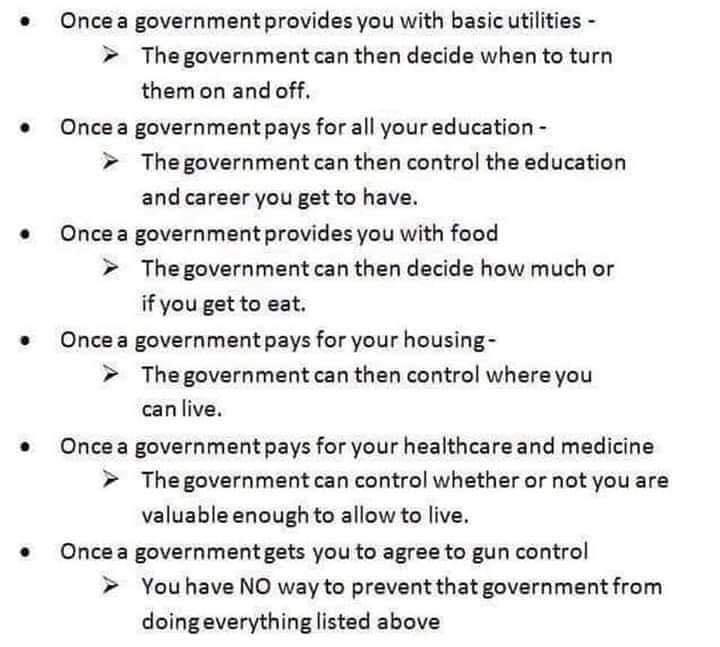
Quoting for accessibility:

  • Once a government provides you with basic utilities –
    • The government can then decide when to turn them on and off.
  • Once a government pays for all your education –
    • The government can then control the education and career you get to have.
  • Once a government provides you with food
    • The government can then decide how much or if you get to eat.
  • Once a government pays for your housing –
    • The government can then control where you can live.
  • Once a government pays for your healthcare and medicine
    • The government can control whether or not you are valuable enough to allow to live.
  • Once a government gets you to agree to gun control
    • You have NO way to prevent that government from doing everything listed above

* * * * *

A government big enough to give you everything you want, is a government big enough to take away everything that you have.

— Paul Harvey, “Remember These Things“, 1952

“Once government provides you with basic utilities -“

I live in a county where the county provides the water and electricity. Right now they can’t cut off utilities for anything except failure to pay. But there is nothing except diligence by voters stopping them from instituting other… conditions on your utilities. It’s one of the reasons off-grid power (solar panels with battery backups) is growing in popularity in places where counties control the basic utilities.

“Once the government pays for all your education -“

We already see this to an extent. With the education, not yet the career. The government controls the curriculum. We saw this with the introduction of “common core”, which was introduced by government fiat without any kind of say by the teachers and parents, and in some instances against any protest.

Which it’s rather interesting how the left pushes back against the right’s badly-veiled attempts to get creationism in public schools, yet largely didn’t push back against “common core” when it was introduced… while Obama was in office.

Until they saw what that meant.

At which point it was largely too late to do anything.

“Once government provides you with food -“

All you have to do is look at the SNAP program. Plus we had rationing by government fiat “for the war effort” during the Second World War. Many New Deal programs also instituted massive controls over the American economy for the explicit purpose of bringing the Great Depression to an end.

Except there is consensus among economists that the New Deal programs prolonged the Great Depression. That’s why when those programs were ended after the War, we had massive prosperity going into the 1950s after a short stint with another depression immediately after the war. Yes, contrary to what people have been led to believe, the Second World War didn’t actually end the Great Depression. It just pushed it to the side.

“Once the government pays for your housing -“

Section 8 housing already falls within this.

When you have a choice over where to live, landlords will compete for your money. Most renters can get up and leave most any month, so a lot of landlords will do what they can to keep you there. Because vacant apartments and homes are cash sinks. The landlord is responsible for utilities and upkeep when no one is living there, and they have no income from rent to offset the mortgage, property insurance, and property taxes.

With Section 8, however, while vacant apartments pose the same issue to the property, how much they get for each apartment is also controlled by the government. Who can live there is also controlled by the government – there is an income CAP at such complexes, because if you make too much, you don’t qualify for the Section 8 assistance.

But everything I’ve read about Section 8 housing also shows it to be “bottom of the barrel” in terms of quality, because the complex knows that those who live there largely don’t have any other choice. So there’s no need to compete with other Section 8 complexes for residents.

And that’s largely the crux of giving the government so much control over our lives: it takes away our choices. And without choices, you don’t really have any freedom.

“Once a government pays for your healthcare and medicine -“

And this is happening in countries with universal health care. Proponents of “health care as a right” don’t want to talk about that reality because they seem to think they can tax the rich enough that everyone else will be prosperous and everyone will get whatever care they need regardless of the cost.

Which shows they don’t understand wealth as a concept, nor do they understand the basic realities of economics.

There are numerous horror stories about universal health care. Much the same horror stories with private health insurance – grandma not getting her medicine, kind of stuff – only it’s patients being left to die in hospitals so the beds will be freed up, surgeries being denied or massively delayed, and other forms of rationing such as wait lists to see a doctor, and so on. At least in the United States, you’ll get care if you need it, even if it’s at an emergency room – where I ended up back in March (with the premium to go with it) when I had that dental abscess flare into massive swelling in my jaw and cheek. And there are charities and foundations and other forms of financial aid to help with the cost. And, yes, crowdfunding as well.

Whatever care is *necessary* to your wellbeing, you can get it in the US, and the hospitals and clinics will help you figure out how to cover the cost later. If you need prescription meds and can’t afford it, the manufacturers have programs where you can get your medicine at reduced or no out-of-pocket cost, either through a local pharmacy or directly from them (with some exceptions as required by law, e.g. opiates).

One thing to bear in mind with so-called “universal” health care and “health care as a right”: he who pays the piper calls the tune. And while many would consider the idea the government should decide who gets to continue living is far-fetched, it also isn’t new.

And I think it would be a good thing to make everybody come before a properly-appointed board – just as he might come before the income tax commissioners – and, say, every 5 years or every 7 years, just put him there and say, “Sir or Madam, now will you be kind enough to justify your existence?”

If you can’t justify your existence, if you’re not pulling your weight in the social boat, if you’re not producing as much as you consume, or perhaps a little more, then, clearly, we cannot use the big organization of our society for the purpose of keeping you alive because your life does not benefit us and it can’t be of very much use to yourself.

— George Bernard Shaw, playwright and Fabian socialist

“Once a government gets you to agree to gun control -“

Democracy is not freedom. Democracy is two wolves and a lamb voting on what to eat for lunch. Freedom comes from the recognition of certain rights which may not be taken, not even by a 99% vote.

— Marvin Simkin in his article “Individual Rights”, 1992-01-12

Majority rule will only work if you’re considering individual rights. You can’t have five wolves and one sheep vote on what they want to have for supper.

— Larry Flynt

While democracy is five wolves and a sheep voting on what to have for dinner, a well-armed sheep can contest that vote. Whether the sheep prevails is immaterial. What matters is whether the sheep has the ability to do so. Not having that ability means a 0% chance of prevailing. And it seems that a lot of people on the left want everyone else (who doesn’t agree with them lock step) left without the ability to contest.

With self defense, a firearm is the ultimate equalizer. It can stop a confrontation that is escalating from escalating further. It gives a 125lb, 5′-tall woman power to defend herself against a 6′-tall, 250lb man. It gives an older man the ability to prevail against a younger, stronger, more agile person who initiated a violent confrontation.

Rifles gave the Colonists the power to fight off what was then perceived as the most powerful military in the world. Which is why the first task of that military, which directly led to the Revolution, was seizing arms from those colonists.

Until the late 19th century in the United States, the People had the same firepower as the government. There was no distinction between civilian and military weaponry “meant for the battlefield”. It was only going into the 20th century that there started to be a power disparity in that regard that only grew from there. Even in the 19th century, private merchant vessels had cannons to ward off pirates. Today… not even cruise liners have armed security, and most who sail their own yachts also don’t keep arms onboard. Granted the saltwater air over the open ocean would wreak havoc on the steel in most firearms, but there are ways to combat that. After all they needed that kind of protection for the cannons and cannonballs.

Now the First and Second World Wars drove a massive arms race in which the United States ultimately won the checkered flag. But in the United States while war drove advancements in arms, those advancements eventually made it to private hands. And with personal arms (rifles, pistols, etc.), this has still held true. But not with everything else.

Instead the only thing that would keep the “everything else” from being turned on the People of the United States are the military officers in charge of that “everything else”. Officers who take an oath to the Constitution of the United States, not the government. But as we saw during the Second World War, even military officers aren’t immune from the kind of brainwashing that could push them to turn their firepower on the people they are supposed to be defending from tyranny, not installing tyranny over.


Mississippi man facing 7th trial on same charges

The Ninth Amendment to the Constitution of the United States is quite simple in its language:

The enumeration in the Constitution, of certain rights, shall not be construed to deny or disparage others retained by the people.

It is arguably the most overlooked Amendment to the Constitution. But it is also the most important in my opinion. I’ve argued here that even if the Second Amendment were repealed, the Ninth Amendment would still preserve a right to keep and bear arms. Removing the enumeration of it from the Constitution doesn’t erase the right.

And it is the Amendment that has been cited whenever the Supreme Court of the United States “finds” rights, such as the right to privacy inherent to several other protections the Supreme Court has afforded the People.

Among the enumerated rights in the Constitution is the protection against double jeopardy. But the trade-off on this protection is the Courts declaration of when jeopardy “attaches”. And generally it’s accepted that jeopardy attaches when a jury renders a verdict. But jeopardy is nullified if the conviction is overturned and a new trial ordered.

Which is why a man in Mississippi is currently facing a 7th trial on the same charges. I wish I was making that up.

49 year-old Curtis Flowers is facing his 7th trial on capital murder charges. His most recent conviction was overturned by the Supreme Court of the United States, citing racial bias in the jury selection.1Flowers v. Mississippi, 588 US ___ (2019) Trials four and five ended in hung juries.

One could definitely argue that, even though jeopardy technically hasn’t attached to Flowers, the Constitution does not allow what appears to be seemingly endless attempts to get a conviction that sticks. While the Constitution specifically calls out double jeopardy in the Fifth Amendment, the Ninth Amendment surely protects a right against endless attempts to get a conviction.

Right now Flowers is trying to get the indictment quashed while also trying to secure bail, saying there should be a limit to “oppressive retrials”. And I agree. Six tries is beyond too many. This man has been in and out of jail, on trial and not for 20 years. At what point do the Courts say that enough is enough and quash an indictment with prejudice? Flowers’ case should become precedent on that mark.

Update: The Mississippi Attorney General filed motion to dismiss the indictment against Flowers, and the Fifth Circuit District of Mississippi dismissed the indictment with prejudice on September 4, 2020. This is, in effect, an acquittal as this indictment cannot be later revived.

References[+]

So close to getting it right

Article: What’s the Statute of Limitations on Credit Card Debt?

A lot of articles get debt collection wrong in some way or another. I’ve yet to find an article that gets the facts completely correct that I didn’t also write. And so too is that the case with the article above discussing the statute of limitations. Which is a topic even the United States Federal government, specifically the Consumer Financial Protection Bureau, got horribly wrong.

Why do these writers insist on telling debtors to ask debt collectors whether a debt is still within the statute of limitations?

First the statute of limitations is the maximum amount of time a creditor has to pursue a debt through the Court. That is all. It doesn’t mean they cannot come after you outside Court for the debt. The only way to stop that is to send them a letter – yes, it must be in writing – telling them to stop contacting you.

So how long is the statute of limitations? Well, that depends. I’ve typically said the statute of limitations depends on the resident State of the debtor. That is… not entirely true. And the article linked above reminded me of one particular concept in contract law that slipped from my mind because it typically isn’t something we need to worry about.

The duration of the statute depends on which state is identified in the contract or the state you live in, and the type of debt in question.

“depends on which state is defined in the contract” brings up the concept of contract jurisdiction and the jurisdiction clause. This clause provides for which State’s laws shall control the contract terms along with the specific Court that shall have original jurisdiction for any claims arising under it. As an example, here’s a jursidiction clause from a photography agreement I’ve written:

This agreement shall be governed by the laws of the State of Kansas and Johnson County therein, and the laws of the United States of America where applicable. The Parties submit to the jurisdiction of the Johnson County District Court, Tenth Judicial District of Kansas, for adjudication of any disputes and/or claims arising under this agreement.

The Parties submit to the jurisdiction of the United States District Court for the District of Kansas for any claims arising under any statute of the United States Code, including, but not limited to, any claims regarding copyright.

Most of the time, the jurisdiction of the contract will be the Court of competent jurisdiction over the party accepting the offer in the contract. When I lived in Clarke County, Iowa, for example, any contracts I signed to which I was accepting an offer would likely state such. It tends to make things much easier on both parties. For example if you sign a contract for any kind of remodeling or construction on a home, that work must abide by the building codes for where the work is taking place, so that will generally be the stated jurisdiction of the contract.

But any jurisdiction statement is still subject to the law where the contract was enacted.

For credit contracts, however, any jurisdiction statement is overridden by Federal law, specifically 15 USC § 1692i(a), which provides that any legal action – again, the jurisdiction for enforcing the contract – must be brought in the Court over which the contract was signed (where you lived when you opened the credit account), or the Court over which the debtor resides at the time of the lawsuit.

So if you live in New Hampshire and the credit contract tries to stipulate that all actions under that contract shall be enforced by a Court in Hawaii, that clause is unenforceable under Federal law unless you lived in Hawaii when you signed the credit contract. Not to mention that clause would likely also be unenforceable under Hawaii law since you live in New Hampshire, so Hawaii wouldn’t have jurisdiction over you with regard to the ongoing enforcement of the contract.

Not saying such doesn’t happen. There’ve likely been shady creditors who’ve tried to do that. But the vast, vast, vast majority of debt collection lawsuits are filed where the debtor lives, since having the judgment through that Court opens up enforcement options. As an example from my history, I used to have a credit card with CapitalOne. I lived in Polk County, Iowa, when I opened the account. And it fell into collections while living there as well. But I lived in Clay County, Missouri, when they sued me, and they sued me through the Missouri 7th Judicial District Court in Clay County.

But with regard to the statute of limitations, which laws control? That depends on where the creditor seeks to enforce the contract. Again Federal law gives them only two options: where you lived when you opened the credit account, and where you live when they file the lawsuit. So when it comes to the statute of limitations, those are the only two controlling options, contrary to the article:

Check your original agreement for language specifying a choice of state law or “governing law” that might apply to your debt. Although courts are not bound to this choice, it may impact which statute of limitations that courts may consider in their decision.

“Governing law” is another name for the jurisdiction clause I mentioned earlier.

A Court cannot enforce laws outside its jurisdiction. The contract cannot override that. A contract legally cannot state that the parties will seek to enforce the contract in Kansas while its “governing law” will be Florida, for example, since Kansas Courts cannot apply Florida’s laws. They can only enforce and apply Kansas law since it is under Kansas law the Kansas Courts are established.

The article goes on to talk about debt re-aging and how to avoid it. This is where my earlier question comes in: why do these writers insist on the debtor asking the creditor if a debt is time-barred?

The Federal Trade Commission’s Fair Debt Collection Practices Act requires a debt collector to respond honestly when asked whether a debt is time-barred. A debt collector can contact you about the debt but might not mention that the debt is time-barred or might choose not to answer you.

Or they may choose to say “I don’t know” since they likely can’t really know. Answering that question would require knowing the entire payment history of the debt, something the collector may not have readily available.

Beyond that, an expired statute of limitations is an affirmative defense to a lawsuit, to be raised by the defendant to the lawsuit at Court. It means literally nothing outside of Court. No, seriously, it doesn’t. As the above-linked article states, correctly, nothing in law stops a debt collector from continuing to pursue a time-barred debt outside Court. Nothing, that is, except you telling them in writing to stop contacting you.

So let’s say you have a time-barred debt, and the collector is threatening to sue you. The article writer suggests… filing a complaint with the FTC.

You can submit a complaint to the FTC regarding unfair debt collection practices, such as if the collector threatens to sue you for a time-barred debt.

Ugh…

Here’s the thing about filing a complaint with the Federal government: nothing will come of it unless they get a lot of complaints about one company. So there really isn’t much of a point. They won’t act on singular complaints, and likely won’t act on any complaints if they all come from one State with the company also being located within that State since that may fall outside their jurisdiction. Remember the Constitution grants the Federal government only the power to regulate interstate commerce.

Instead you’re better off just telling the debt collector to stop contacting you. Don’t tell them you think the debt is time-barred. Don’t tell them you know the debt is time-barred. Just tell them only to stop contacting you without any reason. Once you’re certain the debt is time-barred, that is. Since the burden will be on you if you’re sued to prove it to the Court. Meaning if the creditor can show the debt has been re-aged or that your records aren’t accurate and the debt isn’t time-barred due to a payment you forgot you made, you’re sunk, and you’ve got a judgment against you now as well.

Navigate the waters of the statute of limitations carefully. If you’re absolutely certain the debt is time-barred, then proceed forth in telling the debt collectors to go away, as you’ll have your legal defense ready should they sue. Otherwise, proceed carefully by exercising your legal right to debt validation.

Taxing firearms

Article: Don’t Ban Assault Weapons – Tax Them

I’ve said before (here and here) that subtle racism largely fuels the calls for greater financial burdens on firearm owners and buyers. Any financial barrier to the exercise of a right is no better than the poll taxes that were outlawed with the 24th Amendment.

So why are gun control advocates continually proposing additional financial burdens when the greatest effect they’ll have is on marginalized populations who need their Second Amendment rights the most? Again, because of an underlying racism they fail to see is there.

And that racism comes out in two ways: believing only well-off whites own firearms, and ignoring the fact most gun crime in the United States is committed by blacks. And that most gun crime is also committed by people illegally in possession of firearms, and who have zero interest in submitting to any additional laws.

In other words, like most gun control ideas out there, Saul Cornell’s idea of taxing “assault weapons” is racist and punishes the innocent.

Few Americans realize that guns and ammunition are already taxed to pay for conservation efforts. Gun owners have happily tolerated federal taxes for years to support this worthwhile public-policy goal.

A lot of people are completely ignorant about taxation, and Cornell appears to be no exception to this. There are various types of taxes levied against the United States economy.

The tax Cornell is referring to specifically is authorized by the Pittman-Robertson Act, officially known as the Federal Aid in Wildlife Restoration Act of 1937. And it’s an excise tax, meaning levied only at manufacture, and paid only by those in the business of manufacturing firearms and ammunition for sale. The funds from the tax are distributed to the States for conservation efforts. Hunting and fishing license fees serve the same purpose.

But Cornell isn’t proposing an excise tax on “assault weapons”. His article seems to be proposing ownership taxes in the same way we have property taxes on houses and vehicles.

Taxation sidesteps entirely the constitutional qualms some have over assault-weapons bans.

The Pittman-Robertson Act is constitutional only in the same way that sales taxes are constitutional. People who buy firearms and ammunition through retailers still pay the required sales taxes at the point of sale unless the purchase is online through an out-of-State retailer – with all applicable laws and regulations observed.

It also addresses the criticism often voiced that singling out assault weapons is irrational because it would leave hunting rifles that have many of the same features on the streets.

Yes it’ll address that criticism, but that isn’t a criticism lobbied against the assault weapon bans. The criticism lobbied is that it goes after a tiny minority in gun violence.

Assault weapons, in general parlance, are typically defined to include a typical, off-the-shelf AR-15. Indeed that, along with the AK variants also commonly-available and owned, seems to be the only firearm in mind when talking about “assault weapons”. According to the FBI Uniform Crime Report, consistently year-over-year, handguns account for the vast, vast majority of gun violence in the United States. Not rifles or shotguns, but handguns.

Yet no proposal by the gun control advocacy groups addresses this. Why is that? Racism.

Again the majority of gun crimes are committed by blacks, the majority of gun crime victims are also black, and the firearm used in those crimes is almost exclusively handguns. Yet consistently the greatest calls for gun control aren’t about addressing gun crime in the inner cities, but mass shootings that largely affect white kids – the vast majority of mass shooting victims in high-profile mass homicide events (such as Las Vegas) are white.

Moreover, gun bans do not address the problem posed by guns already in private possession. Rather than requiring an expensive buyback program, gun taxation would use a market-based strategy to reduce the number of guns in circulation by effectively raising the price of ownership.

And here we see that he isn’t proposing an additional excise tax, a tax at the point of manufacture. And I can show why he isn’t doing that.

First is the mention of firearms already in private possession. Meaning he’s proposing one of two things: property taxes on already-existing firearms, or additional point-of-sale or excise taxes on ammunition for “assault weapons”.

The latter won’t work, I’m pretty sure he knows it won’t work.

The AR-15 is chambered for one of several rounds: .22LR, .223 Remington, 5.56 NATO, or .300 Blackout. But none of those rounds is unique to the AR-15, and you can find other rifles – and handguns in the case of the .22LR – chambered for those rounds. So attempting to levy an additional excise or point-of-sale tax on those rounds as part of taxing “assault weapons” will end up affecting those who don’t own what is commonly called an “assault weapon”.

And there are carbine rifles that would fit the definition of “assault weapon” that don’t use the common rifle rounds. As an example are carbine rifles chambered for the 9x19mm Parabellum, also called the 9mm Luger or just “9mm”. So additional point-of-sale or excise taxes on the 9mm Luger will vastly affect pistol owners more than those who own the carbines.

Nor is this a “market-based strategy”. Taxation doesn’t work with a market, it works against a market. A market-based strategy would be a massive advertising campaign that convinces the millions of people who already own AR-15s to give them up or avoid acquiring more. Taxation circumvents the market in much the same way as an “assault weapon” ban.

Another advantage of using taxation instead of gun bans is that such a policy would provide an opportunity to reward the vast majority of American gun owners who already engage in safe gun practices. Tax policies could offer tax deductions for the purchase of gun safes or for the cost of safety courses. Weapons stored at federally licensed firing ranges or hunting lodges might incur no tax. But if you wanted the convenience of having such a weapon at home, you could be taxed for the privilege.

And now we see the underlying agenda. This isn’t about rewarding gun owners, this is about registration and creating a census on gun owners. By having a line-item deduction on tax forms for “safe gun practices”, this would be the start of a census on who owns guns.

This approach has the additional advantage of shifting the debate away from an argument over rights and moving it where it belongs—toward structuring a set of policies that protects gun owners’ rights and lowers the negative costs that gun ownership imposes on the rest of society.

Protects gun owner’s rights? No, this is about taxing rights in a fashion similar to how the Crown taxed paper, literally taxed paper, with the Stamp Act of 1765. You want a tax as a barrier to the exercise of rights to disincentives lawful citizens from exercising their rights while doing nothing to address those who actually are a problem.

Taxation offers another advantage: It might overcome some of the fear of gun confiscation.

Not even close. That you included tax deductions for “safe gun practices” means you don’t see how that could lead to confiscation. Again the deduction would be the start of creating a census of gun owners. You desperately want direct taxation on gun owners as back-door registration or census taking of gun owners. Don’t even try to say otherwise.

As such, it won’t assuage any fears of confiscation. If anything, it’ll enhance it.

One of the many dysfunctional aspects of our modern gun debate is that we have framed the issue exclusively in terms of rights. Thinking of gun ownership in this way is neither hardwired into our constitutional system nor rooted in founding-era practices.

Actually it very, very much is. Anyone familiar with the history of the militias during the American Revolution knows this. Which means Cornell isn’t familiar with that history.

The first militia act, which required those eligible to serve in the militia to purchase their own firearms, was in essence a tax.

By what definition? And such a law today would not be constitutional since the right to keep and bear arms also includes the right to decide to not keep and bear arms.

The problem was not that Americans did not own firearms—levels of gun ownership in America were much higher than in England—but that most Americans did not want military-style weapons. Such guns were relatively heavy, and not especially suited to shooting the critters that ate their crops or to hunting birds.

Wow, you really need to read on the history of firearms in the United States.

Until the 20th century, the weapons owned and kept by private individuals were much the same weapons, if not the exact same weapons, kept by the military. The only notable exceptions on that mark are field artillery units (e.g. cannons and Gatling guns). Even private merchant vessels had cannons to defend against pirates, with the need for merchant vessels to be armed lessening as piracy lessened.

It was not until the 20th century when there started to be any kind of distinction of “military-style weapons” with the development and increased commonality of full-auto firearms in military combat. The first truly full-auto firearm, known as the Maxim gun, wasn’t developed until 1885, well after the Civil War. The first full-auto rifle was the Cei-Rigotti, introduced in 1900, but never adopted by any military.

The first commercially-successful full-auto firearm was the Browning Automatic Rifle, which saw use in the First World War. Like the Gatling gun, though, the Browning Automatic Rifle and Maxim gun are considered field artillery, not infantry artillery. The Nazis would actually develop the first full-auto infantry rifle.

But throughout the history of the United States, the rifles and muskets commonly used by the military were much the same, if not the exact same, as the rifles and muskets owned by civilians. It wasn’t until the development of fully-automatic weapons that there started to be separation in that.

And that separation applied only to rifles. That separation never applied to pistols.

There is no pistol used by the military that was never in civilian hands. Some pistols were developed first for the military, but they eventually made it to civilian ownership. The two most common pistols in the United States for much of the 20th century are the M1911 (or just “1911”) and the Beretta M9 (called the Beretta 92 in civilian markets). After the introduction of the M1911, the military stopped carrying revolvers. Today Glock reigns as the most commonly-owned civilian and law-enforcement pistol, though it was never adopted by the United States Armed Forces as a sidearm.

And the Second Amendment is the reason for that continued parity between civilian and military arms. The Second Amendment, in a nutshell, basically enshrines the ability for the people to defend themselves. Even if they need to defend themselves against their own government.

Your attempt to rewrite the history of firearms and the Second Amendment is shameful in the kindest terms.

Taxation offers a more flexible set of tools to achieve a goal all Americans seek: lowering the costs of gun violence to Americans.

Taxing rights is not constitutional. And that is what Cornell is seeking to do: tax people who exercise their Second Amendment rights. Again, this is like the South enacting poll taxes to discourage and prevent blacks from exercising the vote.

The problem is Cornell doesn’t really fully spell out what his tax policy would be. What, specifically, would be taxed and how? His article provides a couple implications that he’d want property taxes on firearms and, likely, ammunition, given his statement about taxation being a strategy, not “market-based” as he asserts, “to reduce the number of guns in circulation by effectively raising the price of ownership.”

The only way to reduce the number of firearms already in private possession is to confiscate them. Increasing the price of ammunition won’t do that – people didn’t just sell their firearms during the 2013 ammo scares and shortages following Sandy Hook. And taxation carries with it two tools for enforcement: liens and incarceration. In other words, those who don’t pay the tax could have their firearms seized and/or be incarcerated.

That statement alone means he isn’t proposing an excise tax like the one provided by the Pittman-Robertson Act. He’s proposing property taxes, with the registration to go with it for enforcement of those taxes, and the confiscation and (likely) incarceration that comes with noncompliance. Completely in contradiction to his assertion that taxation would allay fears of confiscation.

This is why I say there is racism underlying any gun control proposal. Any new anti-gun policies are most likely to be enforced against blacks. And the fact gun control proponents refuse to acknowledge that reality is quite telling. Since it shows that they seem to have only white gun owners in mind in making these proposals, since they not only know that whites are more law-abiding, but also more likely to just surrender to the new laws.

While blacks are just going to get locked up.

Student loans and lender risk

Bankruptcy tends to make lenders more cautious when it comes to making loans. The prospect of borrowers going into default and declaring bankruptcy makes lenders nervous since bankruptcy, or at least Chapter 7, means they walk away with pennies compared to the outstanding debt.

With student loans we see what happens when that risk doesn’t exist. Government guarantees plus the protection of student loans from bankruptcy discharge means that lenders have much lower risk lending to just anyone, regardless of their credit history. And regardless of their major.

With all of the talk on how to alleviate the current student debt “crisis”, the one change that I’m sure both sides could agree upon is merely ending the bankruptcy protection on student loans. Make them able to be discharged in bankruptcy and lenders will start feeling the pinch.

But you’ll also see student lending dry up as they pull back on their lending to reduce their risk of loss. I wouldn’t really call that a bad thing.

State gun laws and pediatric firearm-related mortality

Recently the American Academy of Pediatrics published a study concluding that “States with laws requiring universal background checks for firearm purchases in effect for ≥ 5 years had lower pediatric firearm-related mortality rates”. The study has a few flaws. Let’s start with the opening sentence of the abstract: “Firearms are the second leading cause of pediatric death in the United States.”

And how do the authors make that claim? By defining as “children” everyone 21 and younger.

For their study, they used data from WISQARS for 2011 to 2015, giving a total of 21,241 firearm-related deaths. Now what happens if you limit the age range to just those under 18 years-old? The total drops by over 68% to 6,658.

Now let’s limit to just homicides. The number drops to 3,640, just 17.1% of the original total.

So why just limit to homicides? There’s no reason to believe universal background check laws or other gun laws would stop teen suicide by firearm or unintentional homicides.

To keep things simple I’ll also use the Brady Campaign’s scorecards for 2013, since I’ve used that in the past when comparing gun laws against various violence statistics. I don’t need to go any more granular to prove my point. And I’ll also be using the CDC WISQARS data for 2011 to 2015 for victims of firearm violence age 17 and lower.

The range for firearm homicide rates among teens and children ranges from 0.29 (Massachusetts) to 2.75 (Louisiana) per 100,000. The median is 0.99 and the average is 1.03. Five of the six States with universal background checks in 2013 had more than 10 homicides. Here is the breakdown of their rates:

  • New York: 0.54
  • Colorado: 0.65
  • California: 1.00
  • Delaware: 1.08
  • Connecticut: 1.1

That New York doesn’t have the lowest firearm homicide rate tells you that universal background checks aren’t the panacea they’re made out to be. Here are some highlights from running the data on States without universal background checks:

  • Under 10 homicides: 9
  • Homicide rate lower than New York: 15
  • Homicide rate lower than California: 28
  • Homicide rate lower than Connecticut: 33

Given that breakdown, it’s clear that universal background check laws can’t even correlate with lower homicide rates, let alone be causal. You won’t get lower firearm homicide rates among youth by passing universal background check laws. There are other factors at play.

And if you’re going to start out a study by including adults in your definition of “children”, then I really need to question the peer reviewers who allowed that study to be published. Since doing such is beyond disingenuous, and the only reason the 18 to 21 age range was included, along with including suicides and unintentional homicides into the mix, is to inflate the numbers.

* * * * *

So just for completeness sake, let’s look at suicides as well.

For 2011 to 2015, age 17 and below, there were 2,494 suicides by firearm. It’s really the only age group where firearm homicides outnumber suicides. The suicide rate per 100,000 ranges from too low to calculate effectively (6 States) to 2.86 (Montana).

Among States with universal background checks, two have a rate too low to effectively calculate: Delaware and Rhode Island. Colorado tops out the other four at 1.31 per 100,000, while California, New York, and Connecticut come in at 0.24, 0.25, and 0.28, respectively.

That is why they included suicides in their tallies and didn’t provide a breakdown. It skews the numbers toward the States with universal background checks.

By not providing this breakdown between suicides and homicides, they make it seem like universal background checks reduce overall firearm death rates, and that isn’t true. While it might help with suicides, it does nothing for homicides as I’ve shown. This is why gun rights advocates continually emphasize breaking homicides out from suicides.

Teen suicide is a problem unto itself. Between 2011 and 2015, 6,291 teens and youth committed suicide, of which about 2 in 5 committed suicide by firearm. Meaning more teens killed themselves by some other means than by firearm. Meaning teens will use some other method if they can’t get ahold of a firearm as the numbers readily show.

But I guess the authors of the above study want to act like laws will somehow curtail that.

“Got home” routine for photography

For about a year I’ve been a photography hobbyist. Every photographer, whether you’re a professional or hobbyist, must have a “got home” or “back at the office” routine. So I’ll detail mine here. If you’re trying to establish a “got home” routine, or you don’t have one, you can use this as a guide.

Every weekend for the last several months, weather permitting, I’ve been going to a local park for a nature photo walk. For reference, I use a Nikon D7200. And this is the routine I typically follow when I get home.

Nikon D7200. Image copyright Nikon, Inc., and used with "fair use" for commentary.

1. Copy off the pictures – two copies

I make two copies of all pictures on the card. My system has 4TB secondary HDD storage. All the files get copied there first. Each session has a separate folder.

Once they’re copied, I immediately copy them to my NAS – networked attached storage. If you don’t have a NAS, and even if you do, you can instead (or also) back these up immediately to any cloud storage you have – Google Drive, OneDrive, etc. The point is to have at least two copies of the original files: one you’ll cull and edit on your workstation to make your final photos, and the backup(s).

2. Check the batteries

Do this while the files are copying off to your system, or the NAS or cloud storage. I said this in a comment to a YouTube video by UK photographer James Popsys:

While you’re backing up the photos off your card(s), check your batteries with your camera to determine which ones are still good or decent (50% or more) and which ones need to be charged. Integrate it into your “got home” routine. On site or in the field, segregating the dead from good batteries can save you a little bit of time – that way you’re not wasting about 30s because you grabbed a dead one. But, again, checking and charging your batteries should be part of what you do when you get home. Do it while you’re backing up your card(s).

If you have a separate battery grip for your camera that doesn’t plug directly into the battery compartment, use this as a chance to rotate the batteries as well if they aren’t low enough you feel the need to charge them. I always make sure the battery with the higher charge is the one the camera is configured to use first.

I use the Vello BG-N11 with my D7200, and I love it! It’s a fraction of the price (only about 70 USD as of this writing) of the Nikon MB-D15. Several brands make battery grips for the D7200, but the Vello has very positive reviews at B&H, and is the only off-brand battery grip for the D7200 that B&H sells.

3. Format the cards

Once the photos are copied off, I put the card back into the camera and format both cards. I do this immediately so I don’t have to worry later about whether I got everything off the cards. Since I format the card immediately afterward, I know I got everything.

4. Review and cull the photos – Nikon ViewNX-i

This step I actually only recently started using, and I’m glad I did as it’s been a significant efficiency boost to my workflow.

Nikon ViewNX-i (with Capture NX-D) is Nikon’s RAW viewing and editing software. (Obviously use the proper software for your camera.) It comes in very handy for culling through the initial set of RAW files from the camera since it just reads files straight off the file system. I can quickly look through the files and delete any that are out of focus or missed focus. I also normally take multiple exposures of a scene, sometimes with differing settings, so this allows me to easily determine the best of those sets.

Lightroom CC is very slow in this regard, since you need to import them first, for one. And deleting a file locally means it must also delete it from the cloud, which… isn’t quick, even with my gigabit Internet connection.

I used to use ViewNX-i to bulk-rotate all of the images as well prior to import into Lightroom, but ViewNX-i no longer saves those settings to the RAW file directly. Lightroom can bulk rotate images – you need to be in one of the grid views to do so – so it isn’t much of a pain having to do that twice. But I still use ViewNX-i to review and cull the files before importing, with its bulk rotate coming in handy for that. In case you’re wondering, I’ve had issues with in-camera auto-rotate in the past on my D40 and D3200, so I just don’t bother with it.

I don’t determine all of the keepers in this step, only the ones that absolutely are not keepers – missed focus, out of focus, unintentional shutter presses, etc. I also don’t typically try to do this all at once unless I’m working with a small initial set.

5. Adobe Lightroom

Once I’ve culled through the set, I import that set into Adobe Lightroom. Since I’m now working with a much, much smaller set compared to the initial set, the time for import is negligible compared to how long it would’ve taken to import everything from the card. And bulk rotating the files is the first thing I do after importing them into a new album for the shoot.

Concluding…

So that’s my “got home” routine in a nutshell. It’s working out well for me so far, and if I ever change it for whatever reason, I’ll hopefully remember to come back and update this article with the specifics.

Copyright 2019 by Kenneth Ballard. All rights reserved.

This isn’t about abortion!

Let’s establish the scene. Here’s the cast:

  • MJ – woman who is 5 months pregnant
  • EJ – woman who is presumably-lawfully armed

Somewhere in Alabama. MJ starts some kind of altercation with EJ. Somehow the altercation escalates and EJ pulls a gun, shooting MJ in the stomach, ultimately resulting in a miscarriage. A grand jury hears evidence and returns an indictment against MJ for manslaughter in the loss of the pregnancy.

Pro-choice advocates become outraged. One is quoted as saying this:

The state of Alabama has proven yet again that the moment a person becomes pregnant their sole responsibility is to produce a live, healthy baby and that it considers any action a pregnant person takes that might impede in that live birth to be a criminal act.

Except this has nothing to do with abortion. This isn’t any indication that women will be subjugated under the new anti-abortion laws, as many have readily alleged. A lot of pro-choice States have laws wherein it is counted as a homicide if a woman loses a pregnancy during the commission of a crime.

This isn’t about abortion in the least. But they want to paint his situation as such given the recent laws passed in Alabama all-but banning abortion.

MJ is Marshae Jones, a 27 year-old black woman who was 5 months pregnant at the time of the altercation. EJ is Ebony Jemison, 23 years old and, I’ll presume, also black. The incident occurred on December 4, 2018, so this wasn’t recent. Meaning it preceded the new abortion laws, so the new abortion laws cannot, under ex post facto, be applied to this.

The fight was allegedly about the MJ’s baby’s father. MJ started the fight, and escalated it to the point where EJ felt it necessary to produce the firearm. Quoting Lt Danny Reid of the Pleasant Grove, AL, police:

The investigation showed that it was Jones who initiated and pressed the fight, which ultimately caused Jemison to defend herself and unfortunately caused the death of the baby.

Again what is lost here is the fact that MJ started the fight. That means she is ultimately responsible for its outcome. That EJ produced the firearm means we can reasonably infer that MJ produced some kind of weapon as well, or gave reasonable indication she was about to produce a weapon. In response to a perceived threat, EJ produced her firearm and shot MJ, ultimately ending the altercation, and unfortunately ending MJ’s baby’s life as well.

Including any deaths that occurred. But in my attempt to explain this to various individuals online, I kept getting the sense that they felt EJ was in the wrong because she produced the firearm.

So far I’ve yet to see it, but it wouldn’t surprise me if someone would try to parallel this with the Trayvon Martin and Michael Brown shootings, with the exception being an unarmed, pregnant woman is being charged with manslaughter. Because it’s the same mentality at play: whoever produces a gun is always in the wrong.

Again this case has nothing to do with abortion. It isn’t even about gun laws. But the recent Alabama abortion laws being on everyone’s minds, many have attempted to frame this in that light. So much so that Amanda Reyes, Executive Director of the Yellowhammer Fund, said this:

Today, Marshae Jones is being charged with manslaughter for being pregnant and getting shot while engaging in an altercation with a person who had a gun. Tomorrow, it will be another black woman, maybe for having a drink while pregnant. And after that, another, for not obtaining adequate prenatal care.

And there is nothing about the incident and indictment that supports such a disgusting reduction.

MJ started the altercation. MJ escalated the incident to the point where EJ felt threatened. EJ produced a firearm and shot MJ. MJ lost her baby. MJ is therefore responsible for that. And under the laws of close to every other State in the US, she would still be held responsible unless EJ’s actions could be shown to have been an unreasonable response to how the altercation escalated.

Again this isn’t about Alabama’s new abortion laws, since they don’t apply here.

End of story.

Source: “Alabama woman loses unborn child after being shot, gets arrested; shooter goes free“, AL.com

Leaving on short notice

There are a lot of decisions made in the heat of the moment that many likely come to regret. In Michigan today there’s a store manager likely regretting some of what she said in the heat of a moment, and I’m hoping the employee berated by said manager is also regretting it.

The headline is pretty straightforward: Manager fired over heartless text messages to worker with child on life support. And it’s a classic case of not all relevant facts being available. Now this case I realize is from July 2018, but the details of the case aren’t moot with regard to discussion. There are still lessons that can be learned, both on the manager and employee side.

Here’s the long and short of the situation. Crystal Fisher had to rush her son to the hospital on Thursday June 28 with a 104°F (40°C) fever and low blood oxygen. Initially Crystal’s daughter called into her employer, “Can you have somebody cover mom for [Friday], my brother’s really sick, they’re going to have to ventilate him?” The manager replied that Crystal needed to be the one calling in.

After the son was transported to the University of Michigan and put on life support, Crystal texted her manager in an exchange that went viral after she posted it to Facebook. The parent corporation caught wind of the exchange, fired the manager, and told Crystal to take as much time off as she needed.

Now given only the facts made available, one could reasonably presume the manager was heartless, cruel, a bitch, etc. But I fear that would be reaching conclusions not completely warranted. Time to play devil’s advocate here.

“Until further notice” = Leave of absence

Any kind of “until further notice” request is a leave of absence. You don’t request that over text message. Not in a phone call either. You can give a “head’s up” to it by text, e-mail, or phone, but that is not a request unto itself and is not binding.

Virtually every employer subject to the Family and Medical Leave Act (and a lot of those that may not be) has a procedure for requesting leave, regardless of whether the leave is subject to Federal law. With paperwork detailing the estimated time of the leave and why it’s being taken. Even if the leave isn’t protected by law, meaning the employer isn’t required by law to hold your job, this should protect you from any claims to the contrary and a “no-call, no-show” termination.

These policies also involve human resources (HR), meaning your direct manager or the store manager (in the case of retail and food service) is not the only person with whom you will be speaking. The HR manager will know the company’s specific procedures and what the law requires with your specific circumstance.

So Crystal certainly did not do everything right in this circumstance. Understandable given the specifics of the case. Let’s outline a few guidelines that I’ve at least followed in the time I’ve been working – last 20 years minus a few years for college.

Guidelines for calling off work

If you’re going to be out for one or two shifts or days, then you can call in, providing a reasonable idea of what’s going on, and giving them a reasonable estimate on when you’re going to be back. For example, contracting influenza (“the flu”) and expecting to be out for two or three days since that always happens when you catch it. And keeping your manager (and team) in the loop if it appears you’ll need more time out.

Caught food poisoning where you ate the night before? Call or write in – or have a family member do it if you’re too busy… reminding yourself of what you ate. And again, keep your employer in the loop on when you expect to be back to work. The last time I had a bout of food poisoning, I spent the next several days after I was done… recalling what caused it trying to regain my strength. It took well over 6 months to be able to eat at IHOP again, and my wife and I still don’t eat there with the same regularity as prior to that incident.

You’ve just been told your son or daughter is on life support? You get the attending physician to put that in writing so you can send a family member or friend to your place of employment with the details. And you show up as well once things have stabilized to get everything in writing.

The fact this all occurred the day before her scheduled shift means she had adequate opportunity to do just that. She had options beyond a text message exchange. But it sounds like she wasn’t all that versed on employment law, so couldn’t directly assert her rights. And she let her emotions get ahead of her reasoning skills.

With that out of the way, let’s turn to the manager.

The manager’s response

It was perfectly reasonable for the manager to demand Crystal call in, especially since this wasn’t the day of her shift. You cannot resolve scheduling concerns via text message. But that’s about the only thing about the exchange that is reasonable.

When an employee contacts a manager about a family medical event, the manager is largely not allowed to question that without… some demonstrable reason (“probable cause”) to believe the person may not be telling the truth. Federal law largely doesn’t allow for that. And they most certainly are not allowed to become combative with the employee, regardless of whether the employee escalated it.

That said, I’m willing to grant the manager some benefit of doubt here with why she became combative.

In that I wonder about Crystal’s history with the store and/or the manager in question. Was this a kind of “last straw” situation? There are numerous reasons the manager responded the way she did, so I’m willing to grant the benefit of doubt. And it’s possible she was just being a bitch without any rhyme or reason, but I’m hesitant to believe such since I don’t know either person.

In short, there are plenty of unknowns here.

But what is clear is the manager may have broken Federal law by becoming combative, hence her termination. The text message should have, at minimum, been interpreted as advanced notice of an intent to take protected leave. Legally speaking, then, the only reasonable response is pointing out the company’s policy regarding leave and stating she needs to follow that policy. But the manager’s response was likely heat of the moment, making me wonder about Crystal’s history with the store and/or this manager in particular, or what the manager had endured at around the time of the text exchange. It appears the manager also easily let her emotions get ahead of her reasoning skills.

Don’t appeal to the court of public opinion

Crystal’s appeal through Facebook, though, was beyond improper.

She may not have initially thought the exchange would go viral, but it was predictable, almost inevitable because she didn’t have any privacy controls enabled on the post. This shows Crystal was willing to shame her employer rather than follow proper protocols. A decision made in the heat of the moment, for sure, but a grave mistake nonetheless.

Crystal largely should consider herself lucky she was not fired as well. But this whole ordeal doesn’t shine well on her either. The viral attention and publicity the situation garnered is likely the only reason she wasn’t terminated. Doing anything that shines a negative light on your employer is grounds for termination. And this… certainly qualifies.

Given how this has played out, Crystal is better off walking away from the store when all is said and done. Her Facebook profile isn’t showing any employer information, so there is no way to know if she’s still employed by that store.

Again I have a feeling there is more to this than we’re being told, in particular with how the manager responded when Crystal texted in. But that’s almost always the case in situations like this.

* * * * *

So now that we’ve gotten that out of the way, how should the situation have been handled? Again this presumes there isn’t any kind of negative history between employer and employee – repeatedly calling in last minute, misuse of paid time off or sick time, etc.

Again, the text message is only a “head’s up”, not a request for leave in and of itself. You can’t just say “I won’t be available to work until further notice,” or something similar, and leave it at that. No employer will accept that. You need to specifically say you will be requesting leave and follow the company’s processes regarding leave. In Crystal’s case, it should’ve been something like this: “My son has just been admitted to UMich and is on life support. I will be in as soon as possible to discuss a leave of absence.”

Virtually every employer has some kind of leave policy and a procedure for requesting leave. And that leave policy is typically worded to allow for unexpected, exigent circumstances. But the point of calling it a “leave of absence” or just “leave” is also to specifically invoke the Family and Medical Leave Act of 1993 (FMLA) [29 USC § 2601] and the protections it affords, provided you’re eligible. I’ve said before that you need to use the statutory language when invoking statutory rights so there is no misinterpretation of what you’re doing. And there’s a big difference between saying you are requesting leave versus saying you “won’t be able to make it to work until further notice”. The latter leaves a lot of room for interpretation.

But then there’s the matter of posting the conversation to Facebook. That alone is enough to warrant termination.

In short, if you have a beef with your employer, do not post that to social media. Most anything negative you say about your employer publicly will warrant termination, and Federal and State-level employment laws won’t protect you. And publicly posting a conversation you had with your manager will also warrant termination, since that is considered a breach of confidentiality and fiduciary duties.

A person who puts in for FMLA leave can still be terminated before, during, or after the leave. Timing might provide the illusion of retaliation. If the employer can demonstrate the circumstances around the termination minus the leave or leave request would still result in termination, the employer is in the clear. So has ruled United States District and Circuit Courts several times over. FMLA will not delay or prevent termination.

And Crystal’s actions would, absent the need for family medical leave, lead to her termination. Again, post anything negative about your employer online, or publicly reveal a conversation you had with your manager, and that is grounds for termination.

Any details about your specific employer’s leave policy or your rights under the Family and Medical Leave Act (FLMA) are best addressed by your employer’s HR department.

Religious police

Let’s talk about that new law recently signed by the Alabama governor. The bill amends Alabama Code § 16-22-1. Here is the original text of that section:

(a) The president or chief executive officer of any state college or university, the president or chief executive officer of the Alabama Institute for Deaf and Blind, the Presidents of Talladega College, Concordia College, Samford University, Birmingham-Southern College, Miles College, Stillman College, Tuskegee University, Spring Hill College, Faulkner University, and Selma University may appoint and employ one or more suitable persons to act as police officers to keep off intruders and prevent trespass upon and damage to the property of the college or university or of the institute. These persons shall be charged with all the duties and invested with all the powers of police officers.

(b) Any person appointed to act as a police officer, pursuant to subsection (a), while on duty, shall carry and be trained in the proper use of a nonlethal weapon. For the purposes of this subsection, a nonlethal weapon is a weapon that is explicitly designed and primarily employed to immediately incapacitate the targeted person while minimizing fatalities and permanent injury. A nonlethal weapon is intended to have a reversible effect on the targeted person.

(c) A person appointed as a police officer pursuant to subsection (a) shall be certified through the Alabama Peace Officers’ Standards and Training Commission.

(d) This section is cumulative.

And under § 16-22-2 of the Alabama Code, any person appointed as an officer under the above section shall have police powers only on the property of the institute that employs them.

The law the Governor recently signed amends subsection (a) of the above statute to include two additional institutions: Briarwood Presbyterian Church and its school (elementary grades are taught at the main church building), and Madison Academy.

Of the eleven (11) institutes listed in (a) above, three (3) are Christian institutes and three (2) are affiliated/associated with a religious institution. Concordia College was one of them, but they ceased operations at the end of the 2017-2018 academic year. And aside from the Alabama Institute for the Deaf and Blind, the rest are historically black colleges and universities.

These are the remaining four (4) religious institutions:

Absolutely there are immediate First Amendment implications to the State authorizing religious education institutes to have their own police force. Since it gives the appearance of the government showing favor to those institutions.

Except appearances can be deceiving. And this has been getting blown well out of proportion.

I’ve discussed the Establishment Clause in detail already, and my prior article will guide my reasoning here. By allowing Briarwood Presbyterian Church and Madison Academy to have their own police forces, has the State of Alabama made a law that has regard for the foundations and principles of religion, specifically the Christian religion?

No.

Indeed with the recent Supreme Court decision in Trinity Lutheran Church v. Comer, 582 US ___ (2017), applying reasoning from Associated General Contractors of America v. Jacksonville, 508 US 656 (1993), Alabama may actually more violate the First Amendment by allowing only secular institutions to have their own police under § 16-22-1. And the same could be said if Alabama had been authorizing religious education institutions only to have their own police under § 16-22-1, and never allowing any secular institutions.

But since this is a matter of legislation, not policy, there is no recourse when an organization is denied. It’d be a different story if it was the Alabama Department of Justice authorizing and certifying those police forces. In which case they’d absolutely be bound by the aforementioned Supreme Court precedent.

But too many people wildly misinterpret the First Amendment in so, so many ways, as I show in my article regarding the response to the Trinity decision.

Contrary to many assertions, Alabama did not establish any kind of religious police. As those police forces are authorized by Alabama law to enforce Alabama law on the property of said institutions, they are also limited by the Constitutions of the State of Alabama and the United States, including the Bill of Rights – the First, Fourth, Fifth, and Sixth Amendments specifically. And as already noted, those police only have jurisdiction on the properties of the institutions that hire them.