And that is not banking

Article: “And That Is Banking

Recently this article came in as a trackback to my article on fractional reserve banking. Now the author classifies the article as “thinking out loud”. He gave me a credit as “to get an explanation of how banks account for the loans they make”. And he really should’ve read beyond that, given some of what he says contradicts what I demonstrated.

Not much of his article needs to be corrected or clarified, so I’ll only focus on those sections that do.

Now, say I’m a bank, and I loan someone some money. This decreases my Cash, or the asset pool I make loans from. How do I get more “cash” so I can make another loan? In normal banking I would have to take payments on loans I had already made to other people and put some of them back into my Cash. In mortgage banking I could do something called “selling the loan.” Basically, the loan turns into a security (essentially a document that can be bought and sold) that I can sell to a company that buys those types of securities.

As I demonstrated in my article on fractional reserve banking, lenders, be it a bank or not, get their money from investors. For banks this comes in the form of certificates of deposit, bonds, or other financial instruments. As I also demonstrated, banks loan out the money that is deposited by their customers.

Non-bank lenders, however, still need investors. They can either borrow the money from other lenders and loan out that money at a slightly higher interest rate to turn a profit, or they can sell stocks or bonds against the equity in their business.

And once a lender has written a loan, they can sell that loan to another lender to recuperate some of the loaned value — they’re unlikely likely to recuperate the entire loaned amount. And this is unlikely to occur unless the lender is in need of the cash and needs to sell off assets to get it, knowing they’re likely to also have to write off a loss in doing so. Which is why they’d be more likely to do this on loans that have already generated enough interest revenue to make it worthwhile.

Central Banks have also promoted the practice of fractional reserve banking. This means essentially that the pool of funds available for lending is larger than the bank’s cash on hand. This is possible accounting-wise because the bank can count the loaned money as an asset, as there is a promise to pay it back. They can then loan more money based on a combination of their actual cash and the promises to pay – up to a certain limit set by the Central Bank.

And this is where the author starts to misunderstand what I wrote.

The practice of fractional reserve banking predates central banks by centuries if not millennia. And fractional reserve banking is possible due to the fact customers rarely directly withdraw the funds they deposit with a bank. This is especially true today when liquidity is able to move through the system virtually instantly. Basically in however much time it takes for one bank register a transaction originating from another bank.

But they can’t loan more money “based on a combination of their actual cash and [receivables]”. They can only loan from their reserves, up to a predetermined reserve requirement.

For example, if the reserve requirement is 10% — the general standard in the United States, as far as I’m aware — the bank must maintain reserves equal to 10% of their total demand deposit liabilities. This means they need to have at least $1 on hand for every $9 loaned out. Few banks will loan out to that degree, though, simply because of the risk involved.

They can then juggle their real cash against their loaned amount by selling securities to get more cash or buying some other bank’s debt if that bank needs more cash.

This is a rather crude way of describing the overnight lending market.

You have $100. But you are allowed to loan out $1000.

The author describes this as his “original concept of how this scam works”. And if that’s the original concept, he still hasn’t corrected it. And it only gets worse. Before proceeding, recall from above how I said that banks must have at least $1 on hand for every $9 they loan out. This means that if a bank takes in $100, they can only loan out $90 from that original $100. Not $1000. Not anywhere near that. Since they don’t have the assets to cover it.

If you don’t have to fork over real cash to make these loans, then all you have to do is add $100 to the electronic accounts of the ten people you loaned it to. If they all pay you back, you have $1000. Did you make a $900 gross profit? That’s what it seems like to me.

No bank could do this and stay in business. They’d become insolvent in a heartbeat. Provided the regulators didn’t catch wind of this and shut them down before insolvency took then under.

To make a loan, the bank must first have the reserves to back it. If they don’t have the reserves, they can’t make the loan. Because the principal of the loan has to come from somewhere. If a bank only took in $1 million in deposits and turned around and wrote $10 million in loans, what is the bank to do when the borrowers attempted to withdraw the $10 million? This was the central question I used to support my arguments in the aforementioned article on fractional reserve banking.

The overnight lending market won’t help in that instance either. Since if all banks did that, there wouldn’t be enough liquidity in the system to cover all the outstanding liabilities. The entire banking system would basically collapse as a result.

Do you need to charge interest? No, you don’t! Interest is just the cream on the coffee. You made your profit using fractional reserve banking, not interest-based banking. And if that’s true, it’s something I never fully realized before.

Except it isn’t true since you start off on a very faulty premise.

Interest is how banks make money from their lending practices. That along with any fees they charge on safe deposit boxes and other services they offer. The principal of the loans actually belongs to their customers, since the banks are basically borrowing that money from their customers to make the loans.

Again fractional reserve banking means only that banks need not have $1 for every $1 on deposit with them. But it doesn’t mean they manufacture $10, or any amount, for every $1 on hand. And given some of what I’ve seen written about fractional reserve banking, this misunderstanding of how it works is not uncommon, and fueled likely by a significant ignorance of the accounting underneath the covers.

Fractional reserve banking means that, presuming a reserve requirement of 10%, a bank may loan out $9 of every $10 deposited with them. They can’t use that $10 to then write $100 in loans. Where would that money come from? Yet time and again I see the idea that banks “create money through loans”.

And, by the way, credit unions are no different from banks in how the accounting works. Credit unions still operate on fractional reserve banking principles. Keep that in mind when the author says:

Credit unions don’t have investors so don’t have to make a profit.

Credit unions are not-for-profit financial institutions by definition. They also have investors. Like banks, their primary investors are their customers, but they also sell other financial instruments such as certificates of deposit. Unlike banks, demand deposit account owners are granted an ownership stake in the credit union as a privilege of being a depositor. As such, like banks and other for-profit organizations, credit unions still operate on maximizing shareholder value.

And credit unions have dividend payouts as well, where they return some of their profit to their customers as deposits to their accounts.

In general, though, the not-for-profit focus of credit unions allows them to offer lower rates on loans and higher rates on deposits. Their general exemption from most taxation under the IRS code also allows this. Whereas banks are subject to general taxation on their net revenue, an expense they factor into their interest rates and fee schedules.

But they still operate through fractional reserve banking, and participate in the Federal Reserve System in the United States. This means they also participate in the overnight lending market, but also have a reserve requirement. The only difference between a bank and a credit union is who gets the banking profit.

And I’ve considered moving my finances to a credit union for that reason, as there are several credit union options in my area. Merely because I’d like to earn more than 15 to 20 cents per year on my deposit account. Plus we’re planning to buy a house within the next couple years, and credit unions tend to have more favorable rates on mortgages and other loans, but you generally need to be a member to take advantage. And given my credit score and income, they’d probably love to have me.
After the election

Note: I originally wrote this back in November 2004 following the 2004 election, and I just decided to share it after finding it on a backup drive. It’s an opinion piece I initially wrote for the student newspaper in college, but withdrew when it was handed to a student editor in a journalism class and butchered.

* * * * *

In several States, this was a close election. Analysts agreed that it came down to Ohio. But, as numbers kept rolling in, it became clear to Kerry and his camp that they were not going to pull it out.

Watching the election progress, flipping through the many channels, I was pleased to see that the networks had learned the lessons the 2000 election taught. Better statistical models, plus their willingness to hold off on declaring winners was a good sign.

Prior to the election, there was a lot of talk about the Congressional campaigns, as it was the prediction of analysts that the Presidential election would end up tied in the Electoral College. If that were the case, the House of Representatives would elect the President by a simple majority with each State having one vote.1Constitution of the United States at Article II, Section 1

The Republicans managed to increase their lead in both the Senate and House. Probably the most surprising of the Senate elections was Tom Daschle’s loss in South Dakota by a narrow margin of little more than 4,500 votes.

Michael Moore recently announced as well that he is making a sequel to his controversial documentary “Fahrenheit 9/11“. Reuters quoted him as saying, “Fifty-one percent of the American people lacked information (in this election), and we want to educate and enlighten them. They weren’t told the truth.” The documentary is expected for release in two to three years.

Much of Moore’s film has already been refuted. Citizen’s United has put out a movie to refute the main points of “Fahrenheit 9/11” called “Celsius 41.11: The Temperature at Which the Brain Begins to Die“. It is available on DVD at http://www.celsius4111.com.

On his web site, in a message dated November 4, 2004, he listed the names of every fatality from the war in Iraq as his “first thoughts after the election”. “May they rest in peace,” he said. “And may they forgive us someday.”

Prior to the election, Moore was telling college students that if Bush were re-elected, the draft would be re-instated. There has already been a Congressional attempt to re-instate the draft: H.R. 163, introduced by New York Democrat Charles Rangel. It was struck down in October. The Department of Defense has stated that there is no need for a draft.

Surveys agree that this election came down to the war on terrorism. And one thing that I clearly noticed about the campaigns was this: Republicans were talking about preventing future attacks, Democrats were talking about reacting to future attacks. Proactive solutions versus reactive solutions.

Personally I would prefer to see future attacks prevented instead of just reacting to them. Reaction would cost much more time and money than prevention. We did enough reaction during the course of the Clinton administration and the first part of Bush’s administration in regard to September 11. To ensure the security of this country, we must do so proactively.

National security does not bow to the wills of the people, for without national security the will of the people no longer matters.

So in a clean election in the wake of dirty campaigns from both sides, the country has once again chosen its President. The Electoral College will make the decision official later this month, and everyone can look ahead to the future.

There was a lot of fire before the election, and there is still a lot of fire afterward. Hopefully that fire will dissipate as we move further into the new century. Four more years with Bush, and hopefully they will be four years free from attacks on the homeland.

To me, only one question remains: how long will it take Kerry to pay off that $800,000 mortgage he took out for his campaign earlier this year?

References[+]

Crisis – another build for another friend

More like a response to a crisis, that being a friend for whom I’ve already told I’d build a new system. So let’s get into this, starting with the parts, a build configuration similar to White Lightning, only different chassis, so different cooling options.

  • CPU: AMD Athlon X4 860k with Cooler Master Hyper TX3
  • Mainboard: Gigabyte F2A88XM-D3HP
  • RAM: 8GB DDR3-1866 running at XMP
  • Graphics: ASUS GTX 1050 Ti
  • Chassis: Silverstone GD09
  • Storage: Seagate 500GB SSHD
  • Power supply: EVGA 650 G2

Many I’m sure will complain about the pairing of the 1050 Ti with the Athlon X4.

I originally considered the GTX 1050, but opted for the GTX 1050 Ti when I saw that card as an open box at Micro Center for slightly less than the GTX 1050. Plus it has 4GB compared to 2GB with the GTX 1050. I initially leaned on the GTX 1050 as it doesn’t need an additional power connector.

I wouldn’t consider putting a GTX 1070 or GTX 1080 with this processor. I wouldn’t even consider it for any build into this chassis due to the limited space.

Since I used the EVGA 650 G2 in White Lightning, I considered it a good fit here as well. With its gold rating and quite fan profile, plus smaller overall size, it fits perfectly in the Silverstone GD09, and would be a great selection for any build. Plus it has a 10 year warranty.

If you’re building a budget system from the ground up, I’ve said numerous times in various venues that you should include in that budget a quality power supply before selecting other parts. A quality power supply will set you up well for the future. And at only around 100 USD with a 10 year warranty, you can’t go wrong with this one.

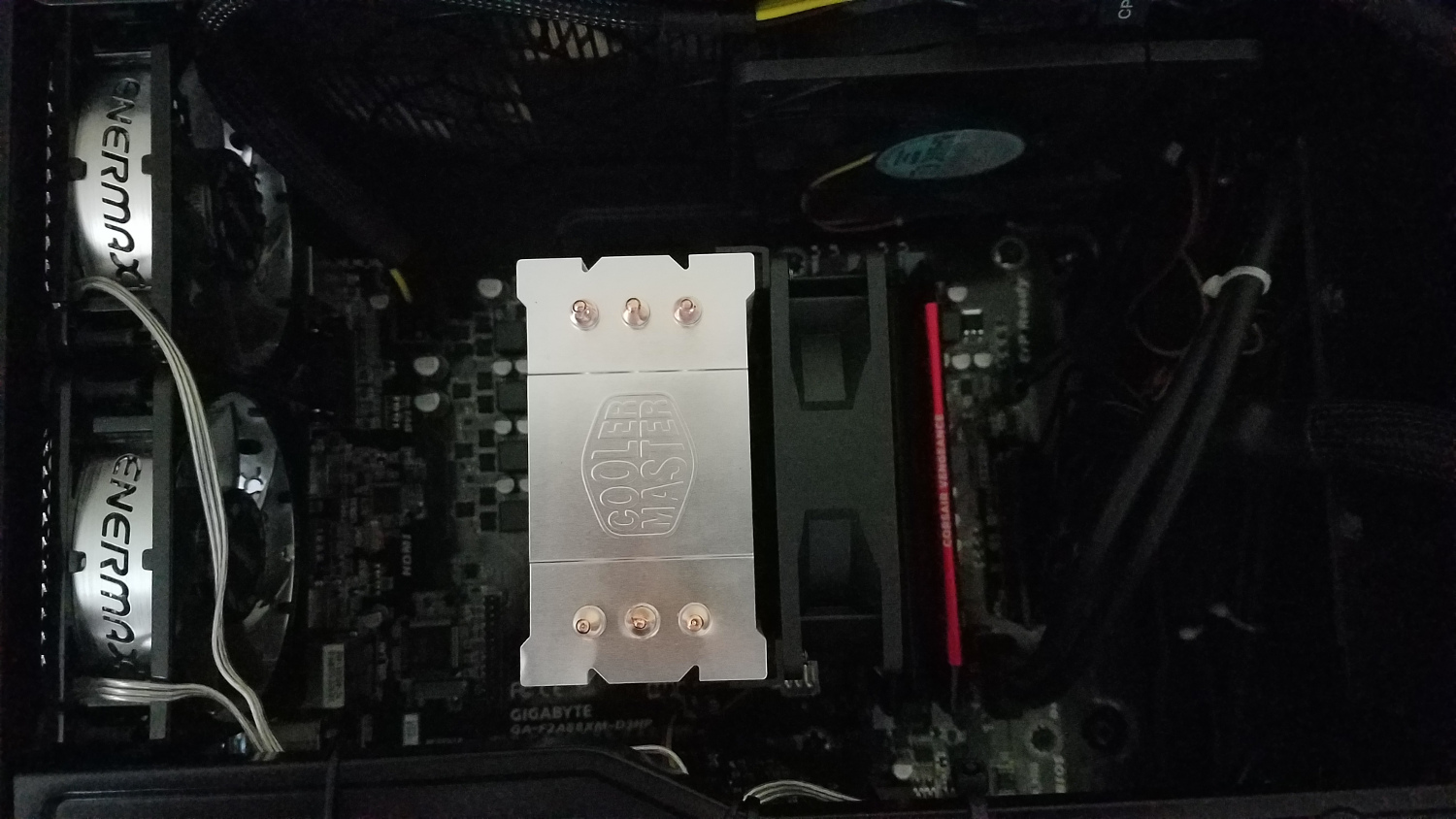
The Cooler Master Hyper TX3 does a pretty good job of keeping the X4 cool as well. It has a lower profile than the famous and popular Hyper 212 EVO, allowing it to fit into the Silverstone GD09 with a few millimeters to spare. And the fan is pretty silent as well, but still had no problem keeping up with the CPU, especially since it has a 120mm intake fan right next to it, and two 80mm exhaust fans behind it.

The GD09 chassis is a great option for building an HTPC or desktop system. Just be sure to select a power supply that allows you to have a 120mm fan on the power supply side of the chassis. And definitely stick with a microATX or miniITX board for this. Full ATX will fit, but it’ll be tight quarters. This is definitely not a chassis for high-end hardware, and there is no room for an AIO. You definitely need to get creative with cable management as well.

In building the system, I picked up a Kingwin KW-PCI2H25, a bracket for mounting 2.5″ drives (SSD or laptop drives) to an expansion slot. Initially I planned to use a 500GB 3.5″ drive as the storage in this system, but couldn’t figure out a way to mount it. In checking prices for 2.5″ drives at Micro Center, I discovered the SSHD for a very good price. But I still needed a way to adequately mount it.

I considered using a 2.5″ to 3.5″ adapter tray and taping it to the top of the power supply. Then I happened to see the Kingwin bracket. So if you’re considering a small form-factor build, keep an eye out for that to see if it might work well for you.

Use case

This system is for light duty and mid-tier gaming. The client is a friend who plays World of Warcraft along with  few lighter-end titles. And her current system is on its last legs, not to mention painful when trying to play World of Warcraft.

Her current system is an AMD E-300 APU, using it’s integrated Radeon HD 6310 graphics, I think 4GB RAM, and a 500GB HDD. It’s about identical to the system that White Lightning replaced, the laptop board that HP adapted to make cheap, low-power desktop systems powered by a laptop power brick and no room for expansion beyond swapping out the HDD for an SSD or adding memory.

Noise

Silence has been one of my main obsessions lately with building systems, especially with Mira and a quiet cabinet I have in progress, and this was no different. And I’m also glad to see that it’s been a target focus of much of the market for cooling solutions.

The only noticeable noise is on boot when one of the fans is noticeably loud — I want to say it’s the fan on the Hyper TX3. Beyond that there is barely any noise unless you hold your ear next to the chassis. Without the power light or staring at the fans to make sure they’re spinning, there’d be virtually no indicator the system was actually on.

Under load, things are a little different, and the system does start to become noticeable with the CPU fan. I don’t recall noticing any noise from the graphics card fan during stress testing and benchmarks.

Along with the stock 120mm fan that comes with the GD09 and the 92mm fan on the Hyper TX3, I added three (3) Enermax T.B. Silence 80mm fans (product no. UCTB8) and a Bitfenix Spectre Pro 120mm. The Spectre Pro is adjacent to the power supply blowing in. Two of the 80mm fans are behind the CPU, and the remaining is hanging above the expansion cards on an expansion slot fan bracket, all blowing out.

Benchmarks

Let’s get into some benchmarks to see how well this system performs. Scores for Mira are in [red]. During benchmarks on its stock cooler with its stock profiles, the graphics card boosted to over 1759 MHz on the core. The CPU boosted to 4.0 GHz.

  • Unigine Heaven (everything maxed, 1080p): 920 [2428]
  • Unigine Valley (Extreme HD preset, 1080p): 1643 [3909]

Since the GTX 1050 Ti is nowhere near as powerful as the GTX 1070 or 1080, these scores aren’t that surprising.

Heaven is usually pretty good about isolating the GPU. I’ve noted such when I upgraded my personal system, Mira, from an AMD FX-8350 to an Intel i7-5820k while keeping my GTX 770 SLI pair for the initial upgrade. In that upgrade the Heaven scores didn’t budge much — only a few percentage points higher. And a video I found on YouTube showing a Heaven benchmark for the GTX 1050 Ti paired with an i5-6400, the score comes in only about 30 points higher than this score with similar settings.

Valley is a little more CPU involved, as I’ve also noticed with Mira. Yet this score isn’t far off what others are producing with the GTX 1050 Ti and newer processors. One video I found which paired the GTX 1050 Ti with the Intel G4560 produced a score shy of 40 points better than this one. And that’s with the card appearing to be clocked better on core and memory as well. And another video with the i5-6400 paired with the GTX 1050 Ti also produced a score shy of 40 points better.

So at least with regard to Valley and Heaven benchmarks, there isn’t much of a problem pairing the GTX 1050 Ti with the Athlon X4 860k. But to get a better idea of whether this is a decent pairing or not, let’s turn to 3DMark.

  • 3DMark Time Spy: 2162 [6143] – Graphics: 2260 [6154], Combined : 1738
  • 3DMark Firestrike: 5650 [15780] – Graphics: 7667 [18942], Combined : 2216

To say this system struggled with these benchmarks would be an understatement. The graphics tests for Time Spy averaged at 15 FPS for the first test, shy of 13 FPS for the second. And the CPU test was shy of 6 FPS.

Fire Strike fared better, but there was still some noticeable stutter from the demo. Both graphics tests averaged above 30 FPS, with the first test averaging better than the second. The Physics test averaged at 14 FPS and the CPU test averaged at a little over 10 FPS.

  • 3DMark Sky Diver: 14402 [38362] – Graphics: 25176 [63835], CPU: 11252
  • 3DMark Cloud Gate: 11427 [33322] – Graphics: 50344 [121253], Physics: 3084

These benchmarks were much nicer to the system, and the system had no problem keeping up with either.

And in comparing these benchmarks with systems with comparable processors, from what I could find, the performance, as represented by benchmark numbers and frame rate comparisons, is very similar when comparing to an i5 or i3 processor.

As such it’s reasonable to pair a GTX 1050 or GTX 1050 Ti with an Athlon X4 860k. Regardless of what you use with the GTX 1050 or 1050 Ti, you’re not getting stellar performance unless you turn down the settings. And pairing it with newer processors (Skylake, Kaby Lake, Haswell-E) doesn’t appear to provide significantly better performance unless it has a higher thread count.

Temperatures

During all of the benchmarks, the GPU never hit 70C, leveling out in the mid-60sC. In part because I took advantage of the horizontal expansion slot at the top of the chassis to mount a fan using an expansion slot mount bracket. It’s just an 80mm fan, but it helps clear hot air away from the graphics card. Additionally there is a 120mm fan adjacent to the power supply to bring air in for the GPU.

With the Hyper TX3 and the fans around it, the CPU never went into the 50sC. Even when running Prime95. So there’s clearly room for overclocking the CPU, but I’m not worrying on that. And this is in part due to the 120mm fan immediately near the CPU and the dual 80mm exhaust fans behind the CPU. The X4 was also boosting to 4.0GHz from its base clock of 3.7GHz during these tests.

So I will almost certainly be using the Hyper TX3 in future builds, where it’ll fit.

Conclusions

Compared to her existing system, this is a significant improvement. She’s getting a processor that supports dual-channel memory, has twice as many cores and a significantly higher clock speed. And the graphics performance is like night and day.

Crisis should be able to power anything she does without difficulty. Unless she opens a bazillion tabs in Firefox or Chrome. The GTX 1050 Ti goes well here, too, and it’ll provide very good performance for World of Warcraft.

This system could likely handle some modern titles as well with the settings turned well down, since even with higher-end processors the GTX 1050 Ti is still not able to perform nearly as well as even the GTX 1070. From what I could find it does outpace the RX 460 while comparing to the RX 470 on performance, but having much lesser power requirements. So I might trade the RX 470 in White Lightning for a GTX 1050 Ti. But since I’m planning to set up White Lightning as a Ryzen system later this year, that’ll likely wait.

More dress code idiocy

Let’s get something straight about dress codes.

High school is when teenagers are supposed to learn what will be expected of them in the real world. And the kind of clothes they’ll be expected to wear on the job. And the fact that dress codes will be a part of your working life. Even in my office where the dress code is casual, some of what teenagers wear to school, allowable under the school’s dress code, would not be allowed. And dress codes are written to, as best as possible, remove subjectivity from the equation.

Yet it seems that teenage women across the country are clashing with dress codes, and labeling the dress codes sexist because they appear to be enforced against women more than men.

Here’s the thing. If teenage fashion, in particular teenage female fashion, is clashing with school dress codes, then fashion needs to change. Again dress codes will be a part of life, so teenagers, especially teenage women, need to learn to get used to it without complaining. In the real world, what you think “looks fine” might get you sent home from work. Without pay if you’re hourly. And repeated noncompliance with a dress code is grounds for termination.

The “distraction” excuse is really just that, and it’s something that administrators need to stop saying. Period. Justifying a dress code is no harder than merely saying “it’s what will be expected of you on the job”. Since you will be expected to comply with a dress code when working, with reprisal for noncompliance.

Perhaps we could completely remove any subjectivity and make public school uniforms universal.

Part of me, however, is actually worried about this trend. And it comes to the narrowing definitions of consent and harassment. I’m wondering if the young women today who are continually purporting the dress codes to be sexist and misogynist will be the working women of tomorrow calling it sexual harassment. Given the trends over the last couple years, I can’t help but wonder if that is the direction all of this is going.

The decline of Christianity

Article: “Ten reasons millennials are backing away from God and Christianity

Just as the left is largely delusional with regard to Clinton’s loss — the constant screams that it’s because of racism and sexism, and Van Jones calling it a “whitelashing” — much of the religious right is very well deluded into why many of the latest generation are eschewing religion. Dr Alex McFarland’s latest article with Fox News is no different.

But millennials largely not wanting religion is one of the reasons churches have been doing more to reach out to them, by adapting their church services and offerings into entertainment-style programs that they feel will appeal more to today’s youth. My wife observed such when she attended a church service with her sister and brother-in-law in Columbus, Missouri. And Seth Andrews, of The Thinking Atheist, observed such as well in a presentation at FreeOK 2013:

Christianity in the West, the United States in particular, is on a steep decline, as Dr McFarland points out in the preamble to his article:

In fact, the Pew Research Center documents that millennials are the least outwardly religious American generation, where “one in four are unaffiliated with any religion, far more than the share of older adults when they were ages 18 to 29.”

And one of the reasons for this, as the Doctor also notes, is this judgmental attitude among a lot of religions and the people purporting to represent those religions. While he specifically notes the attitudes of Christian conservatives against homosexuality, it’s something that I and other atheist writers have noted with regard to any belief that deviates from Christianity. Indeed Christian hostility toward atheism is well documented.

But the Doctor’s attempts to explain why more people are leaving religion — not just the younger generation — is laughable at best. As someone who has been loosely involved in atheist activism over the last decade, I can tell you the reasons are a bit more involved than McFarland’s reductions. But let’s address his points specifically.

1. Mindset of “digital natives” is very much separate from other generations. Millennials are eclectic on all fronts—economically, spiritually, artistically. There is little or no “brand loyalty” in most areas of life.

This actually isn’t true. A lot of millennials do still have a lot of brand loyalty. Often annoyingly so. For example the proliferation of Apple products among millennials isn’t a stereotype without reasons.

While it might seem that millennials have eclectic tastes, thereby allowing the hypothesis they aren’t loyal to any brand, millennials are instead not firm in their loyalties and seem willing to switch their loyalties at the drop of a hat. This has led to many different adaptations within the market whereby companies have had to invent completely new ways to encourage customers to stay with their brand.

2. Breakdown of the family. It has long been recognized that experience with an earthly father deeply informs the perspective about the heavenly father. In “How the West Really Lost God, sociologist Mary Eberstadt correctly asserts, “The fortunes of religion rise or fall with the state of the family.”

This is demonstrably untrue. Indeed some of the peoples with the greatest family breakdown are actually the MOST religious. That being the black population in the United States, where 7 in 10 pregnancies are unintended and nearly half of those end in abortion. And most black children are raised without fathers. But most blacks are also very religious.

Pew Research Forum even demonstrates this. In a survey of over 24,000 individuals, 13% of those who identified as Christian also said they are black, matching approximate population demographics of blacks for the country. This is consistent an earlier 2007 survey that estimated 87% of blacks (as opposed to 83% of the general population) are religiously affiliated, with Baptist making up the plurality.

So religion is largely not connected with family status.

3. Militant secularism: Embraced by media and enforced in schools, secular education approaches learning through the lens of “methodological naturalism.” It is presupposed that all faith claims are merely expressions of subjective preference. The only “true” truths are claims that are divorced from any supernatural context and impose no moral obligations on human behavior. People today are subjected to an enforced secularism.

And now we get into blatant misrepresentation.

Methodological naturalism is, in short, the scientific method. It is a means of determining, to a great degree of objectivity, whether a claim is true. It is the bedrock of science, and as such is the reason for the advances of science. If a claim cannot be shown to be true, it must be rejected, or at least set aside or modified to reflect the evidence.

Eugenie Scott, PhD, of the National Center for Science Education gave a talk at the University of Michigan back in January 2006, not long after the famous Kitzmiller v. Dover “intelligent design” trial in the United States District Court for the Middle District of Pennsylvania. In that talk, she specifically addresses the claim that science is anti-God or, as she put it, “science means God had nothing to do with it”:

As Dr Scott touches on basically every point that could be said on this, I’ll let her words stand on their own. But I will reiterate this point: whatever you want to believe about God and his alleged interaction on the world, you cannot use the scientific method to prove that.

The fact that we can repeatedly demonstrate many of the claims in science shows one of two things: either God exists and is not interacting with the world, letting us learn about the world he supposedly created such that he won’t screw up our attempts to do so, or he doesn’t exist at all.

Since the latter is the easier conclusion, along with science repeatedly showing the claims of the Bible to be completely wrong (such as Genesis creationism, regardless of flavor), many choose to accept that. It is why most scientists are atheist or agnostic.

This is especially the case given the utter dishonesty of many of those attempting to assert the Bible as factual — such as Ken Ham of Answers in Genesis and Kirk Cameron and Ray “Banana Man” Comfort. So instead of asserting “militant secularism”, perhaps you should instead look at those who are attempting to speak on the side of God and get them to clean up their act.

Quoting this notion oft-repeated by atheist activist, and candidate for the Texas State Senate, AronRa, you can either be honest, or you can be a creationist, but not both, because creationism is inherently dishonest, and requires acts of dishonesty, deceit, and outright fraud to purport and defend.

Some scientists are still Christian or Catholic, such as Kenneth Miller, PhD, of Brown University, author of the book Finding Darwin’s God. But Dr Miller and others like him are not creationists.

4. Lack of spiritual authenticity among adults. Many youth have had no — or very limited — exposure to adult role models who know what they believe, why they believe it, and are committed to consistently living it out.

This is in part because many adults largely stop looking to their religion with every thing they do.

5. The church’s cultural influence has diminished. The little neighborhood church is often assumed to be irrelevant, and there is no cultural guilt anymore for those who abandon involvement.

And this is a bad thing… how?

6. Pervasive cultural abandonment of morality. The idea of objective moral truth—ethical norms that really are binding on all people—is unknown to most and is rejected by the rest.

Not quite. Instead what’s different is the morals themselves.

You see, much of what Christianity claims is immoral has no foundation other than “God says so”. The six commandments of the Decalogue that actually apply to human behavior can be shown as immoral without difficulty. Killing, stealing, lying, infidelity. These are all things that most anyone, unless they’re a socio- or psychopath, will agree are wrong.

It comes down quite readily to the Golden Rule — which predates Christianity, by the way.

But if you look at the laws in Leviticus and Deuteronomy, how many of those are actually outlawing something that is demonstrably immoral? And more importantly, how many of those do you actually observe in your day to day?

7. Intellectual skepticism. College students are encouraged to accept platitudes like “life is about asking questions, not about dogmatic answers.” Is that the answer? That there are no answers? Claiming to have answers is viewed as “impolite.” On life’s ultimate questions, it is much more socially acceptable to “suspend judgment.”

And again with the misrepresentation. Intellectual skepticism means not being satisfied with an answer until it is demonstrated as true. Mere assertions are not enough. And since Christianity has only assertions and practically nothing in the way of actual evidence, more people are becoming more skeptical of the church and its claims and beliefs.

And the bedrock principle of intellectual skepticism is simply that no claim is sacred. It doesn’t mean we always suspend judgment or that there are “no answers”. It means only that when someone makes a claim, you ask for the evidence. It doesn’t matter what you believe, but why you believe it. In short, why should I believe what you claim?

8. The rise of a fad called “atheism.” Full of self-congratulatory swagger and blasphemous bravado, pop-level atheists such as the late Christopher Hitchens (whom I interviewed twice) made it cool to be a non-believer. Many millennials, though mostly 20-something Caucasian males, are enamored by books and blogs run by God-hating “thinkers.”

If it’s a “fad”, it’s one hell of a successful one given how long it’s been around as a concept. For one, I’ve been an atheist pretty much all my life. It was only about 17 years ago when I first encountered the word “atheism”. And I’ve been loosely involved in online atheist activism for about 10 years.

And the likes of Richard Dawkins and the late Christopher Hitchens didn’t make it “cool to be a non-believer”. This is especially the case given how caustic both can be in their language and rhetoric. And I’ve read Hitchens beyond his infamous book God is Not Great. I have an anthology of essays called Love, Poverty, and War, and I intend to buy the book Mortality, which is another anthology of his essays. The man was a brilliant writer and speaker.

There is, however, a greater implication here with which I do agree. And to address it, I’ll need to skip to point 10 first.

10. The commonly defiant posture of young adulthood. As we leave adolescence and morph into adulthood, we all can be susceptible to an inflated sense of our own intelligence and giftedness. During the late teens and early 20s, many young people feel 10 feet tall and bulletproof. I did. The cultural trend toward rejection of God—and other loci of authority—resonates strongly with the desire for autonomy felt in young adulthood.

In attempting to establish their independence, young adults often get over confident. I can say I’ve been in that position before, and I’ve observed the same in others. Unfortunately this is now being coupled with a healthy sense of delusional thinking. As in childhood make-believe was never squelched when it should’ve been and has leeched into real life. The “non-binary” and “gender fluid” crowds are evidence of this.

Prior to the Internet, this could be largely contained and kept from getting well out of control. In part because the parents and family of the people exhibiting the behaviors we’re seeing would’ve done what they could to contain and correct that behavior.

We no longer have that containment. And it’ll likely be impossible to regain it.

Tumblr and the subculture that’s grown around that site is easily the greatest example of this:

I’m currently working another speculative article on the rise of social justice warriors in the West. And back in 2011, I wrote another article called “Trading one religion for another“, in which I observed the trend for many teens becoming atheists to also become hardcore progressives, and seemingly overnight.

The larger concern here, though, is what is coming with this. And it’s a phenomenon that’s largely developed just over the last five years: victimhood has become profitable. As I said, I’m working on another speculative article which will delve deeper into this, so I won’t elaborate here.

Instead back to Dr McFarland and his last point:

9.  Our new God: Tolerance be Thy name. “Tolerance” today essentially means, “Because my truth is, well, my truth, no one may ever question any behavior or belief I hold.” This “standard” has become so ingrained that it is now impossible to rationally critique any belief or behavior without a backlash of criticism.

This also goes into the previous points — I think his ordering of them could’ve been more logical. But then he’s probably still taking only an outsider’s perspective on much of that anyway. As I said earlier, I’ve been loosely involved in online atheism for about the last 10 years. Looking back I’ve seen how much of this grew out of that, starting when calling oneself “atheist” was the new rebellion. It’s one of the reasons many Christians called atheism merely a “phase”, similar to the Doctor calling it a “fad”.

The situation is only getting worse by the day. When the universal SCUBA symbol for “I’m OK” is now being purported to mean “white power”, we have a major problem on our hands.

The new “tolerance” attitude is merely indoctrination by a different name. As such, Dr McFarland is actually being quite reserved in how he mentions this, though to be fair his article wasn’t intended to be an in-depth discussion. It’s just a shame he had to misrepresent so much, as I have to be in-depth to correct where he went wrong.

No reason to fear debt, unless you listen to Dave Ramsey

On a forum I frequent was posted a list of books that couples should read before they are married. One of them was Dave Ramsey’s Total Money Makeover. In response to the posting, and another member praising the book, I called Dave Ramsey a salesman, saying he is not a financial guru.

And a recent article on his blog shows this, called “6 Common Money Myths to Avoid“. And what’s top of the list? (Emphasis theirs).

1. Debt is a tool.

The Truth: Some tools help you fix things. Other tools help you break things. So, in that sense, debt is a tool . . . consider it a sledgehammer to your financial future. Another way of putting it: Debt is the enemy of your income. The monthly payments you send to MasterCard are monthly savings you could be putting toward your retirement, your kids’ college, and your down payment on a new house!

Dave Ramsey’s philosophy is to avoid debt at all costs. I really, really wonder how much of what he preaches that he actually practices. Does he also pay cash for everything, and actually keep physical cash in physical envelopes and use that for budgeting? Yeah, I doubt it.

And the reality with regard to debt isn’t so straightforward.

Debt is a tool. But it isn’t the “enemy of your income”, unless you let it become that. Which for most of Ramsey’s audience, that likely is the case. What Ramsey and his contributors continually overlook is “leveraging“. Click on that link and you’ll see where I’ve responded to him before and is continual treatment of the concept as if it’s nonexistent.

As I make clear in that article, how you use debt determines whether it’s an “enemy of your income”. Unfortunately his next point shows as well how much he’s willing to treat “leveraging” as if it’s a concept that does not apply to personal finances.

2. Car payments are a way of life.

The Truth: If you believe debt is a tool, you’re just as likely to believe car payments are a way of life. The average car payment these days is nearly $500 per month, according to Experian Automotive. That’s $6,000 per year you’re putting into something that decreases in value. Instead, save that $500 every month for a year and buy a nice, used, $6,000 car. The best cars are the ones without a payment.

Let’s go back to my article on leveraging and personal finance.

There are two types of assets related to personal finances, since most of us don’t track assets to the same degree of granularity as a lot of companies. So to us, most assets are either appreciable assets — things that will go up in value — or expense assets. The latter goes by another name if you’re referring to a business: inventory.

Most people buy things with the intent of getting utility from them. Food. Utensils. Appliances. Power tools. And even vehicles.

Vehicles are a utility asset, not an appreciable asset. As such, the question that you need to ask before taking on a payment plan is whether you will get more out of the asset than you’re paying each month against it. It’s certainly great to have a vehicle without a car payment. I’m glad to be in that boat myself.

And most who pay off their loans will keep their cars until they’re no longer serviceable. Since there’s hardly any point in paying for a $2,000 repair on a 10 year-old car, for example.

Which actually brings up another part of the equation: opportunity cost. In short, what opportunity are you giving up with a particular decision versus the opportunity you’re accepting? In choosing to make the $2,000 repair, that is $2,000 out of your pocket up front to get your car a little more down the line.

Now if you can afford to pay that $2,000 out of pocket, congratulations. Now you could instead make that $2,000 a down payment on a newer vehicle, perhaps one still under warranty. Sure you’re taking on a monthly payment, but the newer vehicle will have several advantages over the clunker you’re trading in or leaving behind. You have a vehicle you won’t have to worry might break down on you at any point — including the day after you make the $2,000 repair. And peace of mind is difficult to label with a price tag.

But even if you can’t afford the $2,000 repair, again taking on the monthly payment for a newer vehicle buys you some peace of mind. And the cost could be offset in other ways, such as lower insurance rates and better fuel economy (depending on how often you drive). Having a more reliable vehicle could also lead to better opportunities since you’re not so paranoid about your car.

See what potential opens up when you’re not being so short-sighted about having a car payment?

4. You can’t go to college without student loans.

The Truth: You can. You absolutely can. Will it be easy? Probably not. Will it be worth it? Totally. Whether it’s college-specific aids and grants, or federal and state aid (that’s grants and scholarships, not loans), going to college without debt is absolutely possible. And what about paying for college out of your own pocket—or making your upcoming college student do just that? Rachel Cruze talks about college planning all the time. There are plenty of alternatives to loans when it comes to funding college tuition.

Yes there are plenty of alternatives. Few will be able to fund them to the degree that you need to get a college degree in a reasonable amount of time.

I know a few people who came out of college without any debt. And I would’ve loved to be them. But I didn’t have much in loans myself, not compared to what was considered average back then.

But I also studied a major that is worthwhile. If you study a major that is worthwhile, then you should have little difficulty paying off your loans out of college. At the same time, though, be smart about where you go. Get an Associate’s degree first to keep initial costs low. I had only a small loan coming out of community college that was easy to pay off.

Do well in community college to set yourself up for scholarships when you transfer to a 4-year school. Study a decent major and do well and you’ll come out of school employable. Which will make paying off your debt easier.

At the same time, depending on what you study, you may be able to find sponsors who would be willing to pay your way through college in exchange for a few years of work. And there’s always the military and the benefits you get from serving for a few years.

And before even considering college, ask yourself whether you actually need to go, or whether your time would be better spent in a trade school.


Well that’s it for this iteration. Don’t have much to add to his other points, so I’ll just call it here.

You want a result, not research

With the recent (forced) resignation of the Surgeon General of the United States, many have alluded to his gun control stance as one of the reasons the President pushed for his resignation ahead of the end of his term. So with Vice Admiral Murthy out, Rear Admiral Sylvia Trent-Adams is the acting Surgeon General.

The Office of the Surgeon General has not been without controversy. When I was growing up, one such controversy arose during the short term of Jocelyn Elders, who publicly called for drug legalization and distributing contraceptives in schools. She also talked quite frankly about subjects such as masturbation, abortion, sexuality, and comprehensive sex education.

And even C. Everett Koop wasn’t able to escape controversy. Koop was personally anti-abortion. As such he was pressured by Reagan and other conservative politicians to position the Office of the Surgeon General as decisively anti-abortion. He openly resisted, even refusing to prepare a report declaring abortion to be psychologically harmful to women, citing a lack of evidence supporting the assertion.

Vivek Murthy’s controversy, however, was gun control. And his confirmation was opposed by gun rights groups due to his stance that the CDC needs to research gun violence. This stance is well-reflected in anti-gun circles with the continued calls for more research.

It’s also a flat-out lie. Gun control groups don’t want research. They want a pre-conceived result.

They want the research to reflect their views. Yet research has been ongoing by independent groups. So I guess they want the CDC doing the research because of the perceptive authority of the CDC. I guess that if their views are reflected in CDC research, it sounds more official.

Two problems with this, though: the facts don’t support gun control, and the entire United States Public Health Service, which includes the CDC, has a clear anti-gun bias.

And again the facts are not on the side of gun control. Never have been.

Even post-Heller DC has not seen an increase in homicides, contrary to all the predictions. This is reflected in articles published over the last several years. Sources include an article from the Washington Times in 2009, from Reason in 2012, the NRA-ILA in 2014, and most recently on from the Daily Caller on April 17, 2017.

For those not immediately recalling, Heller refers to the District of Columbia v. Heller, 554 US 570 (2008), decision that upheld the right to keep and bear arms as an individual right in striking down the District of Columbia’s handgun ban. Heller didn’t change the homicide rate trend since it was already going down before Heller. But the fact the homicide rate continued to go down after Heller shows that DC’s handgun ban wasn’t helping things either when they did have it.

Something else was leading DC’s homicide rate decline despite the strict gun laws and the forced change by the Supreme Court.

The trend also contradicts the repeated assertions of anti-gun advocates who claimed with Heller the same thing they claimed with expanded concealed carry: “OK Corral”, “blood in the streets”, “road rage settled with guns”. That whole spiel.

And the single largest fallacy of gun control proponents is improper representation of the data.

Let’s start with this: the United States is federated republic of 50 sovereign, independent States, plus several Territories and the disparate Native American tribes and reservations. The fallacy with data representation comes in aggregating the data together.

I’ve said before, and the data demonstrate, that gun control laws largely don’t do much for homicide and crime rates. Neither do gun friendly laws. Because I’m largely convinced that regardless of the state of gun laws, those who seek to victimize others will take their chances. They will adapt. If gun laws loosen and more people are armed, then they’ll become more careful, but they won’t stop.

What concealed carry laws do, however, is change the odds. They make it so that fewer people need not take chances as well. It doesn’t mean they can be cavalier about their safety, and situational awareness will always be your friend. But it doesn’t mean they’re sitting ducks either. Instead those seeking to target the innocent have to be more calculating.

We have gun friendly States with high homicide and crime rates. Missouri comes to mind, but that is largely skewed by St Louis and Kansas City. And there are gun friendly States with low homicide rates. Vermont comes to mind.

And there are gun control States with high homicide rates, such as Illinois and California. But again the same must be pointed out: the rates are skewed by the bigger cities where crime is more rampant. And gun control States with lower homicide rates. Hawai’i comes to mind. But even if Hawai’i were to go constitutional carry tomorrow, I doubt it’d have much effect on their homicide rates due to their isolation from the mainland. It’s difficult to get guns to Hawai’i, especially with Federal laws regarding interstate transport of firearms for commerce, let alone get a gun in Hawai’i.

So stronger gun laws don’t really do jack for crime, and looser gun laws don’t do much either. Because crime exists independently of gun laws, and won’t change because of stronger or looser gun laws. That is the overarching reality many don’t want to accept.

Same with this reality: most crime and violence occurs where Democrats reign. The majority of homicide offenders, where race is known, are black. And the majority of homicide victims knew their killer. And there is little that legislation can do to address that since it can’t really address the desire to commit crime.

But again, gun control advocates don’t want research. They want a particular result. Make no mistake about it.

An idea for Illinois (and other States)

While Illinois issues non-resident concealed carry permits, it will only entertain applications from residents of four other States. Interestingly one of them (as of the time I write this) is Texas. So for everyone else, we’re basically out of luck as far as being able to carry concealed in Illinois since they will only honor their concealed carry permits.

Absent national reciprocity, is there a viable alternative? Absolutely.

I’d like to make a simple proposition to Illinois: allow non-residents to go to Illinois to obtain an Illinois permit as if they are an Illinois resident. I’ll use myself as an example as I live in Kansas. If Illinois allowed this, I would make the necessary reservations for the concealed carry class at a licensed venue in Illinois. This would mean also making reservations at a hotel and seeking out nearby restaurants and businesses while staying there. So the immediate economic benefits to Illinois businesses are obvious.

And then there’s the benefit to the Illinois government. Along with sales and service taxes, non-residents would be paying the fees to file application for a concealed carry permit. So that’d be additional money for Illinois all around.

Beyond that, it has the potential to create new businesses, which leads to more jobs. Since the only way to meet the potential demand is with additional supply. And Illinois would likely also need to hire more law enforcement to handle a surge in permit applications.

It would also alleviate Illinois’ concern about non-residents and concealed carry.

And non-residents would have an avenue for being able to legally carry concealed in Illinois. Rather than just avoiding the State entirely.

Safety regulations and firearms

The site TeddyGun.com has recently cropped up, sponsored by the Illinois Council Against Handgun Violence. And it aims to mislead you into thinking that there is virtually no regulation around the manufacture of firearms.

And they say their comparison is “based on Federal safety regulations for the manufacture of domestic toys and firearms”. As they are comparing it to the manufacture of a child’s toy.

Interesting how in discovering the various regulations (and I doubt they listed all applicable ones) regarding child toys that they aren’t advocating for lesser government regulation regarding said toys. Question: how much of that regulation is needless?

And if you believe what they say, apparently all you need to make a firearm is a Type 7 Federal Firearms License. Setting aside for the moment how difficult obtaining such a license can be, what else is involved?

For starters, regulations regarding the forging of steel and molding of plastics. These are regulations not specific to firearms, though, because they apply across the board to all businesses working with molten metals and plastics. The same regulations apply to the manufacture of a 2L soda bottle as the polymer frame for a firearm. And the same regulations governing the forging of metals for the steel frames for a vehicle apply to the steel work for making a firearm.

The only reason to have onerous safety regulation would be defective firearms. Except firearms are almost never defective in manufacture. And when they are, it’s almost never in a manner that would endanger the person handling it. Unless the defect causes the firearm to fail to fire when you’re trying to use it in self defense… Typically if a firearm becomes defective, it’s due to improper maintenance or negligence by the owner.

Ammunition is a slightly different story simply because the risk of misfires and squibs is there, with the latter being far more dangerous. But both are extremely rare in the totality of cartridges manufactured. And anyone who owns a firearm should know how to deal with that.

The fact that firearms don’t have specific safety regulations doesn’t mean it’s a complete free-for-all. The legal concept of strict liability comes into play. This concept applies to the makers of power tools. What are the Federal safety standards regarding power tools? There likely aren’t any specific to power tools. Indeed in searching for the phrase (without quotes) “federal safety standards for power tools”, what are the first search results? OSHA, the Occupational Safety and Health Administration.

And they’re unnecessary because it’s quite obvious that companies like Black and Decker and DeWalt make and will continue to make safe products. Because not doing so would be very, very bad for the future of both companies.

Same with firearms. Beretta hasn’t been around for over 500 years by making defective firearms and crappy products overall. Same with Springfield Armory, the first firearms manufacturer in the United States, and one routinely cited as being top notch with their pistols and rifles. Their reputation is well earned.

But even among the lesser-reputable brands, such as Hi-Point and Kel-Tec, you’re still extremely unlikely to find a defective firearm.

If TeddyGun.com was actually advocating for safety standards and regulations over the manufacture of firearms, they would know that such standards are largely not necessary. Indeed many advances in firearms safeties have come without any government regulation or oversight! The biggest example is making sure that firearms are “drop safe”, meaning it will not discharge if dropped while a round is chambered. Other safety features include firing pin blocks and other safeties that prevent the firearm from discharging without the trigger being pulled.

The firearms and ammunition manufacture markets are virtually entirely self-regulating. If anything, the firearms manufacture industry is actually a major testimony against the need for strict government oversight and regulation. People aren’t dying from poorly-manufactured firearms. They’re dying because people are intentionally pulling the trigger, with the muzzle pointed at themselves or someone else. Adding onerous regulations to the manufacture of firearms won’t change that.

And that isn’t TeddyGun’s motives either. Instead it’s purely about gun control:

Support efforts to keep guns out of the hands of dangerous people with Federal common sense gun laws like Universal Background Checks on all gun sales, Legalizing CDC Research on Gun Violence and Illinois common sense gun laws like State License for Gun Dealers, and the Lethal Gun Violence Order of Protection Act.

So then why are there so many safety standards around the manufacture of toys? Toys don’t fall under the legal standards of strict or vicarious liability. And the standards are intended to give the Federal government authority to punish noncompliance, along with establishing other penalties should death or injury result from noncompliance.

Firearm defects (i.e. a true accidental discharge) that result in the death or injury of another person are virtually non-existent. I’ve personally never heard of one, and I welcome any reports of such incidents.

Like virtually every other anti-gun group out there, the Illinois Council Against Handgun Violence is merely misrepresenting the state of the law to pursue an agenda.

Chicago Sun-Times gets it horribly wrong

Article: Stop Congress from trashing Illinois’ concealed gun protections

Hard-left liberals are vehemently anti-Second Amendment. And since Illinois is largely controlled by them, no surprise the Chicago Sun-Times editorial board would produce an op-ed piece that gets everything wrong regarding the current state of gun laws.

And they start off by strawmanning gun rights advocates:

The people who think the Second Amendment phrase “well-regulated” means “not regulated at all” are back.

And then continue by butchering the definition of concealed carry reciprocity:

This time, they’re pushing a dangerous idea called “concealed carry reciprocity” that would allow people who get concealed gun carry permits in states that have absolutely no restrictions to carry those hidden, loaded guns anywhere in the country.

They are referring primarily to “constitutional carry” states like my resident State of Kansas. While I can carry a firearm without a permit, I can’t carry it wherever I want, so it is not without restrictions. Same with the other constitutional carry States.

And continuing from here, it’s clearly obvious that the editorial board is completely oblivious to the current state of gun laws across the country. Since they list people who would be unlikely to receive a concealed carry permit in any State, including the more gun-friendly States like Missouri and Kansas:

That means a state such as Illinois could no longer draw a line and refuse to give concealed carry permits to people convicted of violent misdemeanors, substance abusers, repeat drunken drivers or who have severe mental health issues.

Substance abusers are considered “prohibited persons” under Federal law. If you don’t believe me, look at question 11 on the ATF 4473 form. Same with those with “severe mental health issues”, provided they’ve been properly adjudicated by the Court.

And while the violent misdemeanor of domestic assault is the only misdemeanor that automatically disqualifies you from owning a firearm, meaning it also disqualifies you from carrying it, States can decide that other violent misdemeanors also disqualify you from a concealed carry permit. And have.

Illinois will disqualify you if you’re arrested too many times, regardless of the reasons behind the arrest or whether you were actually formally charged with anything. And apparently that’s been used to disqualify a lot of blacks from being able carry concealed in Illinois. So the hard left complains about racist policies, and then hard-leftists in Illinois use their own policies in a racist fashion…. Oh the irony!

So their worries are definitely far overblown.

But it doesn’t stop there.

Under the U.S. House version of a proposed law being considered in Congress, all those folks could simply get a permit from another state — one with much looser restrictions — sometimes just by mailing away for one. Twelve states require no permit at all.

Twelve States don’t require a permit to carry within their own jurisdiction.

And you can’t just “mail away for one” either. Several States do grant permits to non-residents who are not in the military and residing in the State under orders. But you can’t just “mail away for one”. Well, technically you can, as the application paperwork is mailed to that State. But the application process isn’t easy, and the qualifications for a non-resident permit aren’t different from the qualifications for a resident permit. Meaning you likely need to submit a certified marksmanship evaluation as well.

And you also have to submit to a background check.

And the lowest fee I’ve seen so far for a concealed carry permit is $100. So how can you just “mail away for one” exactly?

If your permit is ever revoked or an application denied in one State, that doesn’t mean you can just send away and get one in another State. Background checks for concealed carry permits are very involved. And if you’re denied in one State, chances are you’ll be denied in one of the States that issues to non-residents.

Let’s take New Hampshire as an example. On their form for a Non-Resident Pistol/Revolver License, you have to provide information not required by residents. And several of the questions repeat those found on the ATF 4473. Two questions in particular:

  • Have you ever had a permit or license to carry denied in this or any other state?
  • Are you an unlawful user of or addicted to any controlled substance?

And given the form is signed under penalty of perjury, someone could lie about the second question (unless they’ve been involuntarily hospitalized for substance abuse), but the first one is likely to show up in a background check.

Moreover, Illinois requires 16 hours of training and a valid Firearms Owner Identification Card before someone can get a concealed carry permit. The training ensures that those who carry hidden guns understand the laws. But why would anyone go through all of that if they could mail away for a permit instead?

Again, YOU CANNOT DO THAT! Seriously, does no one fact check what you publish?

Under concealed carry reciprocity, someone like Stephens — still on the run as of Monday afternoon — could legally carry and conceal his guns anywhere in the country, including Illinois, no matter what his background is like.

That’s provided a State will actually issue him one! If he has questionable events in his background, he’ll likely be denied a permit, in which case he can appeal the denial depending on what’s on his background report.

Given all the calls leftists make about background checks, I’ve got to wonder if you think no one is doing them. That not even Illinois does them.

Seriously….

The Violence Policy Center has documented 928 deaths since 2007 in incidents involving concealed carry permit holders in 40 states and the District of Columbia. Concealed carry laws ought to be tightened, not tossed out with the trash.

That’s 928 incidents in 10 years. Not even 100 per year.

In 2015 alone, more 1 year-old children died from drowning according to the Centers for Disease Control than the per-year estimate of deaths related to concealed carry. Total drowning deaths just for 2015 is 3,602.

And in 2015, more people died EVERY DAY on average in motor vehicle-related accidents.

The rest of the article deviates from reciprocity and talks about State licensing of gun sellers, so I’m not going to focus on that.

* * * * *

So let’s talk about the reality of National Reciprocity.

National reciprocity would basically declare a concealed carry permit lawfully issued in one State to have Article IV protection in other States. By “Article IV” I mean Article IV of the United States Constitution, specifically the Full Faith and Credit clause:

Full Faith and Credit shall be given in each State to the public Acts, Records, and judicial Proceedings of every other State. And the Congress may by general Laws prescribe the Manner in which such Acts, Records and Proceedings shall be proved, and the Effect thereof.

This clause is why marriage licenses and divorce decrees have the full weight in all States as in the State in which the license was issued or divorce finalized. Driver licenses have similar reciprocity as well, courtesy of this Article IV protection since a driver license is considered a “public Act”.

But yet concealed carry is not, despite the fact that driving is not an enumerated Right in the Constitution, and I’d argue it’s not protected by the Ninth Amendment either, but owning a firearm is enumerated with the Second Amendment, with concealed carry being an extension of that.

When the Supreme Court of the United States declared in DC v. Heller, further strengthened by McDonald v. Chicago, that owning firearms is an individual right, the question of whether Article IV of the United States Constitution applies to concealed carry permits should have been settled in the affirmative. But it is not.

The bill to which the Chicago Sun Times was referring is HB 38, the “Concealed Carry Reciprocity Act of 2017“. And that bill was woefully misrepresented by the Chicago Sun Times since it’s not a free-for-all with regard to concealed carry.

Contrary to assertions, it does not override any State restrictions on concealed carry. It cannot. That would be a violation of the separate sovereigns doctrine. It doesn’t even force States to honor permits from other States.

Instead it opens up States like Illinois to liability with in a Federal Court for the deprivation of “of any right, privilege, or immunity secured by this section, under color of any statute, ordinance, regulation, custom, or usage of any State or any political subdivision thereof”.

This brings into this the Fourteenth Amendment’s Privileges and Immunities clause as well. This would basically be declaring the concealed carry of a firearm to be a privilege under the Fourteenth Amendment. While not the same as a right, it’s still means that States cannot touch it.