Demographics of gun violence

These numbers come from the CDC WISQARS Fatal Injury Report and Nonfatal Injury Report, cross-referenced with the FBI Uniform Crime Report. All data is for calendar year 2015. Hover over each slice of the pie to see the data.

This data is also incomplete as I need to cross-reference the population numbers provided by the CDC with the murder offender and victim numbers provided by the FBI to get an “offenders per 100,000” and “murder victims per 100,000”, so this article will be amended at a later date to represent that.

Suicide

Homicide

Murder victims (all weapons)

  • “SO/SV” = single offender, single victim — i.e. “one on one”
  • Other includes
    • multiple offender, single victim
    • multiple offender, multiple victims
    • single offender, multiple victims

Non-fatal assaults involving a firearm

Unintentional injuries by firearm

Murder offenders (all weapons)

Summaries

Suicide by firearm:

  • More white males overall killing themselves by firearm than all other race and gender demographics, combined.
  • On an uninterrupted upward trend since 2007.

Homicide by firearm:

  • National homicide by firearm rate for 2015: 4.04 per 100,000
  • Black males are the majority of firearm homicide victims (53.2%)
  • Black males outnumber other demographics in age categories from age 10 through age 49, with peak numbers observed in the age 20-24 demographic
  • In rate per 100,000, blacks outpace all other racial groups in all age categories except 75-79 years and 85+.
  • Homicide by firearm rate for blacks peaks in the 20-24 age group at 49.41, over 12.2x the national homicide by firearm rate
  • Asian/Pacific Islander demographic consistently has the lowest firearm homicide rate across all age groups

Murder victims, all weapons (as opposed to homicide):

  • Males outnumber females in overall numbers of murder victims, and across all age groups except 75+.
  • Black males represent the plurality of murder victims (45.5%) and majority of male murder victims (57.6%)
  • Blacks outnumber other races for murder victims from age groups 13 to 39.
  • Over 3 in 5 black murder victims was killed in circumstances wherein there were multiple perpetrators, multiple victims, or both
  • Handguns and knives are the weapons of choice for committing murder, with handguns making up the majority of murder weapons
  • Almost 2.5x as many people are murdered by “personal weapons” (hands, fists, feet, etc.) than rifles
  • Over 6x as many are murdered by knives than rifles
  • Slightly more are murdered by shotguns than rifles

Assault with a firearm:

  • Where race of the victim is known:
    • Black males outnumber white males almost 3 to 1
    • Black females outnumber white females by over 2 to 1
  • Black males outnumber everyone else in all age groups except 55-64
  • Number of black male victims peaks in the 20-24 demographic with 7,215

Murder offenders (all weapons):

  • Where race is known, blacks account for almost 3 in 8 murder offenders, despite making up just 1 in 8 of the general population in the United States
  • In single offender, single victim circumstances, blacks slightly outnumber whites in overall numbers, accounting for 47.8% of offenders
  • Blacks outnumber whites as murder offenders in age groups from 13 to 29

Buying used

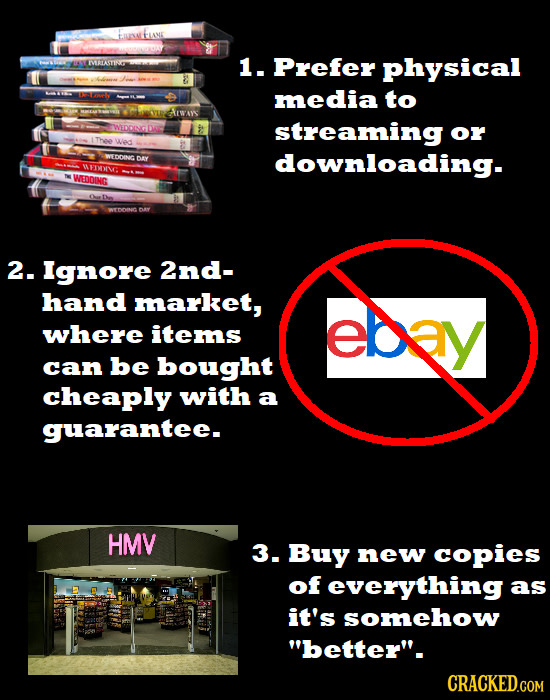
Recently I saw this on Cracked.com in a collection of “Ways You Can’t Stop Wasting Money, in Three Steps“:

And it’s relatively easy to look at this and consider it to be common sense, setting aside the fact the only reason used copies are even available is someone buying it new. Let me throw some perspective on this.

I’ve been working on getting physical copies for the songs I had in my iTunes collection — I’ve detailed why in another article. So since this means buying a lot of CDs, so I’ve been keeping an eye out for saving money where I can, buying used on Amazon and at my local Half Price Books where possible.

Now up front the best reason to buy new is to support the talent behind what you’re buying. This is especially important for lesser-known artists and artists in a niche genre. Buying used doesn’t provide this support since you’re merely taking on a copy someone else paid for originally.

That being said, buying new may, at times, be the better option. For one, it might be the only option, depending on what you’re looking for and when.

But when buying used is an option, you need to do a cost comparison to ensure you’re getting the better value. Let me give you an example.

Currently in my Amazon.com shopping cart, I have Every Open Eye by CHVRCHES, specifically the enhanced edition which has several other tracks to it. I’ll likely buy it with the next Amazon Associates payout. Brand new through Amazon Prime, as of when I write this, it is listed at 9.47 USD with no sales tax (I live in Kansas). Again, brand new.

The lowest cost for a “Used – Very Good” copy: 4.49 USD + 3.58 USD for shipping, 9.07 USD total. A savings of 40 cents. Worth it? Depends on a number of factors, such as the seller’s return policy, but in that instance I’d buy the new copy. As mentioned before, it supports the artist. I can get the new copy with 2-day Prime shipping and I know Amazon tends to ship quickly — two things that are unknowns when ordering through the Marketplace. And I know Amazon’s return policy as I’ve had to leverage it before.

Which is one of the reasons I love Half Price Books. If a CD or Blu-Ray I buy that looks scratched can’t play (always a risk buying used), they’ll take it back. And I typically have the opportunity to inspect the disc before accepting it.

And when it comes to finding CDs that are otherwise difficult to find, places like Half Price Books can work a miracle. Another example.

Taylor Swift’s debut album was originally released in 2006 with 11 tracks, including the original version of “Picture to Burn”. A new version of the album was released in 2008 with 15 tracks, including the “radio edit” for “Picture to Burn”. If you were to order her debut album brand new today, the 15 track CD is what you’d receive. If you’re looking for that original version, used is likely your only option.

And by some good luck a couple months ago, I managed to find the original release at Half Price Books one afternoon. And for less than what I’d pay for online.

Now to summarize, certainly buy used when you can. But depending on the price difference and quality you can find, you may want to lean toward buying new. Not because it’s “better”, but a better value. At the same time, pay attention to return policies when buying used so you don’t get stuck holding a scratched, non-playable disc with little to no recourse, since it’s in return policies that buying new can win out.

And if you have a local place similar to Half Price Books, keep an eye out there where you can, especially if they have a guarantee that’ll allow you to return CDs if you discover they don’t work, or, even better, allow you to inspect any discs before accepting them.

Yet another “there’s nothing wrong with this” dress code violation

Take it way, Annie:

Now, any guesses as to what’s wrong with this? If you said “Nothing”, you need to look closer.

She’s wearing high-waist jeans with a cropped t-shirt. A shirt that’ll not only get you coded at school if you’re caught, but dismissed from work if you tried wearing this to a job. Again, just because you think it “looks just fine” doesn’t mean it complies with a dress code. And in Annie’s case, it’s specifically disallowed by her school district (emphasis mine):

  1. The following items are not permitted:
    1. clothing or accessories with reference to alcohol, drugs, and/or tobacco
    2. clothing or accessories with suggestive, profane or lewd symbols, slogans and/or pictures gang or other groups without permission of the administration.
    3. hoods, hats, caps, bandanas or other form of head covering
    4. Halters, midriff tops, crop tops, spaghetti strap tops, open mesh garments, garments with open sides which expose skin or undergarments, and muscle tops (oversized armholes).

Seriously this is really starting to get old. Do teens today not pay attention to the dress code for their school, since it is their responsibility to know it and comply with it? Do they not understand that they will have dress code rules they’ll have to obey when on the job?

Or do they instead expect that if they scream “sexism” loud enough, they’ll be able to get away with whatever they want? Since that seems to be the direction we’re heading.

Self defense and victim blaming

Article: “Women need to pack gun to avoid rape, says GPO Indiana lawmaker

Representative says that a firearm is a great way to defend oneself against an attacker, though his word choice could’ve been better. A “tsunami of criticism” twists that into, in essence, victim blaming. Somehow in the last several years we’ve twisted “women should learn to defend themselves” into “rape victims are to blame because they didn’t defend themselves”… Ugh…

Crime occurs for a number of reasons, with reasons varying on the crime, so it’s not possible to teach people to not commit crimes. Most people don’t commit crimes, and don’t want to commit crimes. So the common call of feminists to “teach men to not rape”, provided such is possible, is not necessary.

Plus it presumes that men are violent apes who don’t know how to control themselves, or don’t want to, until they’re “civilized”. Just as the anti-gun crowd seems to presume that everyone who wants to buy a gun is out to kill someone.

The chance of any person in the United States being a victim of any crime, petty or violent, is very small. And you’re more likely to be victimized by someone with whom you are at least acquainted. For those uncommon stranger violent crimes, a firearm will stop an attacker the vast majority of the time. And you don’t even have to fire a shot to do it. The mere presentation of the firearm will be enough to stop an attacker in their tracks the vast majority of times. Pepper spray has the same potential, though it doesn’t work on everyone. For the other times, that’s why self defense is codified into law, and the laws and standards are much more favorable to women as well.

This won’t prevent 100% of instances, but it does change the odds. Just as contraceptives change the odds of getting pregnant, but don’t eliminate the risk 100%. No matter how situationally aware you are, no matter how much you’re on your guard, you can still be ambushed, you can still be victimized. That doesn’t mean there are not steps you can and should take to get the risk as low as possible.

But that also doesn’t mean a victim of violent crime is somehow to blame because they did not or could not defend themselves or escape. The criminal is always to blame. But since crime is a risk in any society, everyone needs to account for that risk.

Travelers are advised to not carry significant quantities of cash or significant valuables, and tourists may also be advised to avoid certain parts of a destination. If you’re on a cruise ship, you’re advised to always lock your cabin. And when at an airport or on a plane, there are steps you take to secure what is on your person to avoid having it stolen. And when you’re at a bar, to not get significantly inebriated. Because of the very real risk of crime.

This is not to say that victims of violent crime are somehow to blame because they didn’t or couldn’t defend themselves. Yet unfortunately that’s how the conversation has been twisted.

Again crime is a risk. So you need to account for it and take steps to reduce the risk of being a victim to as low as possible.

Customer service

ArticleOwner Tired Of Rude Customers Puts Up Genius Bar Sign To Teach Them A Lesson, And It Works Instantly

The idea of customer service is, in general, satisfying customers through all reasonably-expected means. Handling exchanges and returns in retail, along with helping customers find what they’re looking for. For food service and mail order companies, it means getting orders correct and correcting any errors that arise.

Most people who walk into an establishment won’t loiter. And unless the customer is a regular and is readily recognized as a regular, chances are they also aren’t there to “connect” with the staff. And even if they are a regular, that will still likely be the case the majority of times.

There are several establishments near where I live and work where my wife and I are recognized readily as a regular. In only one of those establishments do the staff know anything about me beyond my name and I know anything about one or more of the staff beyond their name. And that establishment also has the benefit of being a small business, not a chain or franchise, that I’ve been visiting for years.

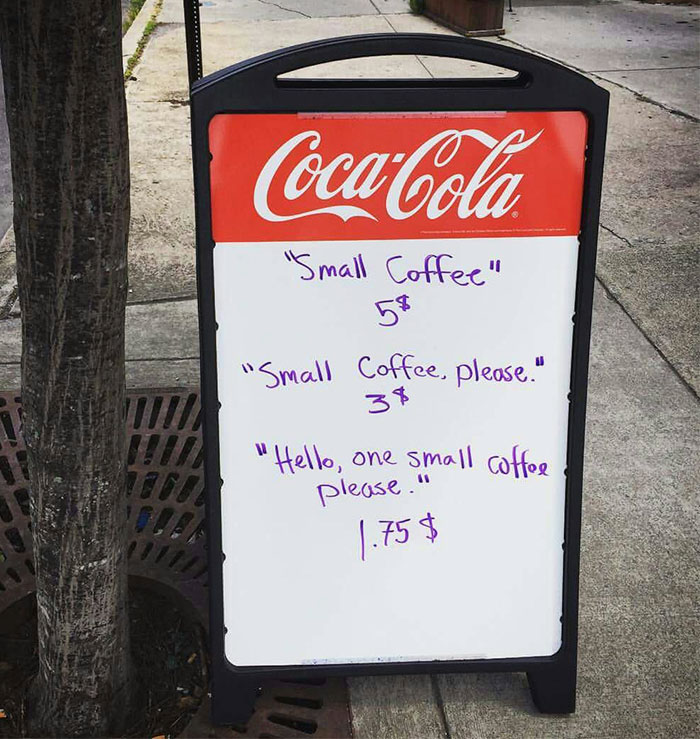
Yet some business owners don’t understand the actual relationship that exists with their customers. Take the example of Austin Simms of Roanoke, Virginia, article linked at the top. Simms owns CUPS, a small coffee and tea shop where a sign he created offered three pricing options:

  • “One small coffee” – $5
  • “One small coffee, please” – $3
  • “Hello. One small coffee, please” – $1.75

He’s not the first to attempt this, and he likely won’t be the last. So he’s definitely not the first business owner to expect more than is reasonable from his customers. His reasoning?

I decided <…> to start charging more for people who didn’t take the time to say hello and connect and realize we’re all people behind the counter.

Question: what happens if someone says the $1.75 phrase but does so in an easily-discernible impolite manner?

While patrons absolutely should be polite and kind with the staff at an establishment, amending or prepending “please” does not make it polite by default. A ready example is the phrase “please shut up” or “please leave”. Indeed both tend to be said in response to someone obviously not being polite. And not saying “please” does not make it impolite by default.

Your customers are not invited guests to your home.

Here’s how I place my order at my local coffee shop: “I’ll have a 16oz latte, to go”. And I always take it plain rather than adulterated beyond the point of being able to tell there’s any coffee in it. At a restaurant, if I don’t have any questions about any menu items, I will just place my order directly: “[Desired food and/or drink item, with or without modifications]”, sometimes prefaced with “I’ll have”. No “please” included, and not in the form of a question.

Am I being rude? According to Simms and the apparent majority of those in the article’s comments, yes. Am I somehow dehumanizing those working in food service by not including “please”? The same would likely also say yes.

However if you were to ask those serving where my wife and I are regulars, I’d wager they would say “No” in both instances. That we are not rude and do not fail to acknowledge their humanity. I’ve also had wait staff ensure I’m their customer. So I’d say my never uttering “please” to them is not really that much of a bother.

An exception to this would be modifications to an order if you’re uncertain if the modification can be done. For example, the first couple times my wife ordered the steak tips dinner at IHOP, she would request with a question or by including “please” to not include mushrooms. Once she was confident the kitchen could do that, she just made it a part of her order.

At a local small business where I frequently buy lunch, one of my favorite sides sometimes isn’t available when I arrive, so I’ll ask for that side as a question: “And can I get [side] as well?” If it’s available they’ll add it. If not, they’ll say so, and I’ll either select something else or forego the sides altogether.

Again, not saying “please” doesn’t make you rude automatically, and adding “please” doesn’t make it polite automatically. It’s everything else about how you place your order that determines whether you’re being polite. At the same time, if you place your order in the form of a question — something that most seem to do — it’s always come off to me that you are uncertain of what you want.

So the pricing idea that Simms had would, as comments to the linked article have already pointed out, lead to a false politeness from patrons who’d merely recite the words on the sign to get the cheaper price.

In coffee shops and fast food establishments, most will expect to get in and out. Trying to make pleasantries with the staff behind the counter is not conducive to the customer’s time, or to the time for those behind them in line. When I get coffee at the coffee shop near where I live, I keep my order short and direct and have my payment method already in hand to allow the order to be placed quickly.

In dining and fast casual establishments, the customer is obviously expecting to spend more time there, but not to make pleasantries with the wait staff. Where I’m a regular I can likely get away with additional pleasantries, provided the place isn’t all that busy.

Now some may say in response that the business doesn’t owe me any service. Which is true. I also don’t owe them my patronage either. The patron-establishment relationship is entirely voluntary. No one is forcing me to be there.

Businesses also have a right to kick out rude or harassing customers. They can also refuse service to someone for any reason or none. They do it all the time. But such choices have consequences, especially in the day and age of massive social media participation where a story of impropriety toward a customer or service staff, even one that’s completely fabricated, can go viral in a matter of hours.

At the same time, though, the fact I don’t use “please” when ordering doesn’t mean I’m somehow reserving the right to be an asshole to the staff that work there.

Business owners need to be mindful of the patron-establishment relationship. A business is only as successful as their customers allow them. Discourage or disparage customers and you’ll either go out of business or never grow as fast or as much as you’d expect.

In the above scenario — and others like it — the establishment doesn’t get to call many shots. The sign as well as the owner’s stated intent implies that I owe the establishment a particular demeanor when the only thing I owe the establishment is a certain amount of money when I place an order.

So ask yourself this: if I walk into my local coffee shop and say to the woman behind the counter, “Hi, I’ll have a 16oz latte,” have I just been rude to her? Have I dehumanized her? If you say “yes”, you really need to re-evaluate your point of view, as well as what is considered polite.

Absinthe to Amethyst

Naming computer build projects tends to have an art behind it. Some builders have a certain finesse with it, while others… not so much.

I chose the name “Mira” when researching known binary stars, going off the system’s previous name Beta Orionis (β Ori). The system is built into the NZXT H440 with an external radiator box that keeps temperatures well in check. Like a binary star system, Mira is not Mira without both parts to it.

Mira (Omicron Ceti)

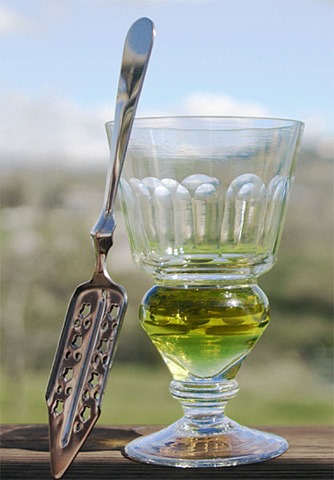
Nasira worked out very well as a name for the NAS. And Absinthe seemed an obvious choice to reflect the system’s green lighting.

Absinthe is coming due for another flush and my wife has expressed interest in changing the colors. This would obviously make Absinthe nonsensical as a name.

Specifically she wants the shade commonly seen with amethyst. Which is a rather brilliant shade of violet or indigo, with the optimal shade called “deep Siberian”. The shade seen with grape-flavored drinks like Powerade is probably a little darker than what she wants, but in the neighborhood. The question then is whether to take advantage of the clear tubing, clear-top CPU and GPU blocks, pump top, and reservoir by running purple coolant, flood the system with purple light, or both.

My wife seems to be leaning toward flooding the system with purple light.

Which would be great if I could actually find lighting for the proper shade, preferably without having to employ an RGB kit. Personally I kind of hope the RGB craze dies the violent death it sorely deserves. It’s been well and truly overdone and oversold. But getting back to the lighting, most purple lighting I’ve seen follows on the purple RGB code. Which isn’t the color she wants. She again prefers indigo, or something close thereto.

Personally I don’t want to flood the system with colored light. Her mainboard is white. So my thought was flooding the system with pure white light so the mainboard stands out along with the silver in her fittings. And then using the coolant to add the Siberian amethyst color through the clear tubing, reservoir, pump top, and CPU and GPU blocks.

In short, something like this:

I called this coolant color “liquid amethyst”.

Only with white lighting so the purple coolant stands out. I think my wife will still want purple coolant anyway, so it’s the lighting that’ll end up being the contention.

I think if I find brilliant white LED lighting and show a color contrast of it with purple coolant inside clear tubing (or faking it with grape Powerade in the bottle), I might be able to sell her on the color contrast over flooding the system with purple light.

Especially since it’ll be easier to find brilliant white LED lighting than the right shade of purple. And as stated I’d rather avoid an RGB LED kit, as I don’t want to, even if momentarily, assist in perpetuating the RGB craze.

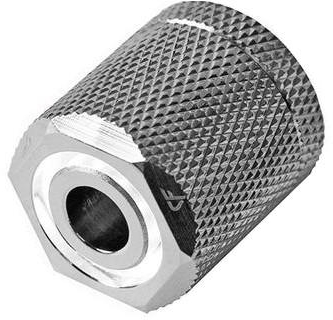
One product I also recently learned existed are lighted fittings. No, seriously, fittings with lights in them to light up the tubing and, presumably, the flowing coolant. And of course there are RGB versions of these. Ugh…

Nanoxia, however, makes static color lighted fittings: red, orange, blue, green, white, and UV. In either nickel or black finish. They work by shining light down the tubing. So I ordered a pair of the white fittings and picked up tubing from Micro Center to experiment. Haven’t tested them yet as I’ve been doing other things.

Plus I want to get the white lighting I mentioned above first so I can see how well that’ll work at lighting everything up. According to Matt from DIY Perks, they’re supposed to be pretty bright.

Along with this, I’m trying to figure out a way to stand the graphics card on end so the clear-top GPU block can be visible. I’ve found a couple mounting options. And the one that impressed me most would require I modify the 750D. It would also interfere with her 10GbE card, so I’d need to relocate that to one of the lower slots off the mainboard. She’s using a USB headset now, so the sound card will be removed.

Another option is a GPU stand. Except on top of her PSU is the only place to put it. And it isn’t anywhere near long enough to support it. So I’d need a PSU shroud to give the support it would need. Which would complicate things pretty much instantly.

So we’ll see what happens from here. The system isn’t really due for maintenance until mid-November, which still gives time to figure out the specifics and experiment with lighting.

One thing is for certain: the change in color will also mean a change in fans, as the green fan blades on the Nanoxia Deep Silence fans won’t work here. So it’ll likely be back to the Bitfenix fans or I’ll find something else.

Letter to Senators Moran and Roberts

Mr Senator,

As you’re aware, Madam Senator Feinstein recently introduced S.1916 with the intent to ban the “bump stock” the Las Vegas shooter used in the commission of his crimes. The text of the bill only recently became available on Congress.gov, so I was only recently able to review the language. After reading the bill, I urge you to not support it. To vote NO on it should it come to a vote.

The bill mentions the bump stock, calling it a “bump-fire device”, but doesn’t stop there. It seeks to ban any “any part, combination of parts, component, device, attachment, or accessory” that increases the rate of fire for a rifle. Mr Senator, this seeks to make it such rifle owners cannot swap out parts on a semi-automatic rifle. As any parts swaps, whether as part of maintenance or as an upgrade, that increase the rate of fire for the rifle, whether intentional or not, will be a Federal felony under this bill.

If Madam Senator Feinstein’s bill sought to only ban the bump stock, the language would be so limited. Her bill instead seeks to chip away at ownership of semi-automatic rifles. I know she wants to see them banned via her “assault weapons ban”, so I think she’s trying to see what she can get instead, how closely she can encroach.

Again, I urge you to vote NO on S.1916 and to not support this bill.

Thank you.

Feinstein’s latest overreach

Last week, Senator Feinstein introduced S.1916, a bill in response to the Las Vegas attack, the text of which only recently became available through Congress.gov. Here’s the meat of the proposal:

Except as provided in paragraph (2), on and after the date that is 180 days after the date of enactment of this subsection, it shall be unlawful for any person to import, sell, manufacture, transfer, or possess, in or affecting interstate or foreign commerce, a trigger crank, a bump-fire device, or any part, combination of parts, component, device, attachment, or accessory that is designed or functions to accelerate the rate of fire of a semiautomatic rifle but not convert the semiautomatic rifle into a machinegun.

The key phrase here is “functions to accelerate the rate of fire of a semiautomatic rifle”. Wording of phrases is key.

And here’s the problem with Feinstein’s wording: no minimum floor is specified on how much the rifle’s rate of fire is to be accelerated, or a minimum threshold the new fire rate is to reach for it to be a violation of this law. Which means any modification that allows for a demonstrable increase in the rate of fire could qualify.

Want to swap out the trigger group on a prefab AR-15 for a faster trigger? Well, better not if this bill is enacted into law. Same if you build your AR-15, then later decide to upgrade the trigger.

The bill amends 18 USC § 922(a)(6) to define the above-quoted prohibition. And adds a reference to the proposed section to 18 USC § 924(a)(2) to define the penalty: up to 10 years in prison and fines as authorized by law.

Feinstein or the Senate via amendment could easily alleviate this concern by placing outside its scope any modification that still requires human power to actuate.

Paragraph 2 exempts the Federal, State, and local governments. Which raises the question: if “no one needs” bump stocks, which anti-gun advocates were espousing in the wake of Las Vegas, why does the “no one” seem to never include the government and military?

Update: I’m not the only one realizing that Feinstein’s bill intentionally extends beyond her desire to ban bump stocks.

On improving our situation regarding firearms

This is a comment I left on a Huffington Post article called “I Have A Mental Illness And A Gun License. Here’s What I Think Of Gun Reform.” by Thom Dunn. I may write a response to this article at a later time, or at least the points where I have disagreement.

* * * * *

The biggest thing hampering any conversation on firearms and reforms is the complete ignorance of those who want the reforms. Not just of firearms and terminology, but the current laws and regulations. Until they overcome that ignorance, and stop taking a “worst first” mentality on everything related to firearms, we’ll continue to be at a stalemate.

Gun rights advocates won’t give ground because they know many at the upper-echelons of the gun control groups want a full-out ban and are willing to work slowly to get it. Even on the one area where we do need reform: the NICS background check system.

A lot of gun control advocates act like background checks will catch everyone — I see that implication A LOT — while not understanding the two primary limitations of the system: 1. it’s only as good as the information available to it, and 2. only persons who’ve been through due process can be listed there (see the Due Process Clause). On point 1 we absolutely can improve. And should.

But we still need to be realistic in its limitations. Would that better information have stopped the LV shooter? No. Would it have stopped the mass shooters in recent years? Maybe the Charleston shooter, but that’s it.

In an open letter regarding their lawsuit against Lucky Gunner, the family who sued them said that Lucky Gunner had a responsibility to make sure the people they were selling to weren’t dangerous killers. This implies they expect gun and ammo sellers and the background check system to be psychic or precognant in nature. No system can be, yet that appears to be what’s demanded.

Again, we need to be realistic about the limitations. We can not stop all mass killings — even Australia shows this — just as law enforcement can’t solve all crimes and catch all perpetrators. But, again, that seems to be what’s expected and demanded.

Breeding fear

Firearms are both exciting and terrifying. Depending on the person, they’ll either command respect and awe for the marvels of engineering they are, or they’ll be shunned by fearful people who’d rather they never existed.

And it seems to be primarily those in the latter camp writing the articles in the media about firearms. Reports not driven by knowledge and respect, but fear and ignorance. It is, thus, not surprising their reports are wrong a lot of the time. In many cases, it seems as if the writer is literally making shit up and not bothering to do any fact checking.

Andy Greenberg is no different with his article on Wired about a new advance in “ghost guns”, or firearms that don’t bear a serial number.

There is a predominant “worst first” mentality in these media reports on firearms. And it isn’t just with firearms, mind you, that this mentality appears. I’ve pointed it out with, of all things, flirting. And Lenore Skenazy has made a career out of pointing it with regard to parenting.

With the recent tragedy in Las Vegas, and the reporting and demonstrated ignorance that has stemmed from that, I guess I can’t be surprised anymore, given the times (here, here, here, here, here, and here) where I’ve called out the media for getting something so drastically wrong.

“80% lowers”

This latest advance in “ghost guns” involves 80% lower receivers. Specifically a frame for an M1911 pistol.

An 80% lower is typically seen with AR-15s, and can be purchased without going through an FFL as they are not regulated as a “firearm”. The reason is quite simple: you can’t just buy it and build a firearm from it.

The “80%” label means you need to complete it. Typically this involves a drill press (not something to try with a hand drill) and several different drill bits. And the intended holes have to be precisely drilled and machined or the completed firearm may not function safely. There are jigs and kits available to make this easier.

On an AR-15, the lower receiver “receives” the trigger group, safety, magazine retention (the magazine well is part of its structure), pistol grip, and stock. The upper receiver holds the barrel, bolt carrier group (BCG) and charging handle (CH), and also has a rail for mounting a rear sight, scope, or red dot sight. The lower and upper receivers are attached by two thick pins.

A completed lower receiver is the only part of an AR-15 kit that is required by the ATF to have a serial number. Transfers require an NIST background check when sold by an FFL. It can also be transferred between two non-FFL parties through a private transfer without a background check.

Completed AR-15 lowers manufactured without a serial number, such as a lower purchased as an 80% and completed by the purchaser, by law, cannot be transferred at all. And any AR-15 rifle completed from a completed 80% lower also cannot be transferred. It is a Federal felony to transfer such firearms and lower receivers.

Defense Distributed and 80% Lowers

The focus of Greenberg’s article is Defense Distributed. The name may sound familiar as they are the originator of the “Liberator”, a 3D printed, single-shot .22LR pistol. They are also manufacturer the “Ghost Gunner“, which is a glorified CNC machine designed to assist in finishing an 80% lower.

Specifically their 80% lowers. The article focuses on the 1911 pistol, one of the lowers that Defense Distributed sells.

Currently you can buy a complete lower frame for a 1911 pistol if you wish to assemble your own. They aren’t inexpensive, though. Like AR-15 lowers, quality will vary based on price. And adding onto that may be any FFL-related fees if you order it online, along with having to submit to an NICS background check and fill out the ATF 4473 paperwork.

Now one thing that needs to be emphasized, since it’s so often overlooked and drastically misrepresented as part of the “worst first” mentality I’ve pointed out: the frame is not the firearm. It is just one part of the entire 1911. You still need EVERYTHING ELSE! All the pins and springs, slide and trigger assembly, firing pin assembly in the slide, safety assemblies, recoil spring assemblies, barrel, grips. And I’m sure I’m missing something.

Yes you can buy those parts without a background check since they are typically sold as replacement parts. Most of the more easily-replaced parts can be found at gun stores without difficulty. A couple years ago, I replaced the recoil spring on a Smith & Wesson pistol. I was able to order that recoil spring online and have it sent to my home. No questions asked. Because it’s just a spring!

But — and this is something often sorely missed by the “worst first” crowd — buying all those parts separately will, in the end, cost you more than a fully-assembled 1911 obtained through a background check. I paid under 500 USD for the 1911 I currently own, and it’s a “commander”-size model.

And then there’s the time needed to assemble it. It won’t go together quickly. Building a 1911 isn’t like building an AR-15 from parts. It’s a lot more involved. As Cody Wilson of Defense Distributed put it:

If the AR is like Legos, the 1911 is like a model ship. If you’re a gangster at home trying to build one, you’ve bought a problem for yourself more than you’ve solved one.

The only reason someone would go through the hassle of buying all the parts separately is the same reason to buy the parts and build an AR-15: getting a custom firearm without changing out parts. It’s actually the same reason people build personal computers from parts.

The overstated threat of “ghost guns”

So then, where does that leave the prospect of “ghost guns”? Let’s just say it’s not nearly the threat Greenberg is making it out to be.

Of course, Wilson’s machine could also help customers who otherwise wouldn’t legally be able to obtain a gun—minors, people with a mental disorder, or those with a criminal record—obtain one. California, in fact, already outlawed so-called “ghost guns”—homemade firearms without serial numbers—last summer. But no such law exists at the federal level, allowing anyone to bypass virtually all gun control laws if they make a gun at home and don’t sell it or give it away.

Not all gun control laws are bypassed.

For one, “ghost guns” cannot be sold or given away legally. Again the transfer of a firearm not bearing a proper serial number is a Federal felony.

And as many gun control advocates in the “ban bullets” crowd love to point out, a firearm is useless without ammunition. And the laws regarding ammunition purchases still apply. And persons prohibited under Federal law from buying a firearm are also prohibited from buying ammunition.

If you honestly think gangs and cartels are going to start buying these kits to build 1911s instead of buying them or obtaining them through other lesser-legal channels, I think you’ve let the media get too far into your head.

Like most fears of the “worst first” gun control crowd, the fears around ghost guns are largely not going to come to fruition.

Let’s start with the Ghost Gunner’s near 1700 USD price tag.

You’ll also need some kind of system for collecting the aluminum shards that’ll be coming off it if you don’t already have one. Your home vacuum won’t be optimal here. A 2-stage system would be best to separate the aluminum shards so they don’t go into the vacuum at all.

Then it’s 120 USD for each 1911 “80%” frame that will then need to be milled with the machine. Add on the other parts and you’re approaching, if not exceeding, 2500 USD.

Beyond that, again, is the time needed to assemble the firearm from all the parts plus the new frame.

The people who are willing to go through all of that just to get a 1911 when it’s far easier and far less expensive to obtain one through both legal and lesser-legal channels are likely people you either don’t need to fear, or they are already on military or law enforcement radar in some capacity.

And there is, thus far, no indication such firearms have been used in any homicides or crimes in the United States. Or where they have, it’s such a small occurrence to not be worth the concern.

Again, the problem of “ghost guns” is vastly overstated and based only on speculation.