Contrary to popular belief, affidavits aren’t infallible.
People lie in affidavits… all. the. time. People lie on the stand under oath… all. the. time.
And that’s simply because… there’s largely no penalty for doing so.
You see… perjury is a rather… interesting crime. I wrote an article 10 years ago about the difference between “I don’t believe you” and “You’re lying”. And it boils down to whether I can prove that 1. what you’ve just said to me is false and 2. that you knew at the time you made your statements that they are false. Welcome to Perjury 101 and why I said there is largely no penalty for lying under oath, whether on the stand or in an affidavit.
The simple reality is that… perjury prosecutions are very, very few and far between. Even when there is a “smoking gun”, a perjury charge that could be easily proven beyond reasonable doubt – e.g., Bill Clinton lying under oath about his affair with Monica Lewinsky – there still may not be a prosecution for it.
The fact there’s largely no consequence to lying under oath – aside from losing out on whatever the lying was trying to facilitate or protect – means that you should always treat an affidavit or someone’s testimony with skepticism. Lots and lots of skepticism.
Someone attesting to something in an affidavit doesn’t make those statements prima facie true.
Since… anyone can really attest to anything “under penalty of perjury”. Such is about as meaningful as swearing to something with your hand on the Bible. Neither make lying impossible, yet many are quick to presume such.
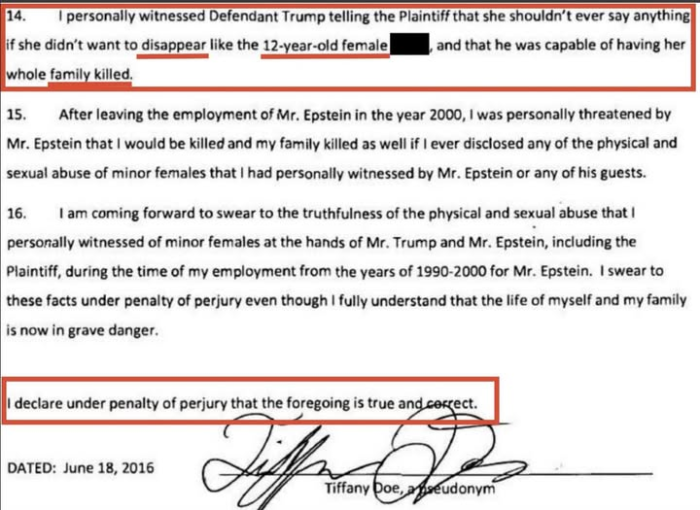
Affidavits are often given the presumption of being incorruptible, infallible, and they’re treated as if they’re immune to being incorrect and, therefore, unimpeachable. Such as the above screenshot from an affidavit from the latest Epstein file drop.
Why would would someone attest to something in an affidavit that isn’t true, right? That’s about like asking “why would someone lie?” Not just “lie under oath”, but “lie” in general.
And one reason is, again, that the risk of actually being prosecuted for perjury is extremely low. Not zero, sure. But those prosecutions definitely aren’t happening as often as they really should be. Witnesses provably lie on the stand all. the. time. Yet almost none of them are prosecuted for it. Attestants to an affidavit provably lie in affidavits all. the. time. And yet… almost none of them are prosecuted for it.
And that is due to how due process actually works in criminal cases. The burden is entirely on the prosecutor to prove beyond reasonable doubt that 1. the statements in the affidavit are false and 2. the attestant knew at the time they attested to it that it is false. There are so many things that work against this, making perjury a damned hard charge to prove.
And if the statements in the affidavit are not provable either direction – meaning there is no evidence supporting the statements and nothing to prove they are impossible – then you can’t prove perjury occurred since you can’t prove the statements are false. Absence of evidence is not evidence of absence. And an example of this is the attestant to an affidavit or a witness under oath testifying to something that happened several decades ago for which no evidence is possible supporting the statements.
An easy example of that is Christine Blasey Ford, PhD, and her testimony against the confirmation of now-Supreme Court Justice Brett Kavanaugh. Pretty much everything Ford testified to was not provable. But because she was making those statements under oath, many presumed them to be correct merely on her assertion they are correct.
And people do much the same with affidavits, presume the statements are true or must be true even when they aren’t provable simply because someone was willing to sign their name to a piece of paper.
But when there is no penalty for lying, why should affidavits or testimony be trusted at all?
Again, in a perjury prosecution, the prosecutors have the burden of proving the statements false. Sometimes that’s easy – e.g., Bill Clinton and Mark Fuhrman. But rarely is that the case unless you have a “smoking gun”.
But even having a “smoking gun” doesn’t guarantee someone will be prosecuted for perjury.
Never accept an affidavit at face value. And if the affidavit is making claims that are not provable in either direction, there is no reason to accept it as true unless there is other corroborating evidence. But generally affidavits are gathered because there is no other corroborating evidence.

You must be logged in to post a comment.